

… the flowers and the trees, all seen on my second trip to the Environmental Interpretive Center (“EIC”) on Saturday, August 19th.
My first visit to this woodsy setting at the edge of the University of Michigan-Dearborn’s campus was back on May 12, 2023. You can read the post about that excursion here if you missed it.
The EIC was just one stop on a journey wherein I meandered along the Rouge Gateway Trail and past Fair Lane Manor, the home of Henry and Clara Ford.
During that first visit to this venue, the trees were just beginning to leaf out, the grass was lush and green and I was happy to photograph a couple of Wild Turkeys, a Chipmunk and some Canada Geese and their goslings. Clara Ford’s extensive flower gardens were devoid of color, save for the Lilac bushes.
After that visit, I subscribed to the EIC newsletter where I learned the Center is a Monarch Way Station, which means this venue provides the resources necessary for Monarch butterflies to sustain life and provide successive generations, mainly through Milkweed which gives them sustenance and the energy to migrate to warmer climates in advance of harsh Winters. Recently, it was disappointing news for butterfly enthusiasts to learn that the Monarch butterfly migration from Mexico this year is down 60%.
After last Spring’s visit, I planned to return to the EIC in the Summer when the warmth and abundant sunshine would create a garden setting filled with birds, bees, butterflies and flowers.
Having become more familiar with the proximity of the EIC to Fair Lane Manor, (just a half-mile/8 km down the road), I knew at the end of my EIC meander, I could simply zigzag through the Manor’s Great Meadow on the way back to the car. I planned to revisit those architectural ruins, (the original Rose Garden, Pond and Summer House), as well as check out that frog pond that an interpretive guide wowed a group of students on a field trip when he repeatedly dipped a net into the murky waters producing frogs and giggles galore.
There is no need to write endless words about Henry and Clara Ford’s iconic places and spaces, as I’ve done so in the past, so today, I’ll touch upon only the ruins briefly and spotlight an iconic tree, new-to-your-eyes items at the Estate.
Exploring the EIC and beyond.
On a hot and humid August morn, there I was, tripping down the familiar path, a/k/a the Rouge Gateway Trail, scanning for deer and/or turkeys, but instead of veering left to enter the grounds of the iconic Ford Estate Manor, I continued walking along Fair Lane Drive to reach the EIC.
Last May it was a Friday morning and the nearby campus was bustling with students dashing from building to building for their classes.
It was very quiet this time.
Some fungi on a fallen log were not really worth pulling the camera out for a photo – it’s not like they were colorful Turkey Tails, so I kept on walking.
But then I saw this sign along Fair Lane Drive – well yikes! Was this sign here the last time?

I was alone once again. I admit this sign did give me cause to pause, but I continued on, albeit a little more mindful of my surroundings.
No, I wasn’t a scaredy-cat, but a few steps later, I saw this.

Well, my eyes told me what it looked like, but my brain said “no Linda, it is not someone’s brain on the side of the roadway” (um, even though is sure looked like that). Thanks to a Google Image Search I learned this was a hedge apple produced by an Osage Orange Tree. Did you know that?
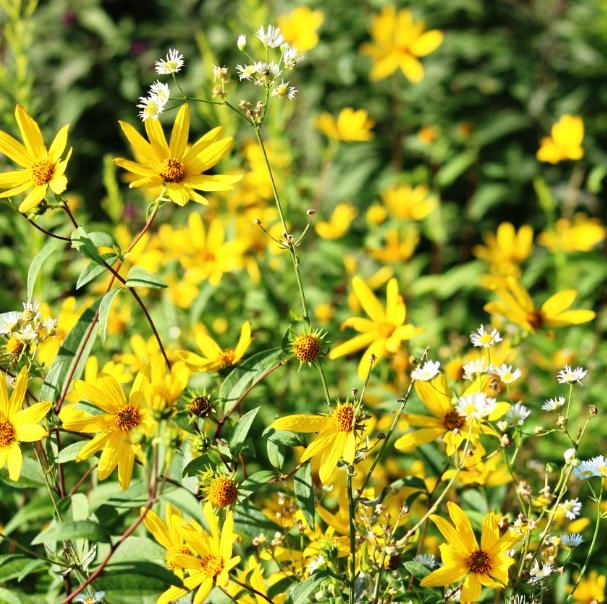
Well those two items had piqued my interest, but there was no time to dwell on either as suddenly I had arrived at the Environment Interpretive Center, which looked decidedly different than back in May, as it was surrounded by an abundance of yellow flowers called Woodland Sunflowers or simply Ditch Daisies.

The flowers were photo ops for birds and bees.
I’d guess the person that originally planted these flowers loved the color yellow, but most likely these patches of vibrant beauties are solely due to pollination. There were a few purple flowers as well, but not many.


I already knew there were several bee hotels – these are two of them.


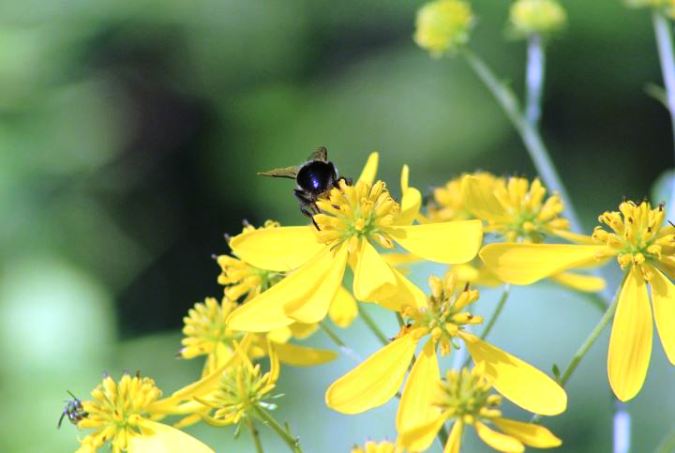
And here are some bees enjoying the Ditch Daisies.


I stood very quietly hoping the bird feeders might give me a glimpse of some songbirds.

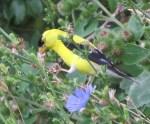
But they were empty like the bee hotels, although I did see a Sparrow (or Finch?) posing nicely on a flower stem.

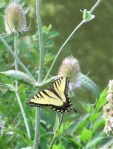
“What no butterflies?” I wondered as I stepped away from the flowers to venture down a trail. Then alighting on some greenery was an Eastern Tiger Swallowtail.


I decided to take the White Oak Trail …


… and wondered where I would end up. (Hmm – it looked a little dark in there.)
What a scenic view greeted me at the end of this trail! I had walked along the shoreline of Ford Lake back in May, but now could see this body of water in its glory. The reflections were stunning and there were already some American Lotuses.
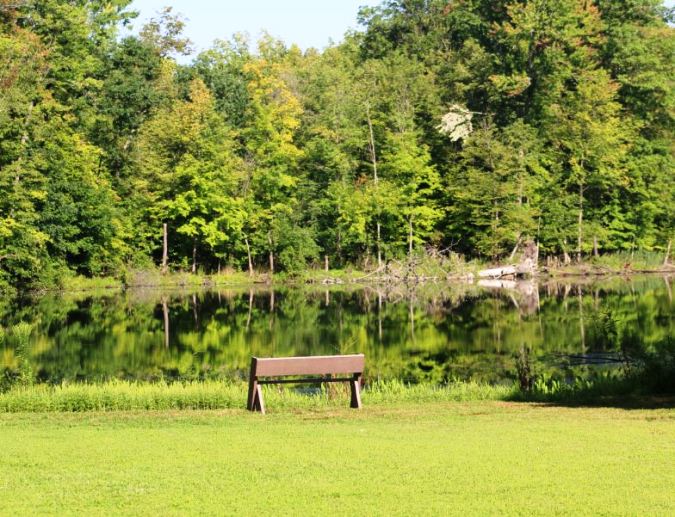


After leaving picturesque Ford Lake, the next trail sign was for Clara’s Rose Garden. The humid morning made dew drops on the sign.

I stopped at the pond to peer inside its murky depths for frogs. There were none. In May the Canada geese and their goslings were paddling around and nibbling on reeds, but today there were a few Lotuses and Pond Lilies and that was it.
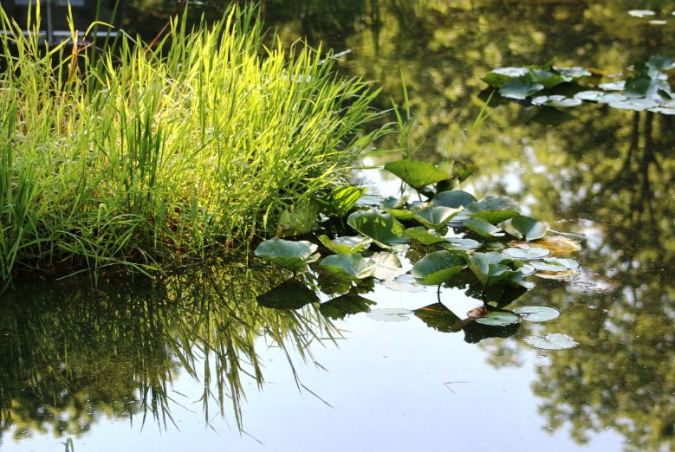
I learned from an EIC newsletter that Clara’s Rose Garden with its Pond will eventually be turned into a contemporary green space by the University of Michigan – Dearborn in conjunction with the EIC.
It seems that Clara’s Summer House is unloved and in disrepair.
Interestingly, since 2010, ongoing renovations at Fair Lane Manor have sought to meticulously recreate the glory and grandeur of the mansion when Clara and Henry Ford lived at this peaceful, nature-laden sanctuary from 1915 until their deaths in 1950 and 1947, respectively. Fair Lane Estate was named a National Historic Landmark in Michigan in 1966.
There was a cessation of renovations due to the COVID pandemic, but outside renovations, plus inside, including each of the 56 rooms in this 31,770-square-foot home are being painstakingly restored. I have followed the Facebook briefings of each meticulous detail and synopses of work done by the Conservation Team by various restorative experts, so it boggles my mind, that the once-iconic Rose Garden, Pond and especially the Summer House, have been allowed to languish into the current dilapidated state where these items were once a highlight in the “Great Meadow” (the expanse of land where these structures are found).
All that is left of the Summer House structure is its frame, seen in the first two pictures.


In these two pictures you will see the frame of the Summer House as it faces the Pond and rock wall and a close-up of the rock wall.


To me, allowing this iconic area of the Estate grounds to fall in disrepair is akin to leaving this dead leaf clinging to a fence at the current gardens near the mansion.

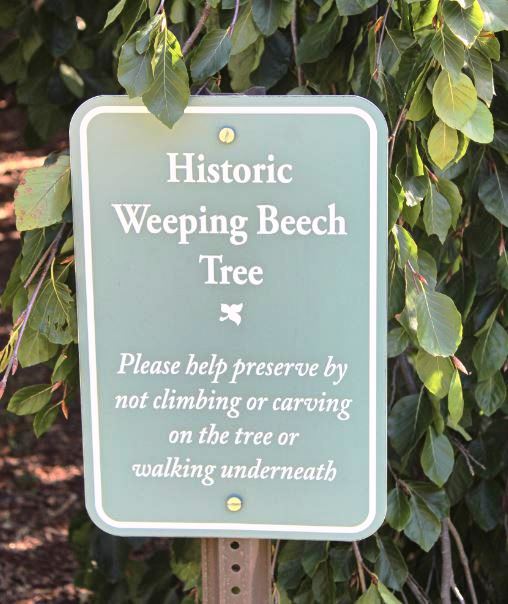
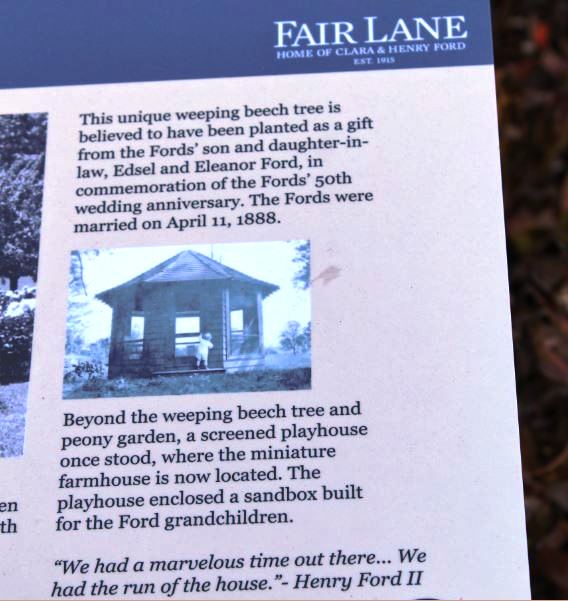
Speaking of leaves, I made one more pit stop at the Estate that day, lingering at the historic Weeping Birch Tree, which was planted in 1948 to commemorate the Fords’ 50th wedding anniversary. The tree is massive and I had to stand way back to get the entire tree in the frame. (Note the signs.)

The sun was climbing higher in the sky and it was still horribly humid. My walking shoes were soaked from the wet grass and my clothes were clinging to me. I put the camera away as I was heading directly to the car. The chances of seeing deer or turkeys now at mid-day were slim to none. They were likely smarter than me and in the cool woods.
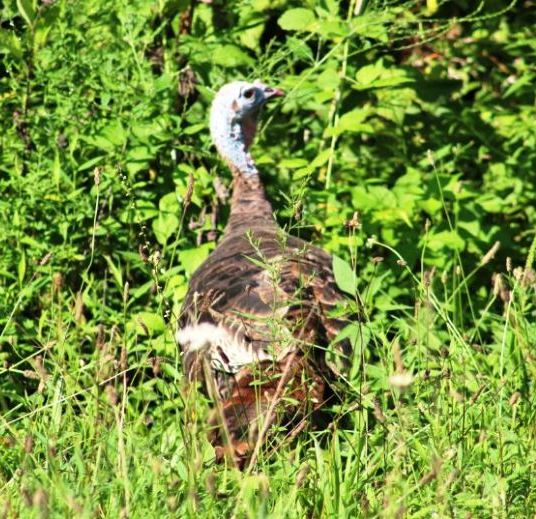
I trudged along, but, wait, I squinted and wondered “what’s that in the distance?” It seemed more birds would grace my walk, when a pair of Wild Turkeys trotted past me, quickly escaping to the brush and away from me and a potential photo op or two. I managed to muster a few faraway shots.



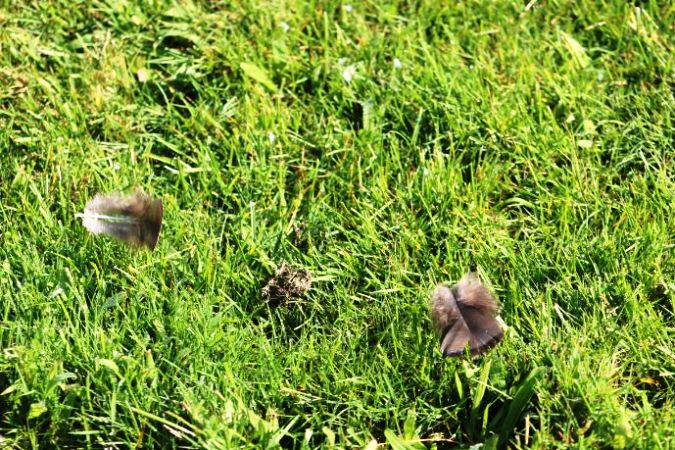
As they turned tail, their rapid departure left a few feathers behind.

I am joining Terri Webster Schrandt’s Sunday Stills February 18th Challenge: “Iconic Places and Spaces”.

 Linda Schaub



























 WALKIN', WRITIN', WIT & WHIMSY
Pingback: Sunday Stills: How #Iconic are Your Favorite Places and Spaces? – Second Wind Leisure Perspectives
I enjoyed your tour of the Ford Estate, Linda. But I chuckled at the sign saying not to explore alone! Not only is this an iconic space for all to enjoy but within the spaces are iconic scenes like that ginormous tree and the gardens themselves. I bet you had a field day with your lens capturing everything!
LikeLiked by 1 person
Yes that was funny Terri. That sign was on the fence right where the woods is located and I went through there in May alone without a care in the world. I worry more about ticks than wild animals, however. I got a newsletter from the EIC the other day and they mentioned raccoons, fox and coyotes in the same woods and said it was coyote mating season. No I wouldn’t want to met up with coyotes or raccoons in the woods by myself.
LikeLiked by 1 person
It is great to see these pictures.
LikeLiked by 1 person
Yes, so bright and cheery looking Anne – for us, this might be another four months or so to get here unfortunately.
LikeLike
These are great pictures. Excellent photography. I much like for 🧠 brain photo. And historic weeping beech tree.
Nice you sharing your tour & trip Ford estate.
LikeLiked by 1 person
Thank you Raj – I am glad you liked the photos. I thought the that “brain” photo was interesting too. I don’t think I’ve ever seen a tree that wide – tall yes, but not wide like that.
LikeLiked by 1 person
I wonder why they put that sign up? About the only real constant threat to a hiker is a human. If people feed Coyote’s, they could become aggressive, but normally they avoid humans.
That weeping Beech tree was interesting! Never seen anything like that.
You should go back on Halloween at night to see If Clara and Henry are around!
LikeLiked by 1 person
I was kind of surprised to see that sign Wayne – then I wondered if it was there last time? Then why? It did not look like a new sign. The other day I got an e-mail from the EIC saying there were coyotes, raccoons and fox seen in the woods lately. In two trips I really didn’t see anything extraordinary there and this place supposedly has:
250 species of birds
80 species of trees/woody plants
170 species of wildflowers
12 species of reptiles
9 species of amphibians
24 species of mammals
The turkeys were nice to see. We had a coyote family living at Council Point Park two or three years ago. People saw them at night moving around the Park, but never during the day. People would be driving past the Park and see the parents and pup, but one adult got into the neighborhood and an animal control officer shot it, wounded it in the leg. It wasn’t hurting anyone. I thought the tree was interesting too – so large. There are a few other old trees there, one which is an Oak and that’s where I saw the “Falling walnuts” sign.
LikeLiked by 1 person
usually when an animal goes into areas it normally does not go,It means it’s hungry. The food at the supermarket is dwindling, so It goes shopping elsewhere.
LikeLiked by 1 person
I didn’t like that the police shot that coyote – it did not go after any humans or pets. Now in Oakland County, where it is more rural and a lot of people have large property with no fences, people have had their small dogs killed by a coyote after they left their pet in the yard alone. So you take your dog on a walk or put it on a leash in the backyard and stay with it. I don’t know why they didn’t just remove the coyote family or use a tranquilizer gun.
LikeLiked by 1 person
Linda, you are brave to have ventured on this walk! The sign would have initially alarmed me, but I seriously wonder what would have prompted the sign in the first place.
The sights you saw were lovely, especially the Ford Lake and the American Lotuses. Nice perspective in your pictures.
LikeLiked by 1 person
Thanks Esther! I wondered why I didn’t notice that sign before, or if it was new? Hmm. Then I worried a little as I started out on my trip – a part of me says I’m not sure I want to go back now to be honest. A recent newsletter says they have fox, raccoons and coyotes. It was a beautiful, sunny day – something that both of us long for right now. I complain about the heat and humidity, but it does beat the very cold and dreariness we have had the last week and I heard about California’s latest weather woes on the news today..
LikeLiked by 1 person
Well, if you come across a wild animal, don’t run. That’s what I read on the newsletter board at a local park. Make a lot of noise and make large movements to make the animal think you are big and strong. I’d be shaking in my pants.
LikeLiked by 1 person
I would be shaking in my pants too Esther. I think I have heard that about bears. I saw the movie “A Walk in the Woods” then read the book and I learned it there. I heard a story today about a man who died after his pet Gila Monster bit him. I have heard of that critter, but Googled it – yikes, it is a reptile, like a big lizard.
LikeLiked by 1 person
Oh my!! Gotta be careful about the pets you keep. Never heard of a Gila Monster.
Yes, please stay aware of wild animals! At SF botanical garden a few years ago, there was a sign about mountain lions or coyotes. Someone was feeding them raw meat and got used to humans.
LikeLiked by 1 person
I had never heard of a Gila Monster, so Googled and it looks like an oversized lizard. Very scary stuff, but even people keeping Boa Constrictors and poisonous snakes – they get loose and you are history. That is amazing someone would do that – why would you not be mindful of those dangerous predators? At our Metroparks, there is only one of the 13 Metroparks that has a nature center, where you can put birdseed or peanuts in your hand and birds (including big ones like Doves or Red-bellied Woodpeckers) will land on your hand and eat it. But the other Metroparks, it is strictly forbidden – they had someone coming to the Metropark with buckets of corn to feed the deer. It was a nice gesture, but they dumped it on the road and never got out of the car. The deer began approaching every vehicle that went down that road, so the park personnel knew something was up.
LikeLike
Cool photos. A lot to take in 🙂
LikeLiked by 1 person
Thanks Brian – yes, my head was swirling all around. There are supposed to be many varieties of flora and fauna here … while my walk was very nice, I wondered where all these below were?
250 species of birds
80 species of trees/woody plants
170 species of wildflowers
12 species of reptiles
9 species of amphibians
24 species of mammals
LikeLiked by 1 person
Thank you for braving the journey and sharing all the discoveries you saw that day. It was fun to see what has deteriorated as well as what has survived the years – that tree is majestic! I would’ve paused at the sign too. Glad you were able to safely discover the area and return home with fun photos to peruse and use in this iconic post. I especially love the yellow flowers and the Lotuses and Pond Lilies’ reflection photos.
LikeLiked by 1 person
I’m glad you enjoyed my long journey, down a road, through the woods, by a lake, through the meadow – I was worn out. I was going to use the turkeys and their feathers in a separate post, but the shots were really too far away, so I put them in this post (it was already long, so made it a wee bit longer). It was hot and humid, but a still day, perfect for the reflections. I kept returning to Lake Erie Metropark to check on the Lotuses and have some of them for another post, but then just before peak time for them, the tornado came thru the park and decimated most of the blooms.
LikeLiked by 1 person
Yes, I did enjoy the journey. You lucked out for a great day. The summer weather last year was quite crazy. Hopefully this one will be better and you’ll get to see the Lotuses.
LikeLiked by 1 person
Yes, that is true – hopefully no multiple tornadoes too close for comfort in one night. A few more months to sit tight and wait be rewarded with nice weather.
LikeLiked by 1 person
My fingers are crossed for you – you deserve a better summer this year!
LikeLiked by 1 person
I was listening to this news feature they have every week (“Weather Wednesday”) and the meteorologist said we will have a hotter Summer due to El Nino. Hmm – more volatile weather with heat spikes … think tornadoes. Yep, no pleasin’ everyone I guess.
LikeLiked by 1 person
Oh, boy, that doesn’t sound fun. Guess we’ll be up for complaining again this summer. 🤣
LikeLiked by 1 person
Yes, the only time we keep our mouths shut is Spring and Fall, but in Spring, all bets are off if it is icy, rainy or windy. Fall is good … it is just too short. 🙂
LikeLiked by 1 person
You got that right. Is there a place to live that has all Fall weather? 🤔😉
LikeLiked by 1 person
I would be packing my bags to go there Shelley if I found it and I’d pass that place along to you too!
LikeLiked by 1 person
😎😍😁
LikeLiked by 1 person
Now I want some of the summer weather!
LikeLiked by 1 person
Yes, these photos do make you hanker for heat humidity and colorful flowers doesn’t it?
LikeLiked by 1 person
Well that sign was troubling and kind of annoying. It says to me that something happened there, and rather than work on solving it they are basically saying, we warned you, walk at your own peril. We had a woodlot on MSU’s campus when I was there in the 70s that also had a warning because of some assaults that had happened there. Maybe something like that happened at the Ford Estate too, once upon a time.
LikeLiked by 1 person
It was troubling to me too Dawn (especially since I didn’t see it the first time and, I think there were more than one of these signs on the fence surrounding the woods). I am tempted to call the number on the sign, which is UM-Dearborn campus security. But this past week a newsletter from EIC said there were coyotes, raccoons and fox sighted in that same woods – is it four-legged predators or two-legged predators?
LikeLike
What a wonderful place and thank you again for the journey. A shame that they have to put up a warning sign. I hope it’s just for the wild critters and not human predators.
I love that giant tree! Again, what a shame they had to put up signs asking people to not be stupid.
LikeLiked by 1 person
I”m glad you enjoyed the journey Zazzy. My interest is piqued too as to whether it is a human or wild critter predator. The latest EIC newsletter I got last week said that coyotes, raccoons and fox were spotted in the woods.
That tree was huge – I don’t think I’ve ever seen a tree that wide and I agree with you – what a shame they put up that sign. In the flower gardens, they have one area that is just roses and then they have other areas that have annuals and perennials. There are signs in the gardens asking people not to pick the flowers as they are there for everyone’s enjoyment.
LikeLiked by 1 person
I have never heard of a hedge apple. It definitely looks like a brain.😬
LikeLiked by 1 person
That was a first for me too Linda – it was kind of creepy looking. The hedge apples have different names, including “monkey brains”.
LikeLiked by 1 person
It’s amazing how fast turkeys can trot. Once they’re on the move, getting a photo is no easy task. 🙂 I enjoyed the tour. Sorry to hear parts of the grounds are in disrepair.
LikeLiked by 1 person
Those turkeys did take off like the wind Rebecca. 🙂 I might have had a better chance, had I still had the camera handy, but due to the heat I was already in just-get-to-the-car-and-cool-off mode. I really am amazed they are not preserving the Summer Home, Pond and Rock Wall as they have the rest of the Estate. It seems odd to me to let it languish like that.
LikeLiked by 1 person
Yes, very sad it is not kept up.
LikeLiked by 1 person
I really don’t understand it at all Rebecca.
LikeLiked by 1 person
Miss Linda………………………………….that was a very interesting blog…………………….no I’ve never see a hedge apple either…………………….yes it does look like our brain………………….thank you for all of the yellow flowers and the wild turkey pictures
LikeLiked by 1 person
I’m glad you liked it Ann Marie. Imagine how fun that would have been to show your elementary school students the hedge apple when you were still teaching. There would have been lots of giggles and calling it “monkey brain” which is another nickname for it. It was pretty today, nicer for walking for us, but seeing the bright flowers makes me long for Summer.
LikeLike
I’d have to assume that there may have been a crime incident. I was robbed in an urban park area on a lovely sunny day once. Around here, I am not concerned when I hike alone. Aside from that, it does sound like you had a lovely day and the photos are excellent.
LikeLiked by 1 person
It was a lovely day and I’m glad you liked the photos Eilene. I am curious enough that I should call the campus police and ask them. Their number is on the sign. I hope you were not injured in addition to being robbed in daylight. A fellow blogger often cautions me to carry pepper spray for walks in the woods. I am usually mindful of my surroundings, however, I am also always looking at the ground for snakes and checking my socks and pant legs for ticks.
LikeLiked by 1 person
That looks like a wonderful walk. I’m glad you survived all by yourself. 🙂 That hedge apple would have freaked me out a bit too. How odd looking. Did google tell you if it is edible by humans (or, only zombies)?
LikeLiked by 1 person
Ha ha – I just Googled to see if humans eat hedge apples and they are unpalatable, but not poisonous for humans, but critters like squirrels and chipmunks love them. I’d think it would keep them busy for a while tackling one of those. It was a wonderful walk on a very picturesque day Janis. Another three to four months and we’ll have some warm, sunny and colorful days again. You’re probably longing for Summer as well with your rainy season out of control right now.
LikeLike
Coyotes, fox and racoons will not bother a person walking through the area. I see plenty of them at my parks and they always slink away. Except, actually for one raccoon that had been fed by people. That was sort of bothersome.
LikeLike
The coyote family actually wasn’t bothering anyone either – they hid during the day. I was sorry that the animal control officer shot the coyote as, once wounded, its chances of survival were not as good. I saw my first fox last Fall at Lake Erie Metropark – I was excited to see it. We had one raccoon at Council Point Park last year – I thought it might be sick, not necessarily rabid, as it was moving very slowly and hunkered under a small tree.
LikeLike
Didn’t know there was such a thing as a weeping beech tree. Seems like a tree with an identity crisis. I am getting more interested in bee hotels. I’m seeing photos of them all of a sudden, like maybe I should get one for our garden.
LikeLiked by 1 person
I first saw them at Crosswinds Marsh, a big nature preserve I visited. I wondered what the heck they were and they had a whole area devoted to various bee hotels and a lot of perennials were planted around the bee hotel set-up so it was colorful. These are not the bees that will sting you. Barbara just had a photo of a cute bee hotel in the children’s area of the botanical gardens she visits in NC. I think you should go for it Ally!
LikeLiked by 1 person
I have never heard of or seen a hedge apple but after looking it up I realized that I have heard of Osage orange. Interesting that the branches can be trained to form a hedge.
LikeLiked by 1 person
Ruth, I just Googled to see a hedge made from Osage Orange. I didn’t know that – pretty amazing to train it like you would a vine, like a Wisteria. it was the first time I saw a hedge apple. Unusual looking for sure!
LikeLiked by 1 person
No, I never heard of an Osage Orange Tree or its hedge apple — how strange it looks. I love the abundance of August sunshiny yellow you found in the flowers there. It’s fun to see different kinds of bee hotels, too. (They get choices!) That weeping beech tree is huge! Loved seeing those wild turkeys with their alert facial expressions. Birds, bees and butterflies, what a lovely summer outing. ☀️
LikeLiked by 1 person
That was a first for me too Barbara as to the Osage Orange Tree and its hedge apple – they were very strange looking and I know I did a double-take when I saw it on the ground. Yes, two types of bee hotels here, but none with a bee on top like you found in the children’s area of your Botanical Garden. Seeing those bright-yellow flowers makes me long for Summer. The wild turkeys were a treat to see and of course, I had already put the camera away thinking that was it for the day, so I had to scramble around to take the shots. It was a lovely outing for sure.
LikeLiked by 1 person
Oooh I’d love that place. The weeping birch is pretty cool.
LikeLiked by 1 person
You would love it Kirstin – it is quite a sight to see. What a shame they had to put up that sign though. There are the original benches around the property that Henry and Clara Ford sat on to admire the birds as they were avid birders – those benches have held up well.
LikeLike
The lyrics in your blog title make me realize the song was pretty racy for something written in 1965. The warning sign you encountered would’ve had me pause too. At first I was thinking wildlife, but sadly I’m sure they’re referring to encounters with other humans. As a former architect, I hope the Ford restoration makes it as far as those satellite buildings. It’d be a shame not to bring the entire estate back to life. My daughter’s considering one of the bee hotels, including a dispenser towards the bottom to collect the honey. Sort of a “beekeeper light” approach!
LikeLiked by 1 person
I remember hearing that song when it first came out Dave. I wonder if parents still have the “birds and the bees” talk with their young children (or perhaps these days the kids know more than the parents). I think the bee hotels are fun and they attract friendly bees, so no worries with being stung. The honey would be a plus! I remember I was interested in those satellite buildings in the Spring, but the school field trip for the young kids made it difficult to get near, so I went back and I knew you would be interested in a closer look. I really don’t understand why the Estate is not interested in the preservation of the buildings. If you could see the meticulous care being taken by a team of restoration experts for the mansion … even the potting shed, so why not here? The smallest items are being restored and/or duplicated. It boggles my mind. Also, like you, I suspect it might not be wildlife is the reason for that sign.
LikeLiked by 1 person