
Wordless Wednesday – allow your photo(s) to tell the story.
Wordless Wednesday – allow your photo(s) to tell the story.

I do my best pondering of life’s mysteries while walking along a nature trail, my thoughts interrupted only by birdsong and squirrels clamoring for peanuts at my feet. Yes, I feel like Snow White sometimes.
So, on the cusp of Easter, I ask you this question: “What does the Easter Bunny do when his gig is over and he retires?”
Years of hopping and bopping down the bunny trail kept this fella limber, so likely, since old habits never die, he packs a few carrots and goes on a long hike …

… or maybe catches up on his TBR book pile …

… and, if he’s still young at heart, that retired Easter Bunny might just while away the hours with simple joys.

Just like Peter Cottontail, I also will be doing a lot more hopping and bopping along the many trails here in Southeast Michigan …

… catching up on my reading …

… and loving every minute of the simple joys that await me now that I am retired.

Spending more time in nature is the best present I can give myself and it keeps on giving as I carry home the images of the day in my mind, on my camera’s photo card and then share them here in my blog.
Happy Easter to all of you. I hope your Easter basket is similarly filled with joy and blessings (and maybe a little chocolate too). Please click here for my Easter greeting.
This post’s vintage bunny photos are from Rebeca Green’s Etsy site “Atlas Vintage Prints” and I am sending Rebeca a link to this post as I told her how I would use these sweet bunny prints.

Wordless Wednesday – allow your photo(s) to tell the story.


It was a gorgeous August day – not your typical August 13th muggy and buggy morning. I’d already walked almost five miles at Lake Erie Metropark, so this was intended to be a short walk to look for the ever-elusive Wood Ducks.
In the four years since Humbug Marsh opened, at the beginning of each walk, I have a routine. I glance over at the Monguagon Delta and if I don’t see any waterfowl to photograph, I will make the Delta my last stop before heading home. Well there were no waterfowl present, so I headed straight to Humbug Marsh.
The entire DRIWR consists of nearly 6,000 acres of unique habitat, including islands, coastal wetlands, marshes, shoals, and waterfront land extending along 48 miles of shoreline and supports 300 species of birds. I have only visited the Humbug Marsh Unit of the Refuge …
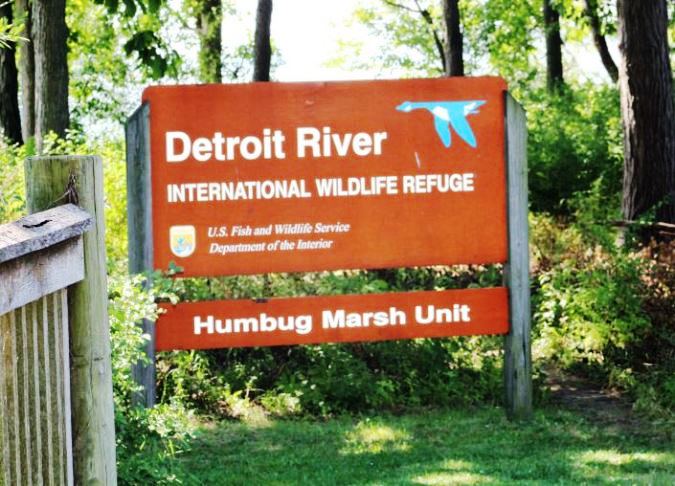
… perhaps I’ll explore the rest of the DRIWR this Summer.

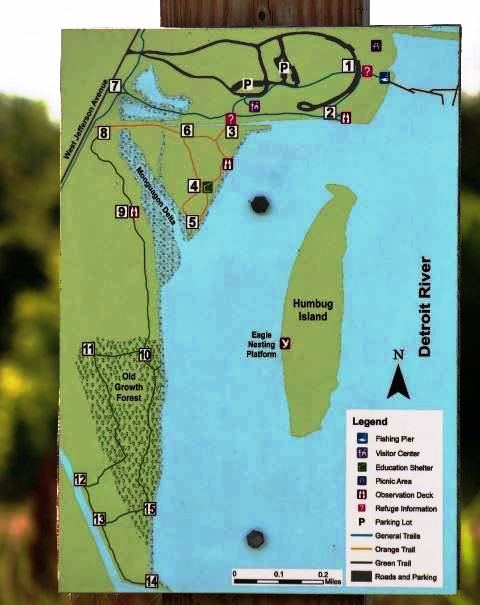
Humbug Marsh is the last mile of undeveloped shoreline along the U.S. mainland of the Detroit River. I strolled along the trail through the Old Growth Forest which is 300 years old and filled with thriving Shag Bark Hickories which can grow up to 100 feet tall and live for 350 years. You can see where the Old Growth Forest is located on this map below.
On the raised platform I checked for Eastern Fox Snakes slithering across – whew, none!

I passed the vernal pond, but nothing was happening there.

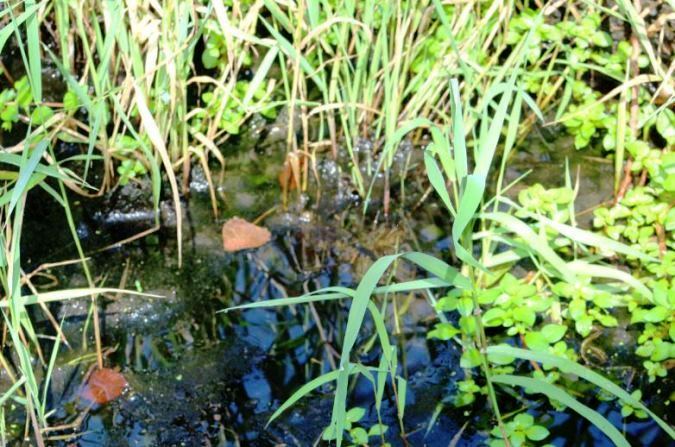
At the end of the Old Forest trail was a viewing platform and a marshy area where I found a few Purple Loosestrife …

… and some Cattails.

There were Pond Lily buds on Lily pads that gently bobbed in the water.

Nearby, a solitary Great Blue Heron patiently scanned the water for fish, ready to stab one with its long beak.

As I stood on the viewing platform, I scanned the sky when I heard a rumbling noise overhead. I could see a large plane approaching and, from its shape, I knew it was likely an antique plane participating in the Thunder over Michigan Air Show later that day.
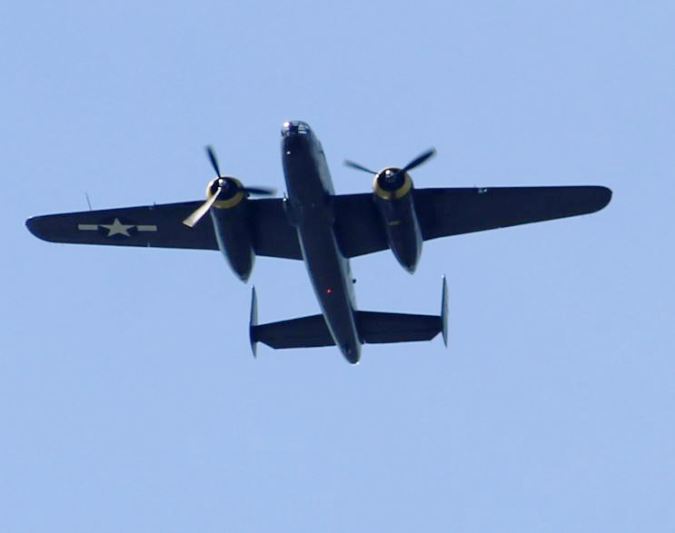
I am not an expert in antique planes, so a Google Image Search helped identify this plane as a B25 Mitchell World War II Bomber.
[Just hours later, the news reported that an antique plane, a Mig 23 fighter jet, had engine failure in the finale of the show, which was held about 25 miles from Humbug Marsh. The pilot and backseat passenger ejected into a lake and the plane crashed and exploded near an apartment building. There were no lives lost and no property damage except the plane.]
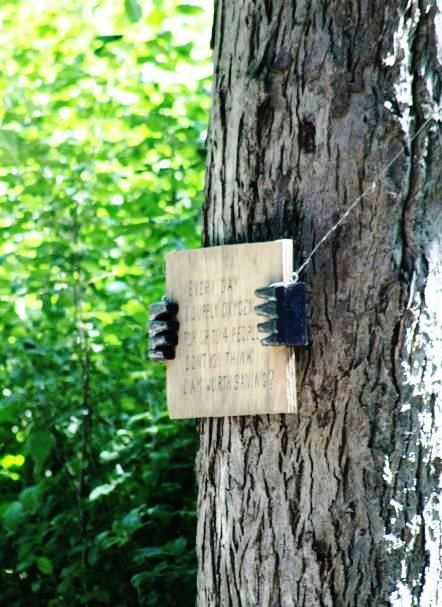
On my return trip to the Delta, I passed this tree with an impressive statistic.

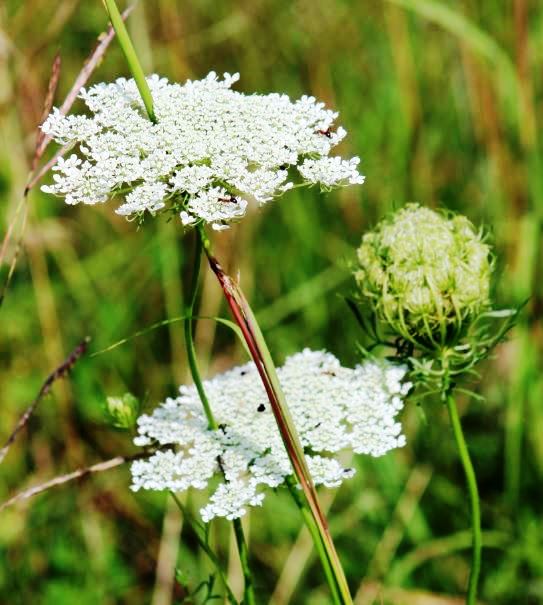
The pollinator gardens were looking good. When this venue opened to the public in 2020, there was extensive planting done to encourage bees and butterflies.


And, just like home gardens, weeds infiltrate every chance they get.

I was able to find three butterflies at these gardens; first, a Monarch on the Milkweed pods …

… and a Monarch that flitted around the Butterfly Weed.

A pretty Pearl Crescent Butterfly stopped me in my tracks; happily I saw it on the ground and didn’t step on it.

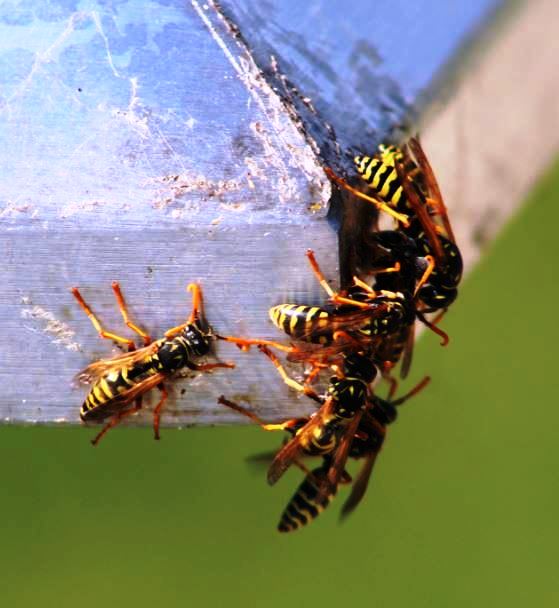
These wasps were glommed onto this solar light post, so I stood a respectable distance away and zoomed in on them.

Speaking of those little buzzing buggers, bugs ARE the bane of my existence. I heard that it wasn’t cold enough to freeze a lot of our bugs over our El Niño Winter, including ticks, so they might arrive earlier than usual and in abundance. Ugh!
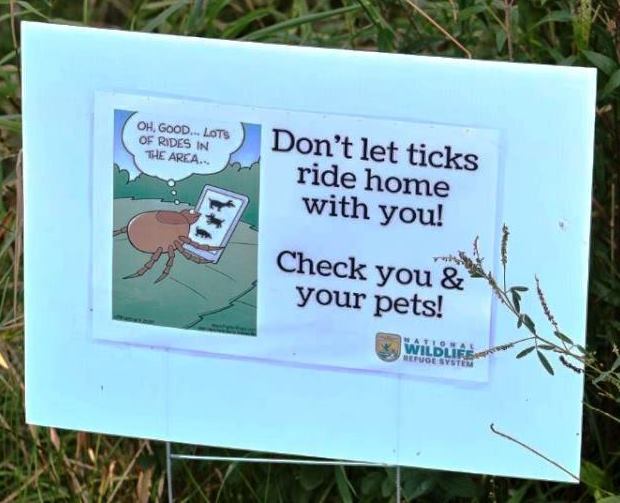
On my walk that day there were many signs warning of ticks. This is one of them.
This is the damage caused by webworms – only the skeleton of the leaf remains. I have photos from another venue that I’ve not yet written about and most of that tree’s leaves are transparent and a huge web enveloped the tree.

I didn’t have to check my pedometer to know I had walked a lot of miles, so I had one more stop, the Delta, then could call it a day.
As mentioned at the beginning of this post, my last stop at this venue was the Delta Pond. A Heron or Egret sighting will have me walking the long, railing-free Monguagon Boardwalk pictured below. The kayak launch platform is in the foreground.

If you are a first-time viewer of this venue, you may be scratching your head at the above photo wondering how a wildlife refuge can thrive while embedded in a seemingly industrial setting; even the DRIWR signage is mere steps away from busy West Jefferson Avenue.

Here is a photo showing close-ups of the industry surrounding the DRIWR.

Urban sights and nature sites would seem to be an unlikely pairing.
Overlooking the Monguagon Delta is a huge metal statue, the reflection which I captured in the header image.
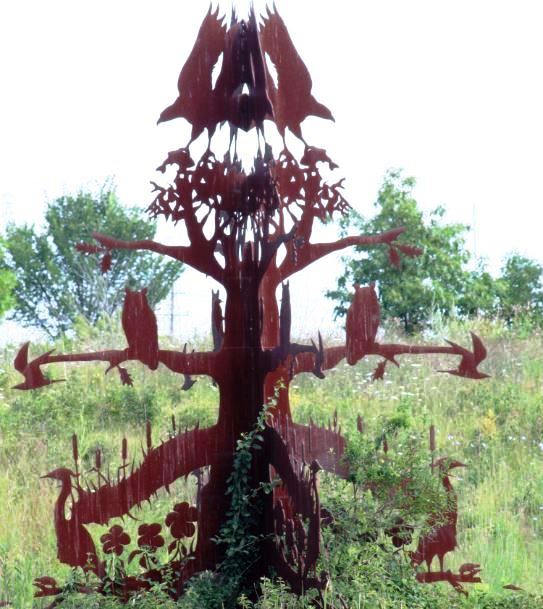
In the past I tried to glean info about this metal artwork to no avail, as did fellow blogger Zazzy who was interested in its origin. I contacted the DRIWR and got a very helpful park ranger named Maddie Drury and she researched and sent me some facts about this artwork.

My many photos taken at various parks along the Detroit River and at Grosse Ile may look picturesque; that is, if you ignore the twin, 536-foot tall, red-and-white smokestacks which always marred the horizon. You can see the smokestacks reflected on the Delta Pond, in this post’s header image. The “Stacks” as locals have always referred to them, belonged to the Trenton Channel Power Plant, a nearly 100-year-old coal-fired facility in Trenton.
Note the words “marred”, “referred” and “belonged” … as in the past tense.
The Trenton Channel Power Plant was decommissioned in December 2022 as our energy provider DTE decided to implode the entire plant and hinted that green space would replace the large property. Unfortunately, now the plan will be to build a facility to house batteries.
All hazardous materials were removed from the site and the demolition was scheduled for two parts: March 1st for the “Stacks” and May 17th for the boiler house. The public was welcome to view the implosion in safe, designated spots.
So, I hustled to the Refuge for one last shot of the “Stacks” intending to make a Wordless Wednesday post entitled “Going, going, gone”. It was a blustery, frigid February morning when I took this shot …
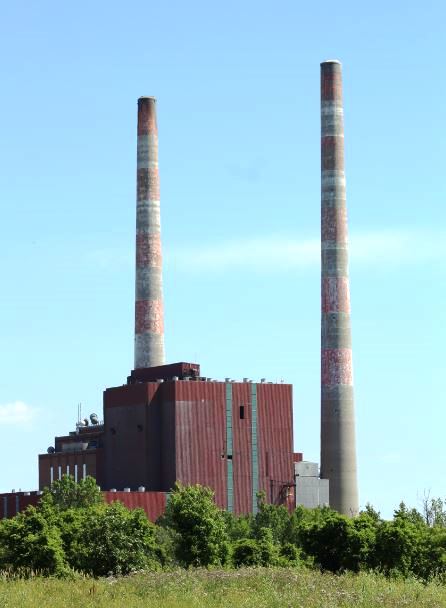
… then the implosion was abruptly rescheduled to March 15th, with no explanation given.
On March 15th at 7:00 a.m. a crowd of approximately 200 people viewed the implosion which used 500 pounds of dynamite at the base of each smokestack, collapsing one, then the other in a choreographed fashion. I found it fascinating to watch that video. If you are interested, you can view the short video right here.
After the dust settled, local folks took to social media to wax nostalgic for those twin candy cane smokestacks, declaring them a navigational beacon for sailors and pilots since 1924 and bemoaning their fate.
So, now you know that urban sights and nature sites CAN live in harmony.
I am joining Terri Webster Schrandt’s March 24th Sunday Stills Challenge: Urban Sights.
Wordless Wednesday – allow your photo(s) to tell the story.

After all, Spring is just a heartbeat away, right? But, as I am writing this post, the winds are howling, snow flurries are flitting about and I wonder why our Summer-like weekday weather vanishes every weekend. It’s no joy to mark miles when 35 mph/56 kph winds are gusting. But, on the other hand, seeing the tornado damage that ravaged some states earlier this week, I remain grateful to be unscathed by wicked weather.
Calendar-wise, Spring IS just around the corner – Tuesday, March 19th. I don’t know about you, but when I was a little nipper I’m sure the four seasons landed on the 21st, i.e. Spring was March 21st; Summer was June 21st; Autumn was September 21st and Winter was December 21st.
Query: was this a Canadian thing? Or, were our elementary school teachers just keeping it simple for us youngsters?
I resorted to Googling to ask when March 21st stopped being the first day of Spring. At the Freep (a/k/a The Detroit Free Press, one of Detroit’s daily newspapers), I learned: “Due to time zone differences, there hasn’t been a March 21st equinox in mainland U.S. during the entire 21st century …. we won’t see a March 21st equinox again until 2101.”
Hmm – I guess I won’t put that date on my calendar then.
So there are big doin’s on March 19th (that is, if you have recovered from your St. Paddy’s Day festivities today).
1 – The Spring equinox officially arrives in the Northern Hemisphere at 11:06 p.m. EDT.
2 – It is St. Joseph’s Day.
3 – The Swallows return to Capistrano. These are Cliff Swallows and, like clockwork, they return every March 19th to nest in the eaves of the old Mission San Juan Capistrano, in San Juan Capistrano, California. They were vacationing in Goya, Argentina, having departed the Mission the prior October.
According to the Mission’s website, this tradition was started by Father O’Sullivan in the 1920s at Mission San Juan Capistrano when he “invited” the Swallows to nest at the old Mission after seeing a local shopkeeper, who was angry with the Swallows nesting in the eaves of his shop; he began to destroy all the nests by poking them to the ground with a broomstick. The Swallows were understandably upset, squealing and squawking as eggs or their young were in those nests. But Father O’Sullivan said: “come on Swallows – I’ll give you shelter. Come to the Mission. There’s room enough there for all.”
While I was on a 10-day tour of the California coast in October 1980, one of the attractions we visited was the Mission. I have a photo taken there, but not with the Swallows. This is Lillian and Ray, two fellow Michiganders, that were in the tour group with me.
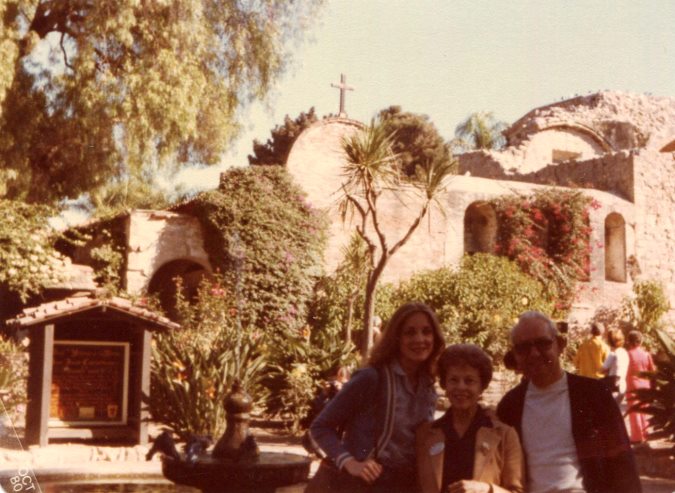
Unfortunately, it was poor planning to visit the Mission in October because the Swallows had already migrated to their Winter destination.
I never thought much about that missed opportunity to view those famous Swallows at Capistrano until I began taking photos for my blog.
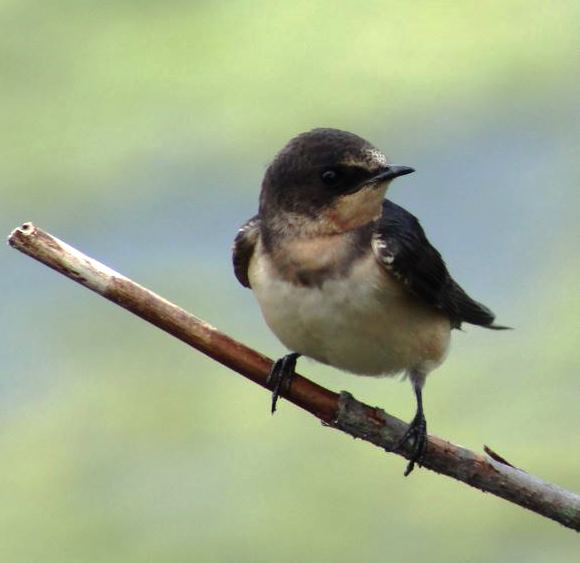
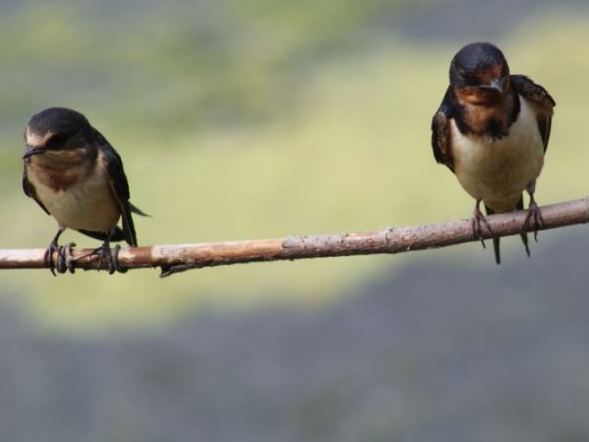
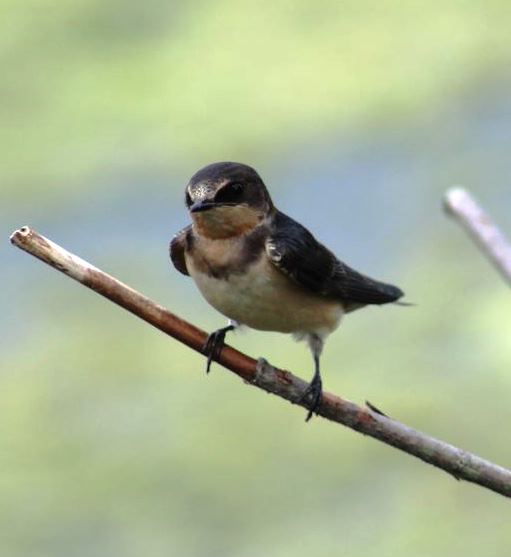
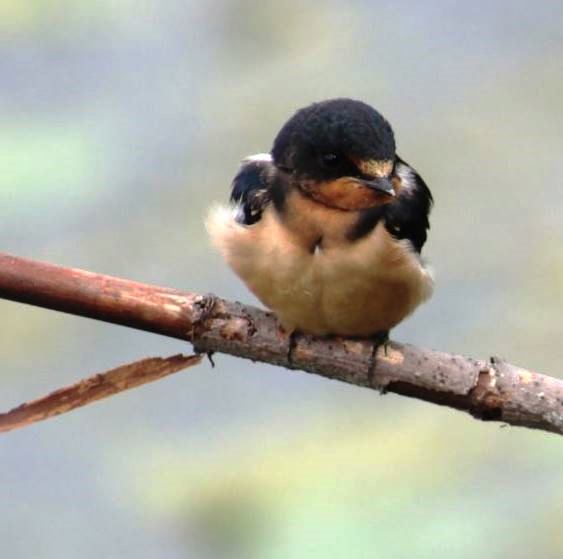
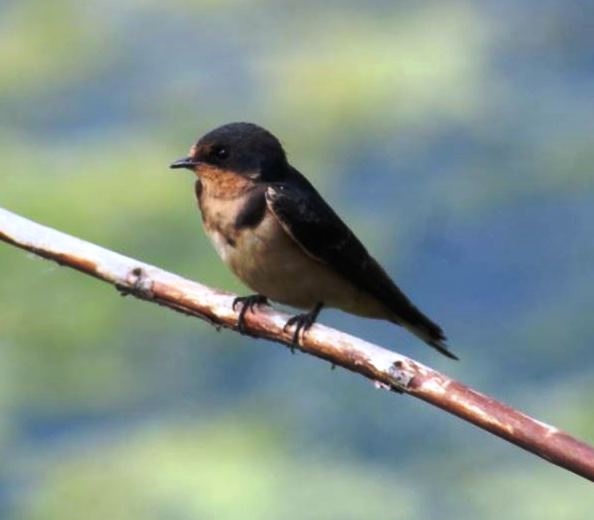
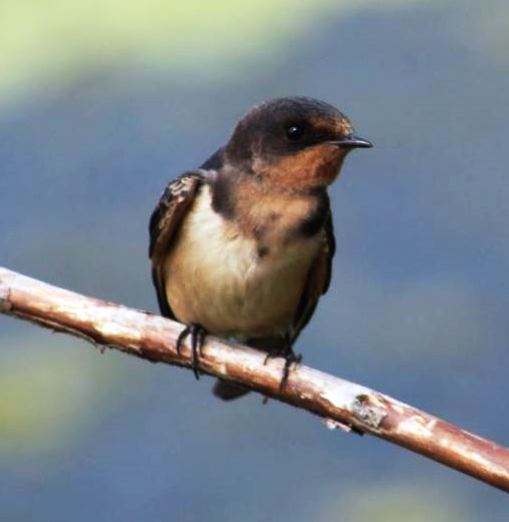
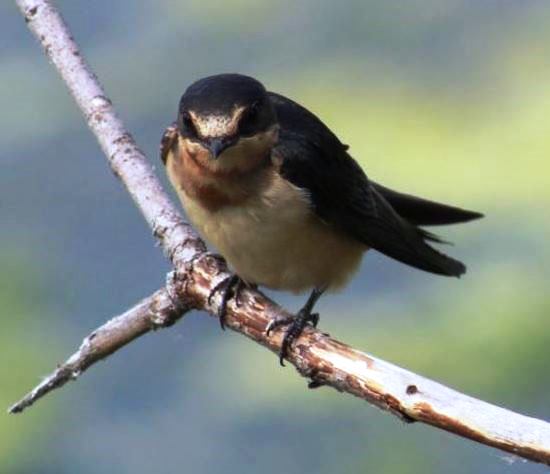
At Lake Erie Metropark there are Tree Swallows and Barn Swallows, but it is the Barn Swallows that fascinate me most because 99% of the time they are in motion, swooping, diving, catching insects in mid-air. In the earliest excursions to this venue, I’d try to take photos of the Swallows in motion, but I would return home with pictures of black dots and the marsh.
Sometimes they’d take a wee breather on the reeds, so I’d quickly take a photo.

Then, one hot, humid Summer morning, as I approached the wooden overlook near Cove Point where the Swallows impress me with their acrobatics, I found them at rest. They didn’t see me, so there they were, perched along the branches of a long-dead tree. That was about three years ago, so now this is always a stop every trip to this park and I try to stay still to observe and photograph them.
Like the Capistrano Cliff Swallows, Michigan’s Barn Swallows also migrate to warmer climates in Latin America for the Winter, so they are only here from April through early September.
I was surprised to learn we have seven types of Swallows in the Mitten State and even have Cliff Swallows, but on my marsh meanders I only see Tree Swallows and Barn Swallows.
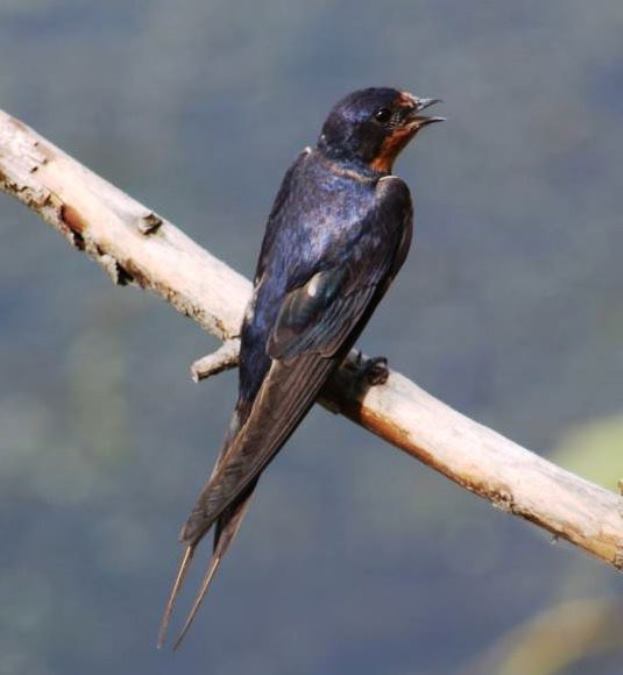
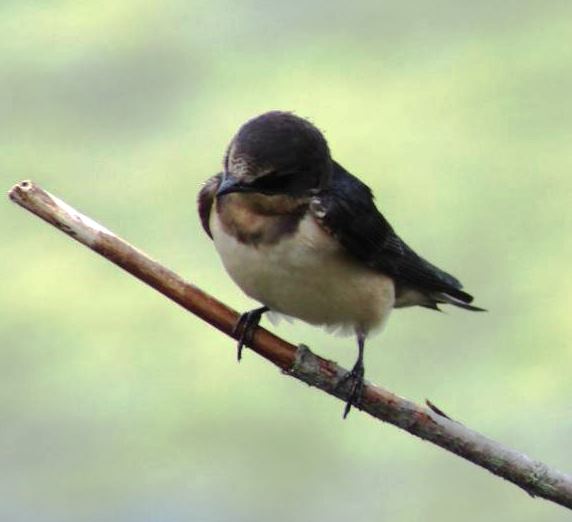
I picked out some of my favorite photos from 2023 of the Barn Swallows – sometimes they were social with one another, but at times, let’s just say they had a bit of an attitude with me, or each other …



… and they were vocal at times as well.

Other times they were cute munchkins.

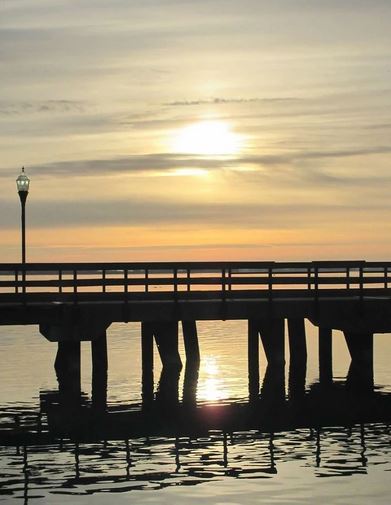
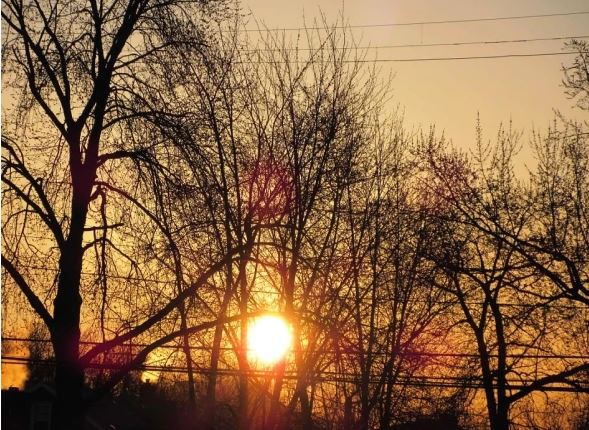
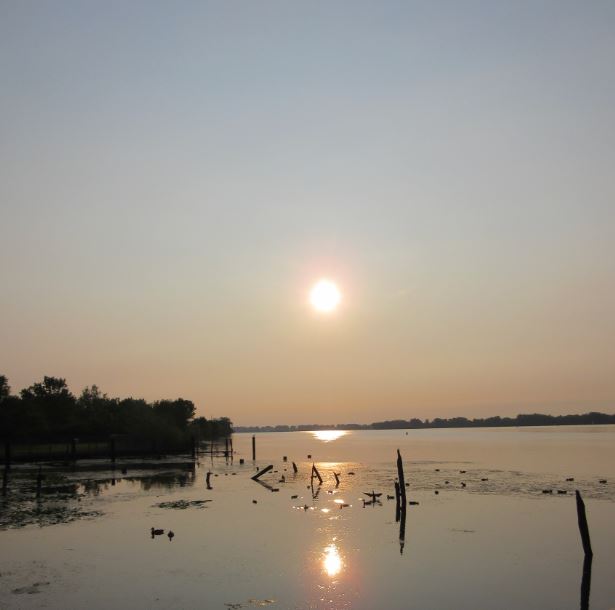
I am not joining Terri Webster Schrandt’s March 17th Challenge “Sunrise, Sunset” today, as I have no sunset photos and only a handful of sunrise photos, but I will participate this Wednesday, with my favorite just-past-sunrise shots. This Wednesday marks four years since I began my weekly Wordless Wednesday posts and have gone without missing a single week.

Wordless Wednesday – allow your photo(s) to tell the story.


Climate change and El Niño partnered to create a beautiful Autumn here in Southeast Michigan and Veterans Day 2023 was no exception – it was a sunny, Pure Michigan day. I was eager to explore a woodsy area located between Heritage Park and Wayne County Community College, so I decided this was the day to discover the Fletcher Discovery Trail.
I’ve written at length about picturesque Heritage Park in every season. I haven’t done a Winter walk in a while, but believe me, the Mallards huddled together on icy Coan Lake, with the covered bridge as a backdrop, or snow settled atop the Little Red Schoolhouse is a sight to behold.
I arrived around 10:00 a.m. and was happy to see the Maple trees ablaze in a fiery red and still quite showy, so the camera came out of its pouch very quickly.
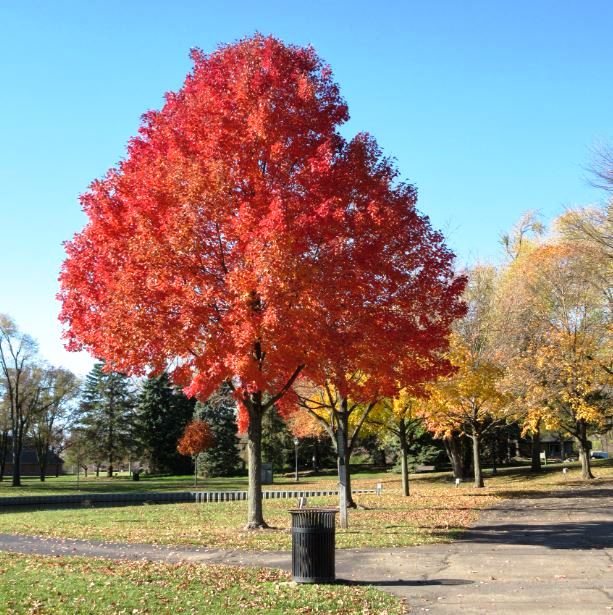
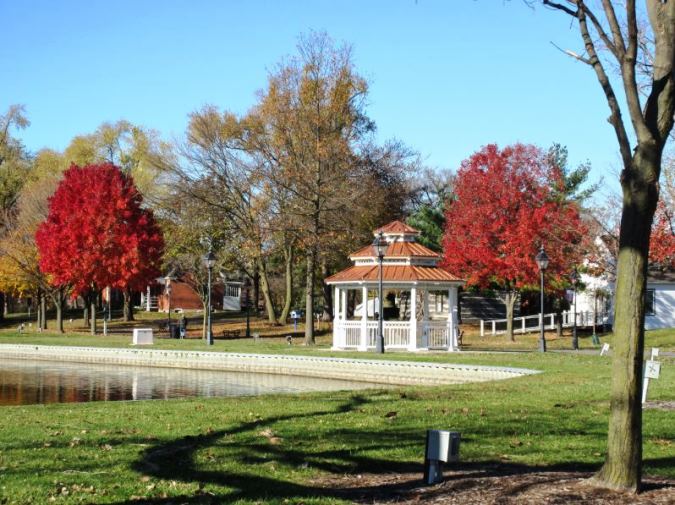
After a quick meander around the historical area, I paused near the Hand Train Station for a few minutes.
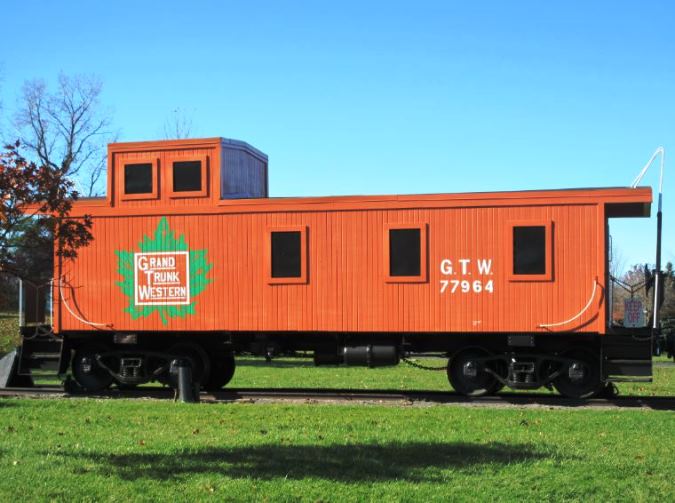
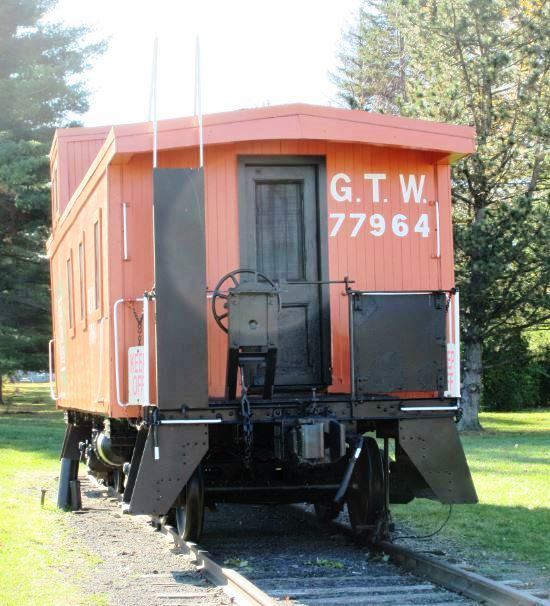
Heritage Park is always sprucing up this venue which the City of Taylor proudly calls “The Jewel of the City” and, since I often visit this park, I have watched the transformation of the two railroad cars, a caboose and boxcar, from faded red and worn looking, to bare wood and now they sport traditional Christmas colors of red and green.
To be honest, I liked the original worn look better, but here they are now, spiffed up with new paint.
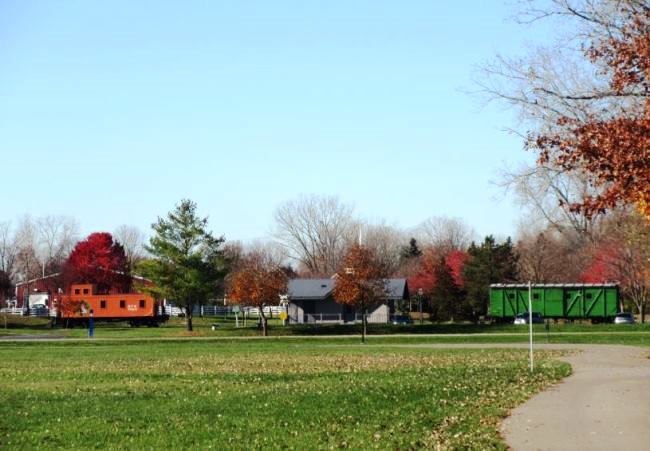
Well, you sure won’t miss them at the entrance to the park.
You might need sunglasses to look at that bright green box car.
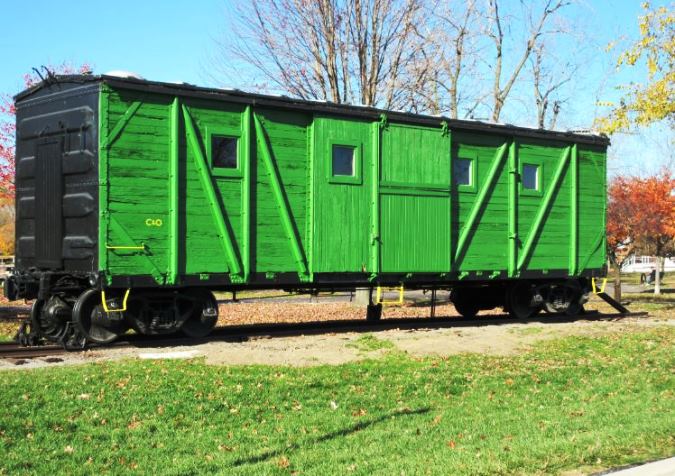
Its wheels look like they were refurbished as they are now brighter.
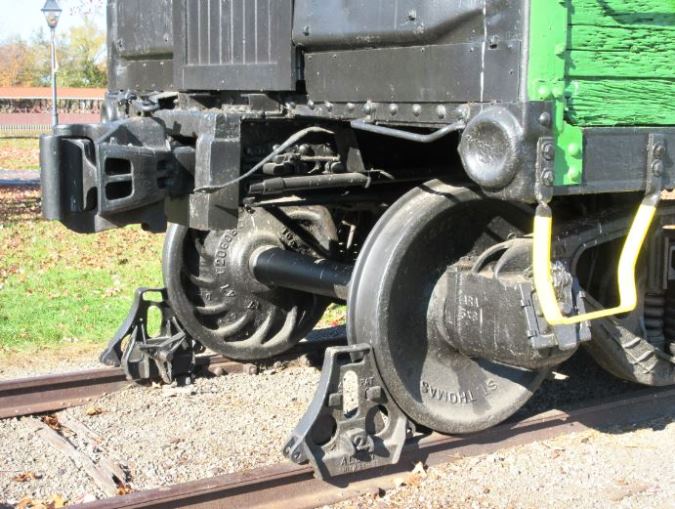
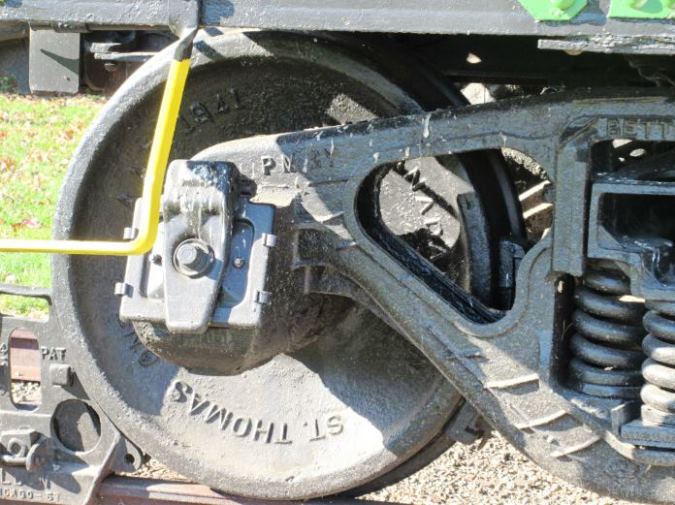
The caboose was tomato red, emblazoned with its green maple leaf logo. Did you wave at the caboose when a train passed when you were a kid? I always did.
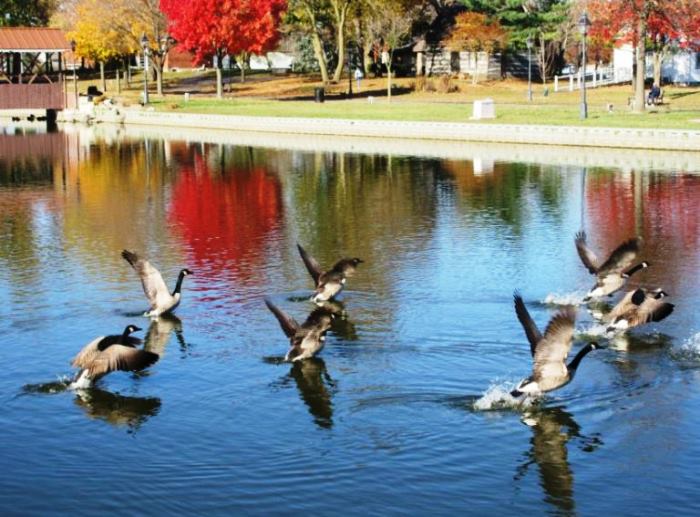
I paused at Coan Lake, camera in hand, to take photos of a half-dozen Canada Geese that seemed pretty sedate …
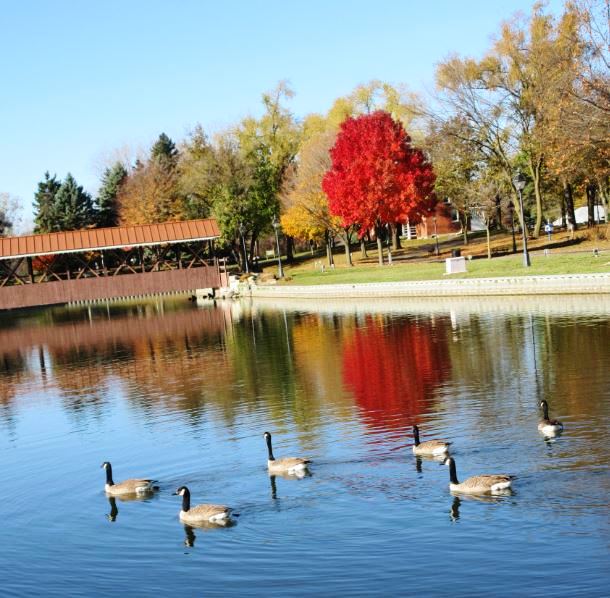
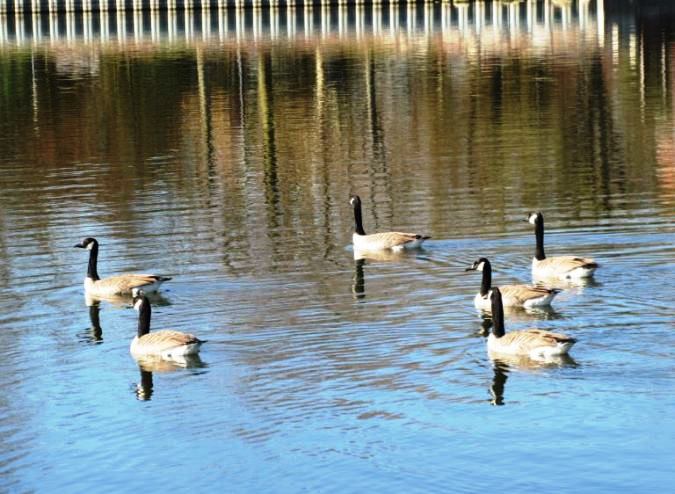
… then. all of a sudden, they made a quick getaway and I hastily stepped back, lest I get splashed. I know I didn’t spook them as I wasn’t that close, so perhaps it was “false alarm flighting” (when flocks of birds suddenly take flight even when there is no known predator in sight).
The Mallard ducks weren’t interested in any goings-on with the geese nor me.
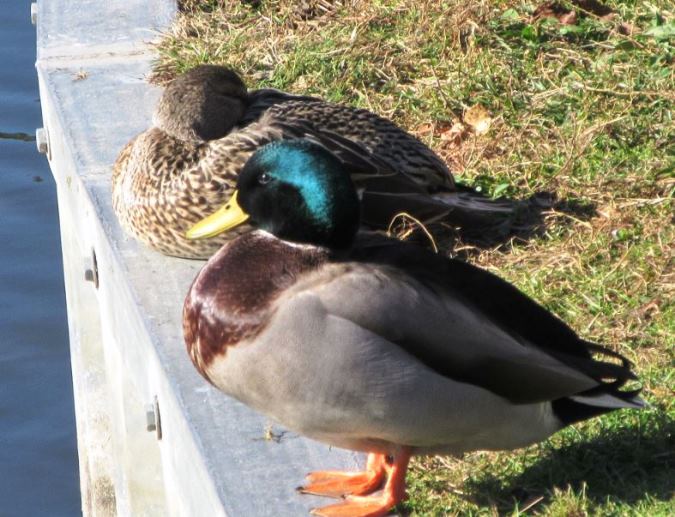
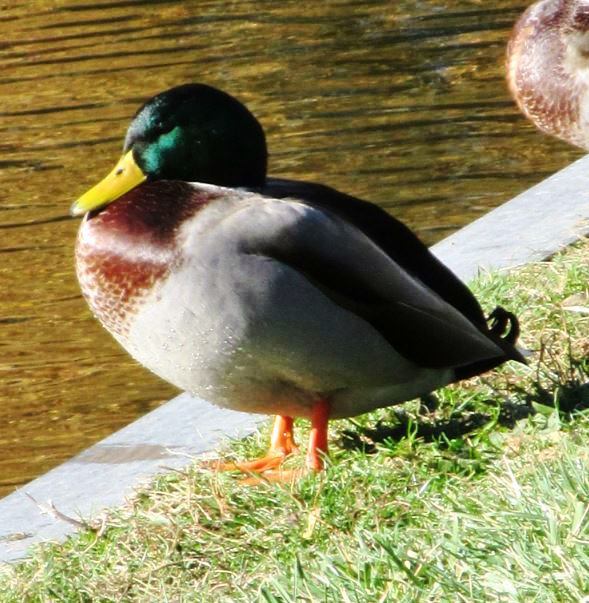
It was time to wander the Fletcher Discovery Trail, which, although created in 2018, was new to me. It is a pathway through the seven-acre woodsy area connecting Heritage Park and the Wayne County Community College campus.
As I strayed from the trailhead, to walk along a rather nondescript trail, the birds were singing, a squirrel was chattering and I couldn’t help thinking about the contrast to Veterans Day 2019 when we awoke to a record 9.2 inches of snow. Yes, it was a fluke and two days later no traces of the “white stuff” remained.
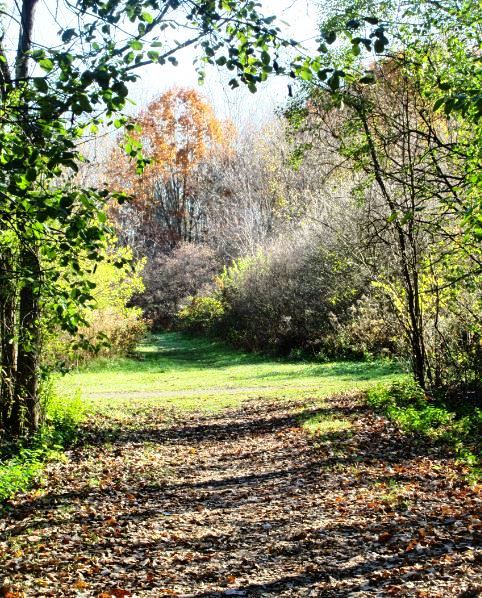
It was not dense woods; I could see the sky through the trees. I was alone for this entire excursion, but for a woman jogger and her German Shepherd which happily loped alongside her.
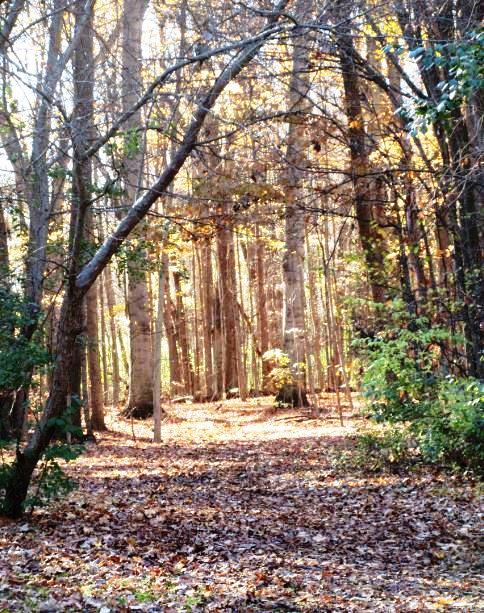
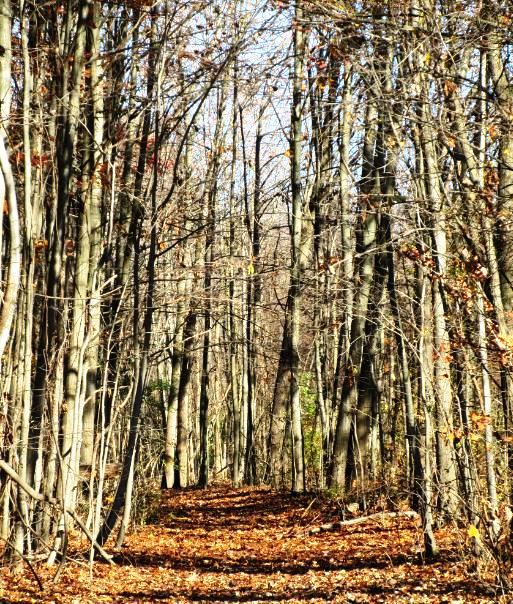
I kept swiveling my head around, hoping to find the mated pair of Wood Ducks. Our local Audubon Society saw and photographed them perching in the trees along the trail a few years back, but I had no luck seeing them.
Leaves were fluttering down fast and furiously, surprising me, since the Maples at Heritage Park were still full of leaves. Oaks seemed to be the predominant trees with leaves littering the trail, but a fair amount of Maple leaves were included in this freefall. I tried taking photos of those falling leaves but they were faster than my finger pressing the shutter button.
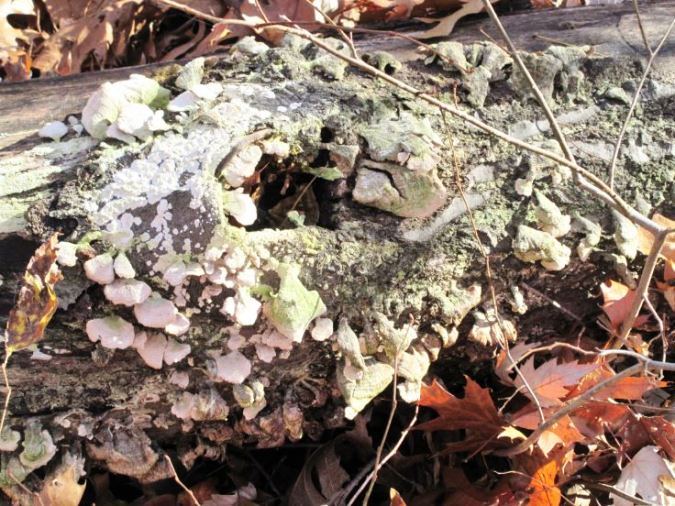
I found fungi on some fallen logs.
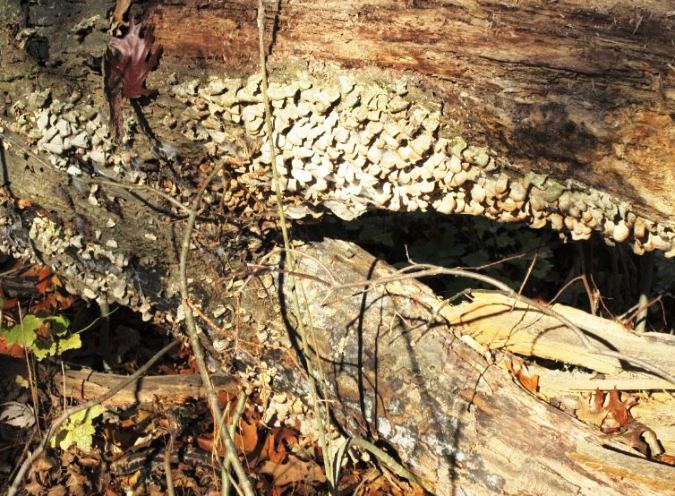
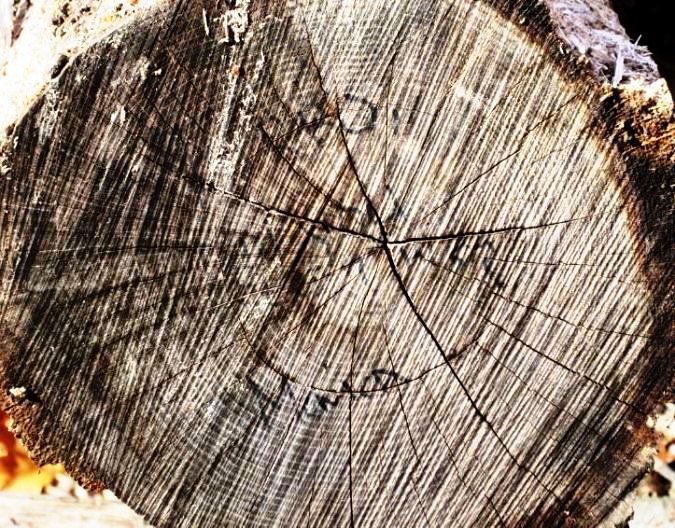
And, on the topic of fallen logs … someone scribbled a message.
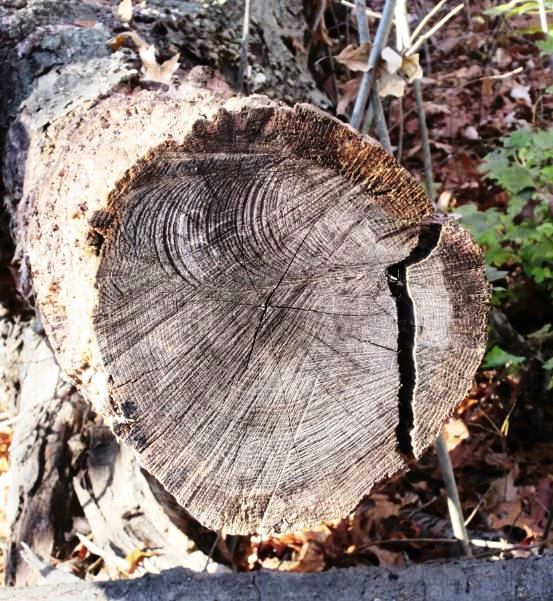
This log looks like my chair seat after it cracked in two causing me to fall in a heap on the kitchen floor last Summer. Ouch!
Leaves, less vibrant, with muted gold and red tones, stood out from the crinkled leaves which crunched under my heavy walking shoes.
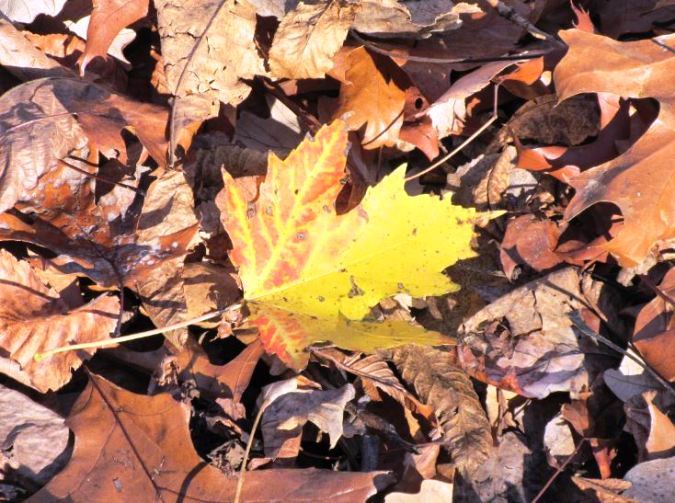
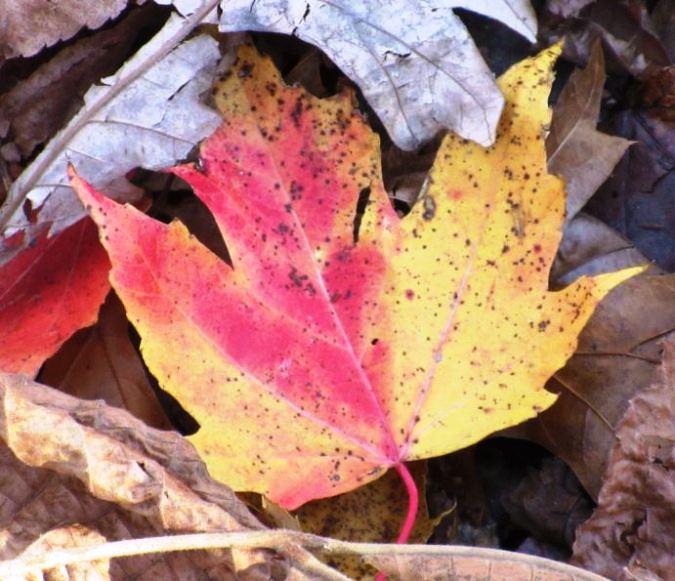
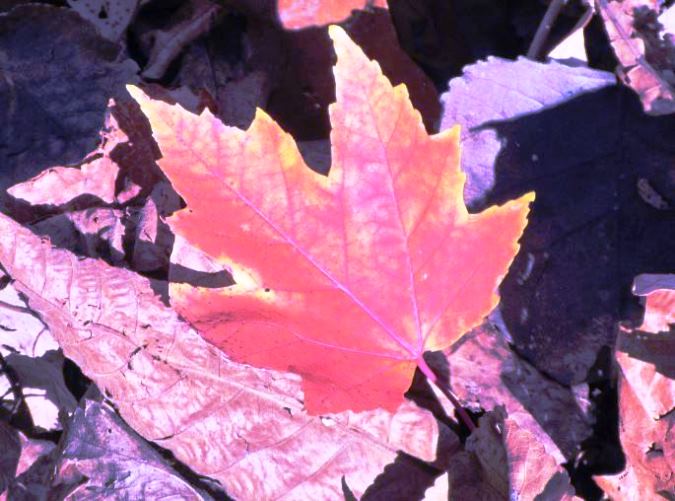
I guessed all the green leaves were gone until the new leaves unfurled in Spring.
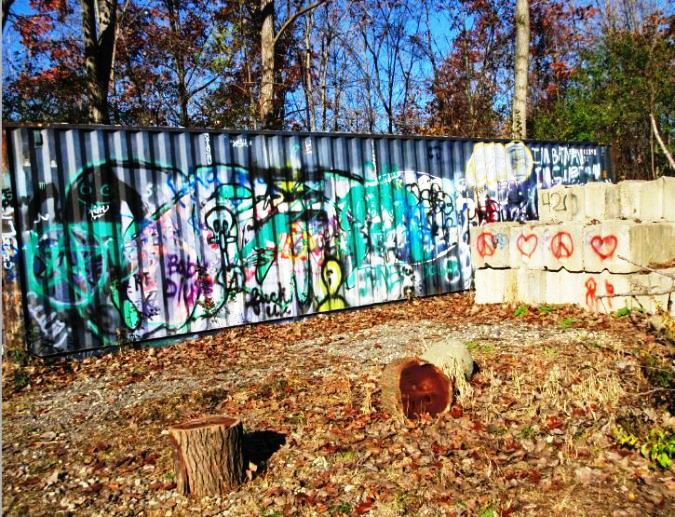
Not far off the beaten path, something caught my eye that looked a bit out of place in a woodsy area. I passed this huge container and wondered what it was used for since Heritage Park has a building, which resembles a barn near the Petting Farm, where heavy machinery is stored.
I had to stand back to get a shot of everything. You may remember the “Peace-n-Love” post I did for Valentine’s Day week featuring some of this artwork. I found those tags here.
I saw several deflated pumpkins, no doubt left by homeowners as a treat for the wildlife … query: who were those pumpkin eaters?
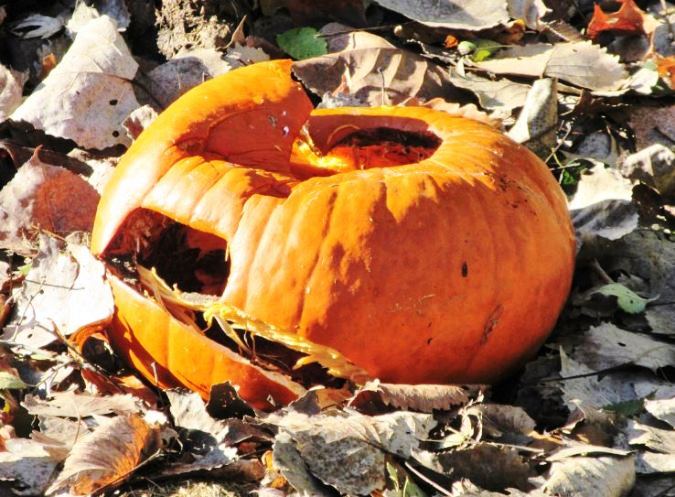
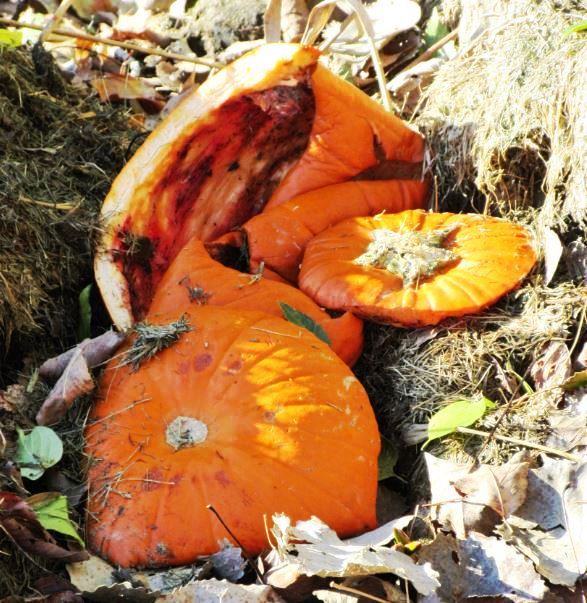
The squirrels (or some hidden critter which I did not see) likely were the culprits that further decimated these orange orbs.
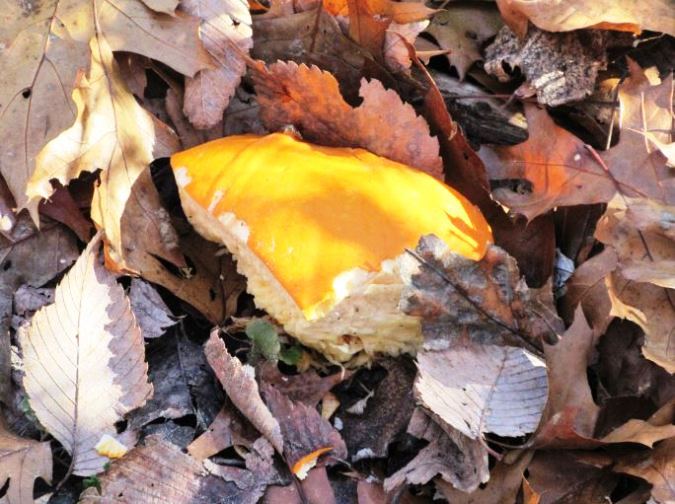
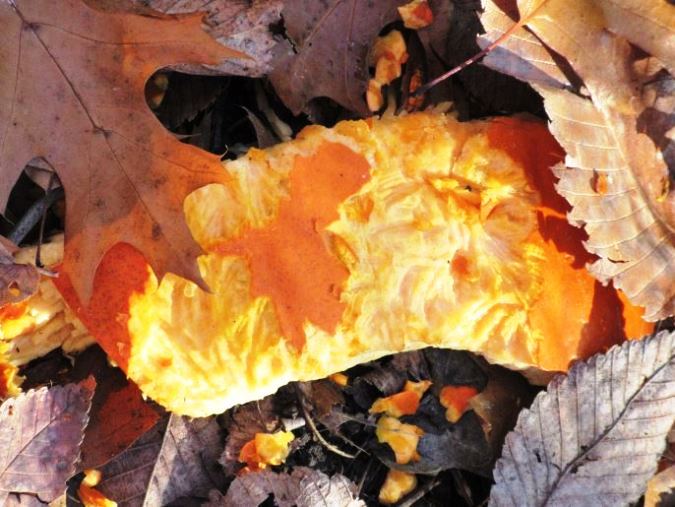
Interestingly, the fleshy part of the pumpkin was gone, but the seeds were left behind or embedded in the dead leaves. I guess pumpkin seeds are not a treat.
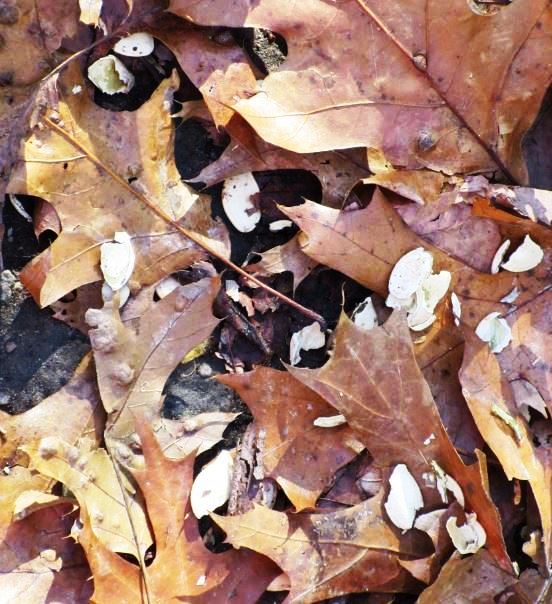
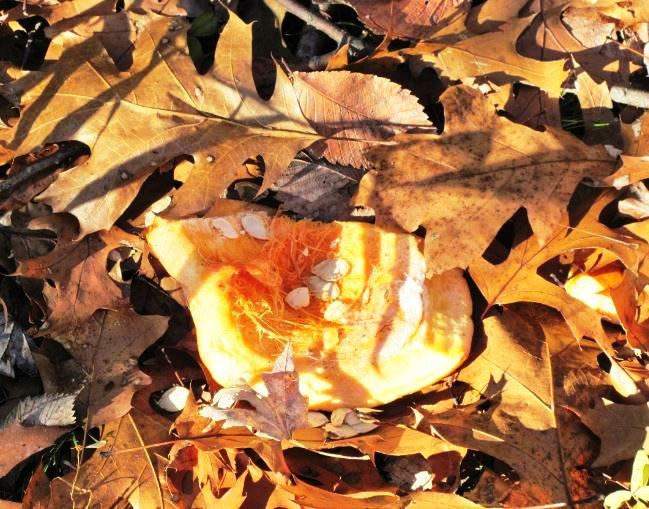
So, this begs the question, did the squirrels spit them out like we used to spit out watermelon seeds when eating a “smile” of watermelon as kids? Seedless watermelons were not available when I was a kid, so Mom would caution “Linda, spit out the seeds or a watermelon will grow inside of you.” Well that was quite a visual, so believe me, I spit out the seeds!
After exploring the entire trail, I headed back to Heritage Park where the sun was brighter and it was actually warm enough to unzip my jacket. I was happy I decided to explore beyond this pretty park and will be returning here again, in search of those elusive Wood Ducks.

Wordless Wednesday – allow your photo(s) to tell the story.


Last Summer’s predictions for a mild and fairly dry Winter, thanks to an impending El Niño, filled my heart with joy. I have never been a fan of Winter and this mindset was long before I began my walking regimen in 2011. For decades I took the bus to Downtown Detroit and waiting on a bus that was behind schedule due to snowy and frigid weather was no treat.
So, the El Niño forecast meant I could possibly walk daily all Winter. Yay!
Unbelievably, snow was not the bane of my existence during this Winter of 2023-24; it was plain rain, some freezing rain and also seemingly never-ending rainy days. The siege of wacky weather began in mid-January after we had snow, then freezing rain, then a flash freeze, leaving an icy glaze on our city streets and of course my driveway and sidewalks. A Polar Vortex settled in and the temps were way too cold for road salt or ice melt products to work.
The weather woes persisted, even after the icy grip was loosened, with three more non-stop rainy days.
Finally, milder temps melted the ice, so the car and I could safely venture out of the garage without slip-sliding all over. That day was February 4th and I tucked my camera into my coat pocket and off we went.
Yes! Just feeling the sun on my face was wonderful and it sure was good to see my shadow again. I spent about an hour at Council Point Park feeding, then taking photos of my furry and feathered friends and watching a Canada Goose gingerly stepping onto the ice. I was surprised to see the Creek was still frozen over in places, but the walking path was ice-free. I will share those photos in a separate post.
I decided to drive to Lake Erie Metropark and see if the Sandhill Cranes stuck around for the Winter. I had visited that venue in mid-December and didn’t see them – in fact, I meandered those marshlands and left without a single photo.
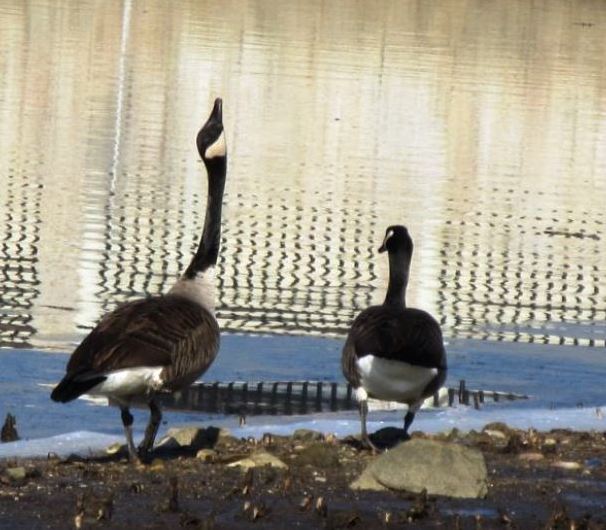
Once inside Lake Erie Metropark, I slowed down at the Offshore Fishing Bridge, craning my neck for a sign of those Cranes, but I couldn’t see them. However, a couple of Mute Swans and lots of Canada Geese were in that narrow marsh area, along with some gorgeous reflections, so happily I pulled into the parking lot, hopped out and turned on the camera.
…except, with my point-and-shoot camera I kept seeing my reflection in the camera’s window. Grrr. I decided I would make the best of it and really, was I going to complain about the sun after almost three weeks of gloomy, gray weather and a slew of rainy days? Nope!
The reflections from the Offshore Fishing Bridge were pretty.
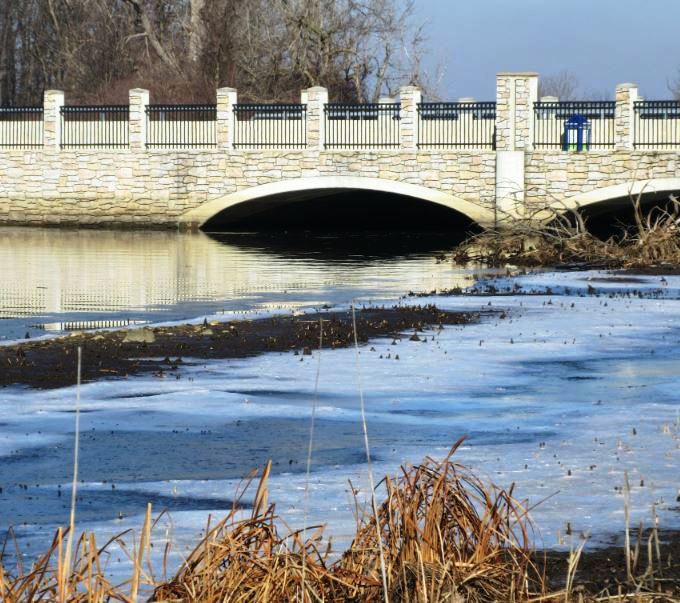
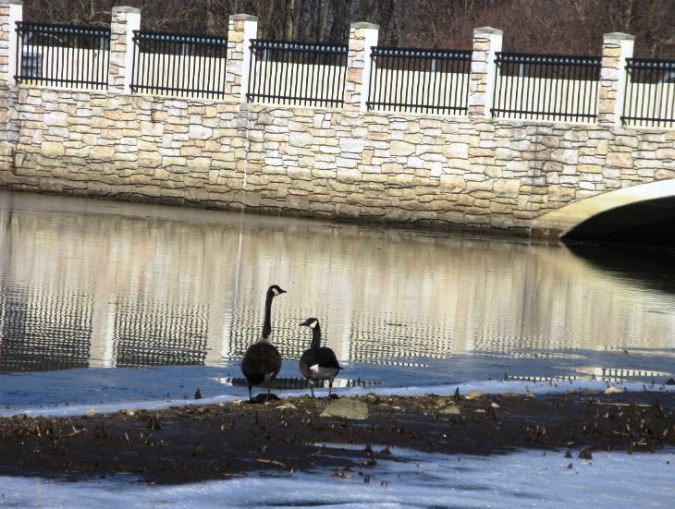
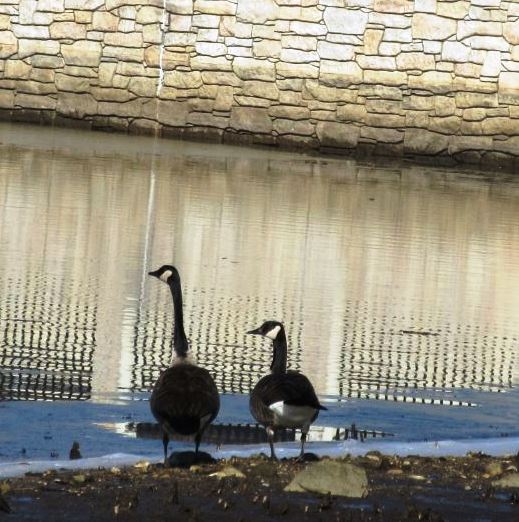
Geese gathered at this narrow marsh area where ice still outlined the edges.
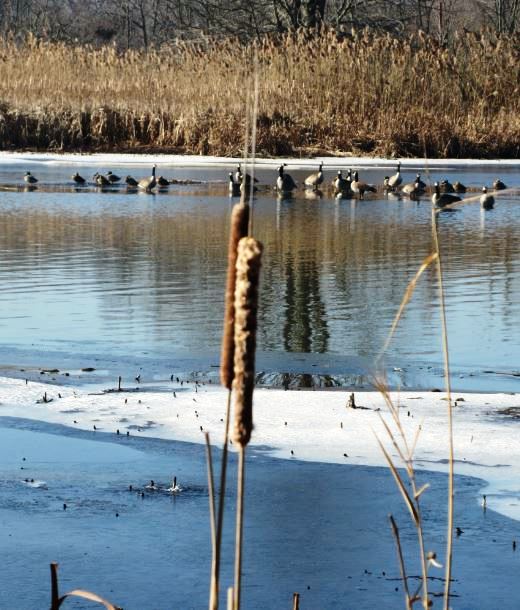
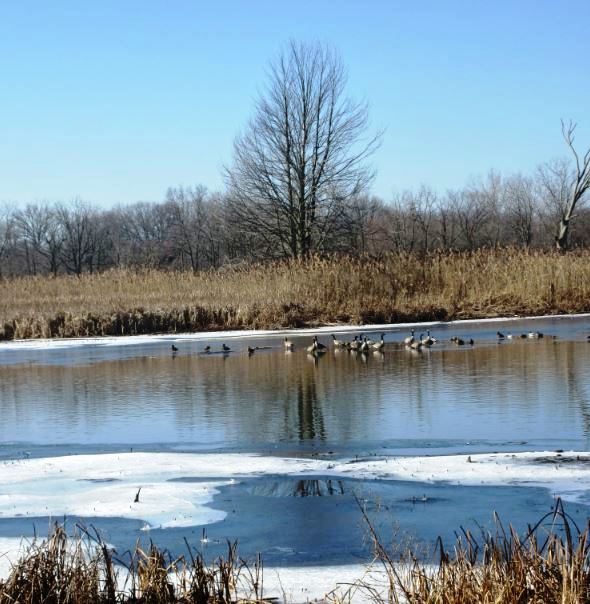
I climbed up the hill to see what I could see from the bridge. A few ducks and geese huddled together atop the ice on the other side of the bridge.

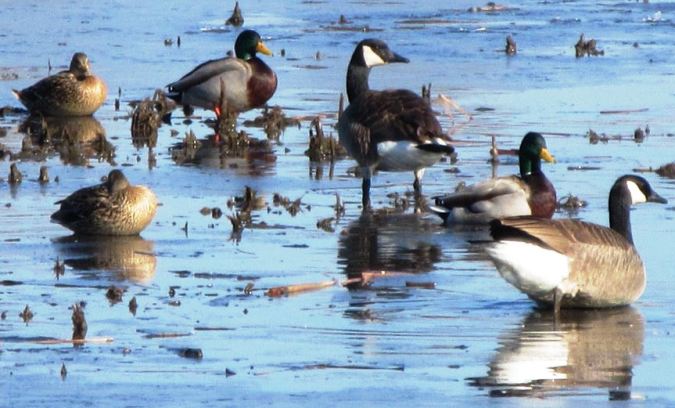
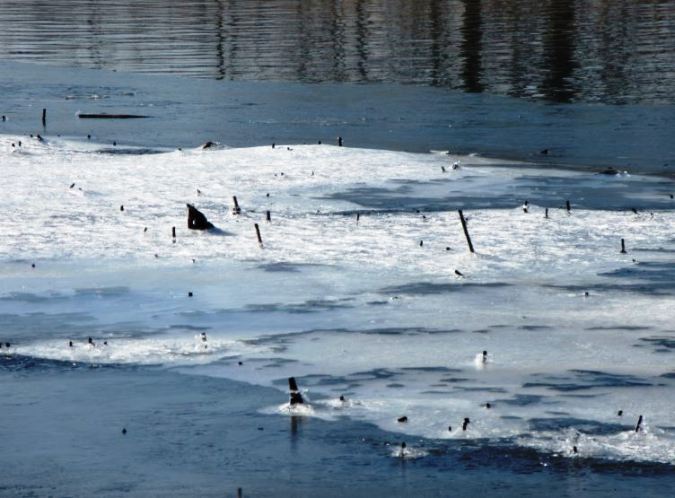
I then wandered back down the hill, closer to the shoreline and stood beside a big tree, grateful for the partial shadow, so I could take a few photos without the sun’s glare. Remnants of the Polar Vortex were more evident here as patches of ice still dominated the shoreline, while the middle of the marsh was almost ice-free.
These Canada geese and Mute Swans were contentedly paddling around.
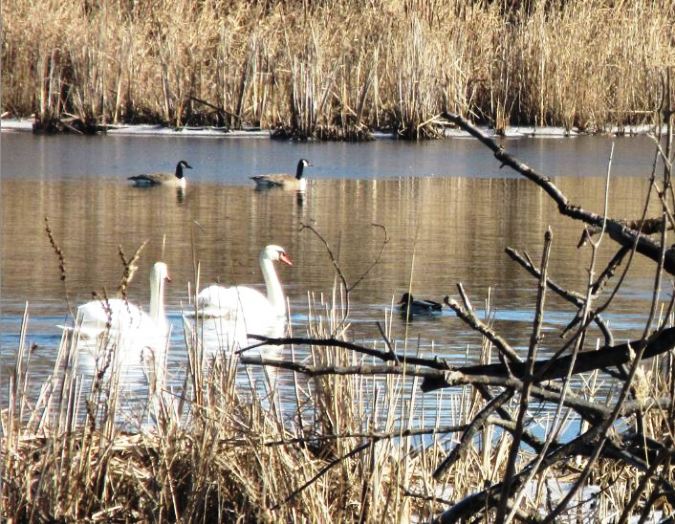
I was not that close to the shoreline for the Mute Swans to take issue with me. Long-time followers may remember how I was taking pictures of a pair of Mute Swans, when the cob (male) angrily stomped up the creek bank and came after me, hissing and snorting. I headed him off by tossing peanuts his way and when he stopped to eat them, I vamoosed.
That was then; now I was enjoying a peaceful Sunday afternoon filled with waterfowl and, as I drank it all in, I realized just how badly I needed this nature outing.
A loud whir of wings told me swans were overhead – would they plunge down into the icy water and give me some photo ops? I certainly hoped they might, but the four Mute Swans circled above, then quickly disappeared over the woods.
But the old adage “be careful what you wish for” was certainly true, when moments later another pair of Mute Swans alerted me to their presence, once again with the unmistakable humming sound of their wings. I swiveled my head upward just as they descended, in an ungraceful landing. Instead of seamlessly descending onto the open water, the two interlopers came in fast and furiously; one hit the ice hard and the other landed right onto the pair of swans paddling together and minding their own business.
All of a sudden, there was a lot to SEE and HEAR from my vantage point in the tree trunk’s shadow. I was torn between watching the feathers flying with my eyes, or capturing the images with my camera, while shooting blindly with that pesky sun in my eyes. I did the best I could.
As this kerfuffle unfolded, several geese began honking and quickly took flight.

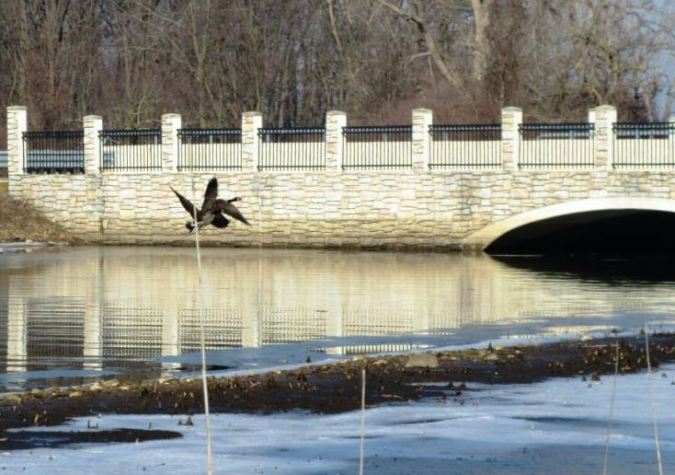
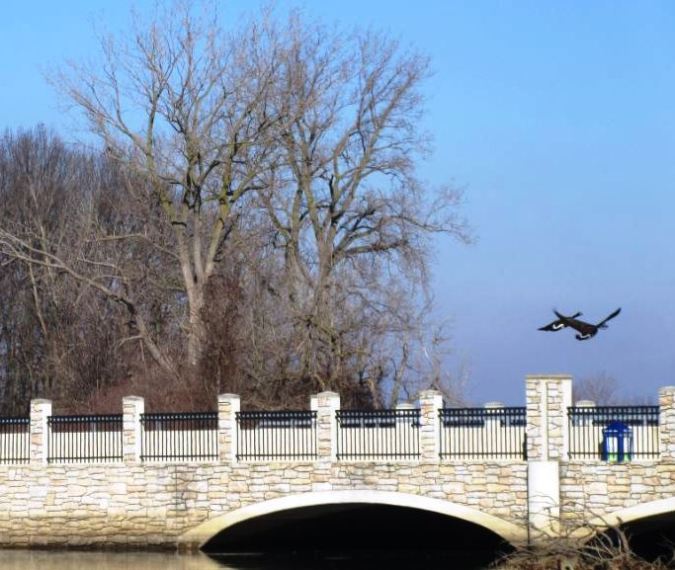
A few geese remained close to the action, but backed off a bit.
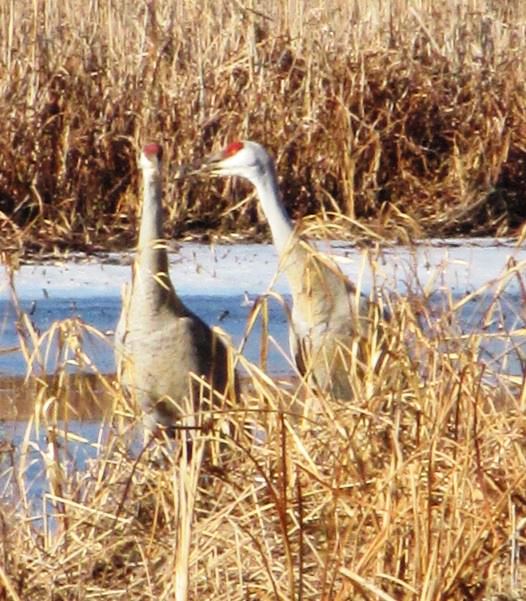
A loud bugle-like call alerted me that yes, the Sandhill Cranes were still in residence, so I swiveled my head toward the direction of the noisy calls, clear across the marsh and there they were, embedded in the dry reeds.
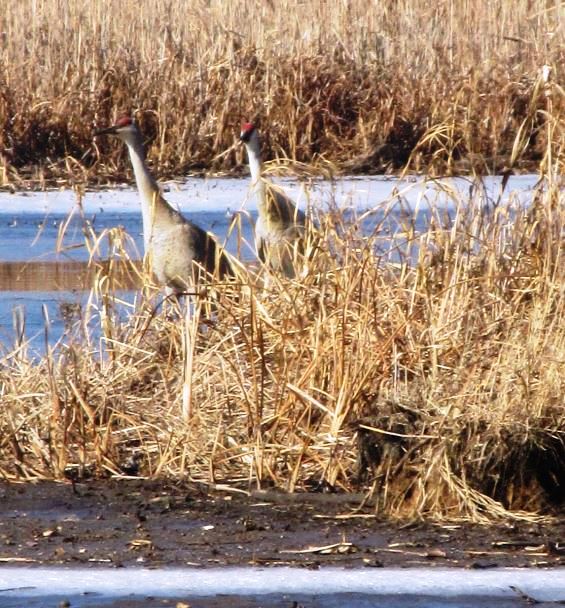
It was like the cranes and geese were watching “Fight Night” – all they needed was some popcorn!
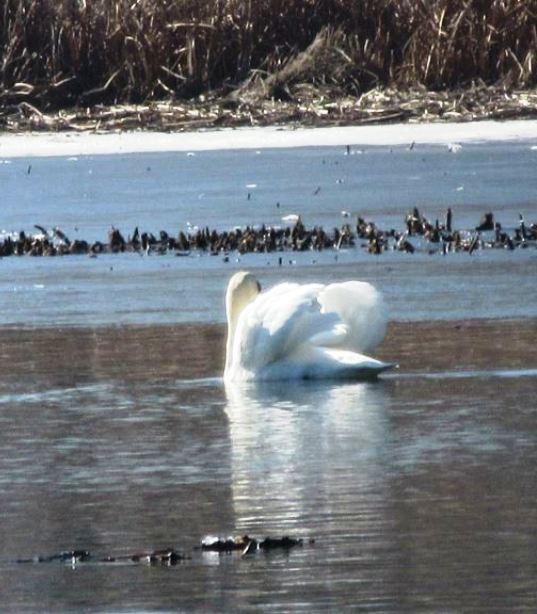
Oddly enough, one swan seemed unruffled in the thick of the fray, as three other swans tangled nearby.
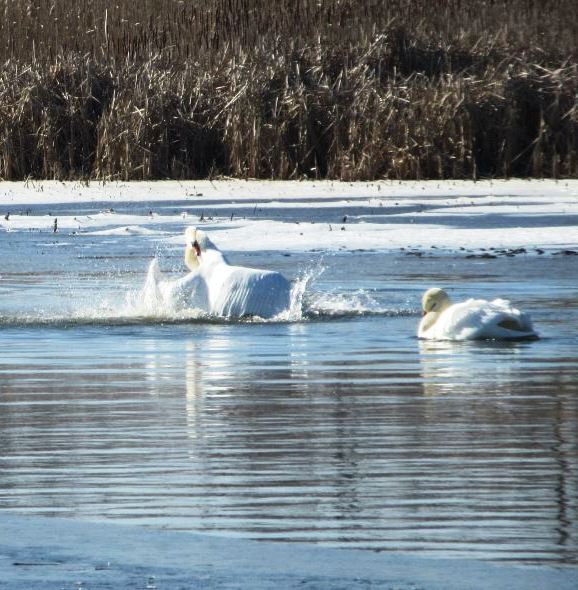
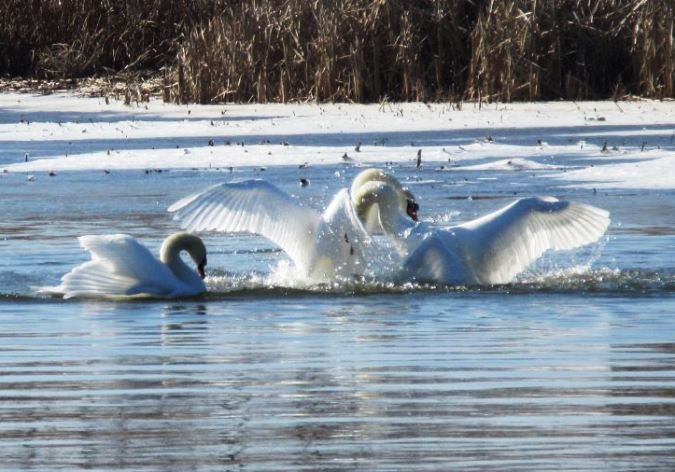
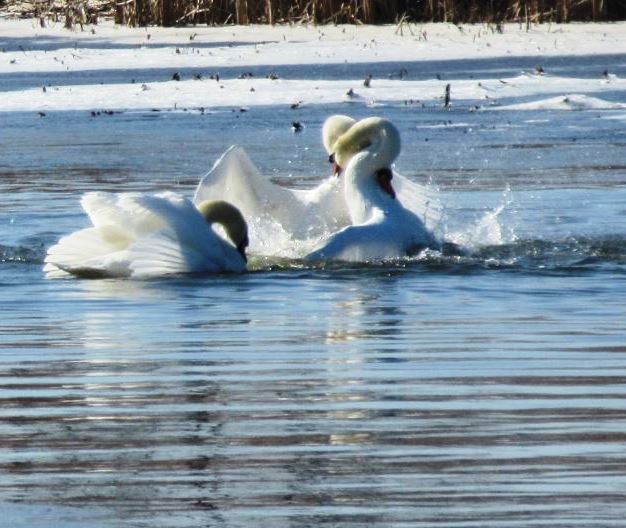
The fracas eventually ended at the shoreline, after one swan tried to get away, with the others in pursuit.
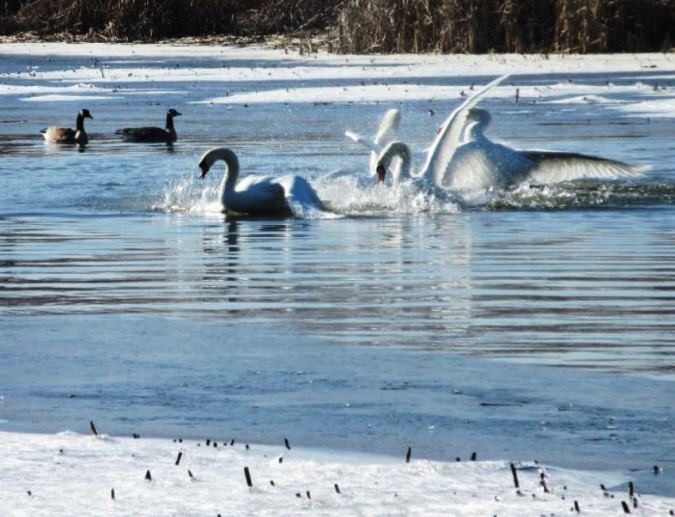
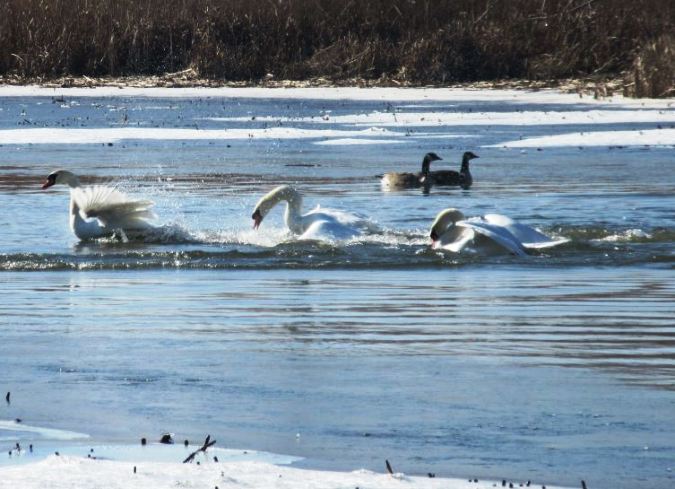
I stepped back as they got closer to me.
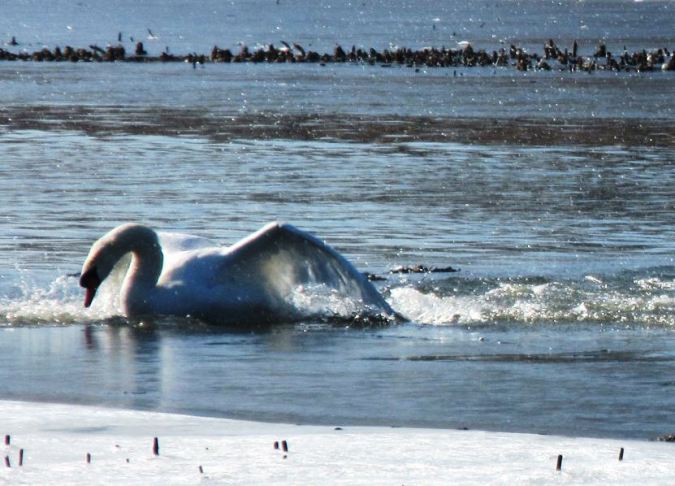
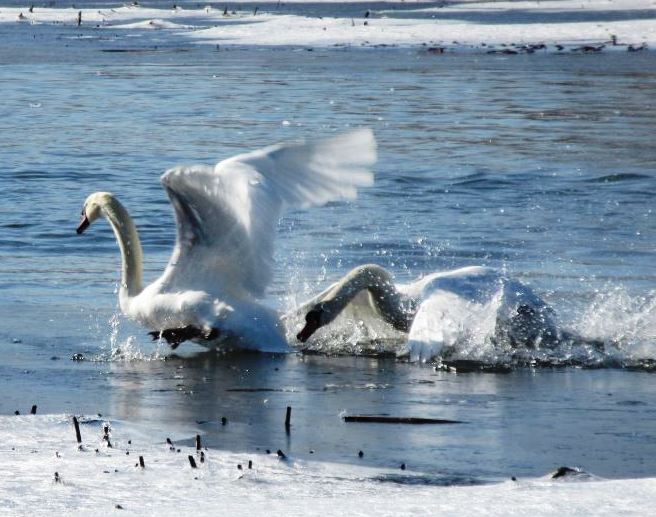
And this is how it ended up – it was “down for the count” for one poor swan, laid out on the ice, with one swan watching and another swan standing with its huge feet on top of it. This sight was disturbing to see.
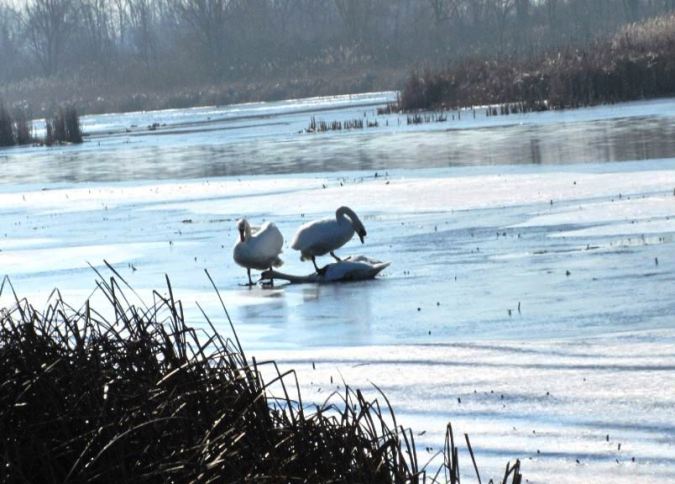
I was aghast at the brutality of the fight and aftermath which had been ongoing for about five minutes. I shut the camera off at this point. Dare I look – was that one swan dead?
No worries, the interlopers flew away, as the seemingly wounded swan righted itself a few minutes later, paddling over to what I presume was its mate.
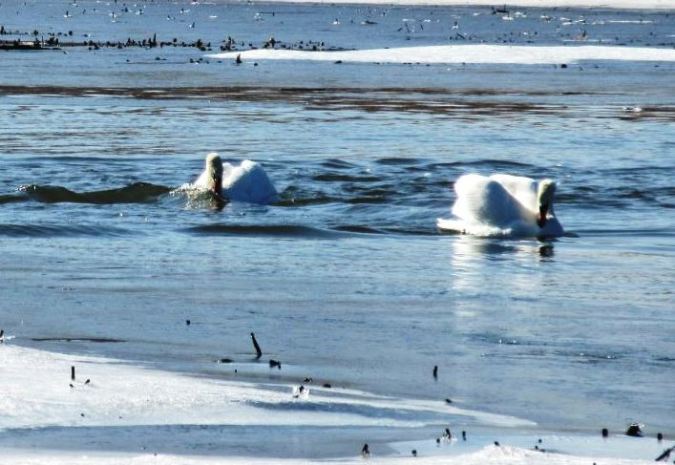
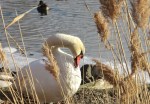
These Mute Swans, presumably the original pair, stayed in place and I got a few close-ups, which you’ll see for this week’s Wordless Wednesday.
I am joining Terri Webster Schrandt’s Sunday Stills Challenge for March 3, 2024 “Rainy Days”.



























 Linda Schaub
 WALKIN', WRITIN', WIT & WHIMSY