

I wouldn’t say 2024 was the best year ever for me … it was filled with ups and downs to be honest and began on a sour note as I HAD intended to retire on December 31, 2023, but reluctantly agreed to stay another three months.
The wacky weather was another thorn in my side.
The weather at the onset of 2024 was wacky and wild, wherein two full weeks passed without walking, with me only venturing outside to run the car. That short walk was accomplished precariously as freezing rain and bitter cold had created a skating rink that even my ice-melting product could not dissolve. Of course I worried about my furry and feathered friends at the Park, but I also worried about a slip and fall for me, so when I finally got back to the Park, while it was impossible to count snoots and beaks, I was satisfied everyone was present and accounted for as they rushed toward me when I started on the perimeter path. Perhaps it was my smiling face, but most likely the smell of peanuts perked up their nostrils.
Come Spring we had many days of rain, torrential rain. Then the heat and humidity settled in. Ugh!
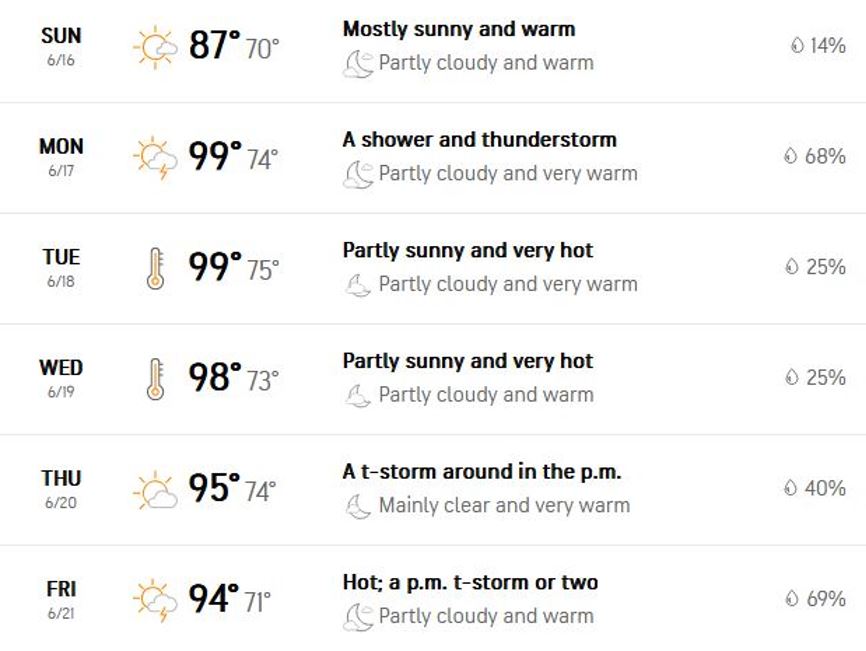
Then there was July 22nd, the hottest day recorded on Earth and smack dab in the middle of the Dog Days of Summer. Everyone was sweating that day!

This weather worrier often stewed over the stormy nights that accompanied those sultry temps. Sigh!
Our warmish Winter of 2023-2024 meant the mosquitoes and ticks didn’t die off, so we contended with those pests too!
We had a warm Fall right into November which allowed me to recoup those two weeks sans walking and some days when it was so stinking hot and humid that I didn’t step out for as long. When I got to the last 100 miles/160 kilometers, the weather got a little erratic as you see below.

Council Point Park: Paradise lost in one fell swoop.
Any minor personal disappointments were surpassed by the destruction of Council Point Park, my favorite walking venue. Here it is pictured in all seasons at the beginning of the perimeter path before “The Project”. (Note the trees along the Ecorse Creek shoreline on the left-hand side of each photo.)

To anyone who cared to listen and in my blog I bemoaned the destruction of my favorite nature nook as I have enjoyed walking there since discovering it in 2013. On May 8th, multiple earth-moving machines wreaked havoc along the entire Ecorse Creek, destroying the habitats of squirrels, songbirds and waterfowl along the shoreline, while in nesting season no less, as well as unearthing turtles as they sunned themselves on fallen logs and paddled lazily in the Creek, sending those poor creatures airborne.
The following day, upon seeing the cringeworthy destruction, my eyes filled with tears for “Paradise Lost” and for the critters, their “homes” in trees that were now haphazardly horizontal, birds with offspring still in the nests, or squirrels that were now skittish, terrified of the loud machines and grieving the loss of their offspring, similarly in the nests. One woman walker told me she saw a female squirrel, heart beating frantically, making many trips from a fallen tree, each time carrying a different dead offspring in her teeth. I’m grateful I didn’t witness that. I have written about the destruction twice, here and here.
This continues to hurt my heart.
I wish I could say it looks better now, seven months later, but I can’t. Kelly Rose, a woman who is involved with the Friends of the Detroit River, is an advocate of saving the Ecorse Creek and organizing clean-ups and assured me in our back-and-forth messages that native plants will be planted along the Ecorse Creek shoreline. To me, that will never replace the ambiance, large trees and critters’ habitats, nor offspring lost when the destruction began.
However, I now wonder about the promise of those native plants because a few weeks ago, I was walking at the Park when a landscaping crew was working along the shoreline. I watched them for a long time as they spread a teal substance which resembled lawn patch. After the patch was applied on both sides of the Creek, a machine shredded up bales of straw, which spewed out layers to cover that lawn patch. “Hmm – this doesn’t look like native plants to me” I mused to myself.
So, when the machinery motors were silent, I strolled over to inquire about the job and was told “it’s just grass patch ma’am – there will hopefully be grass come Spring” but he knew nothing about native plants that were to be planted on the shoreline areas.
As you see in this slideshow below, the stumps have been leveled to the ground (somewhat), brush and weeds removed, but the ugliness remains. These photos were taken about a week apart, before and after the lawn patch and straw were applied. Also, a few days ago the City finally installed a new park bench to replace the one the machinery mangled. It overlooks what used to be “The Point” a very picturesque area of the Park.
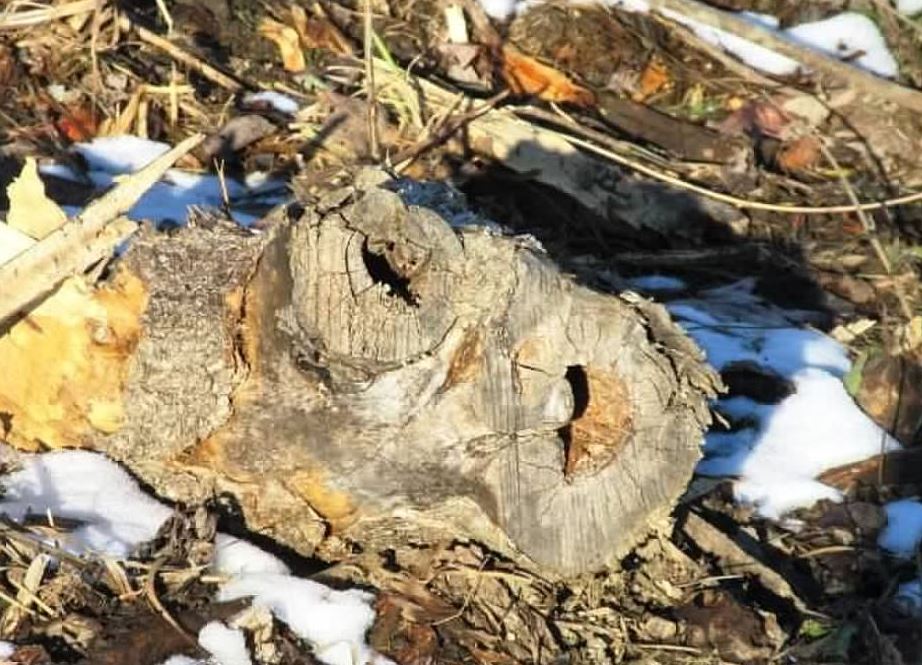
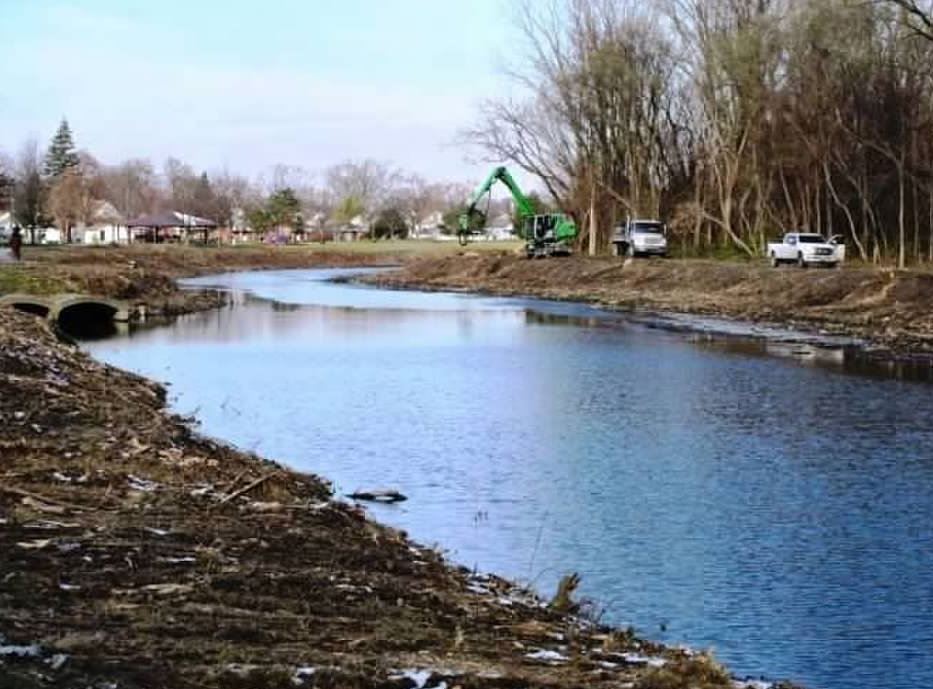
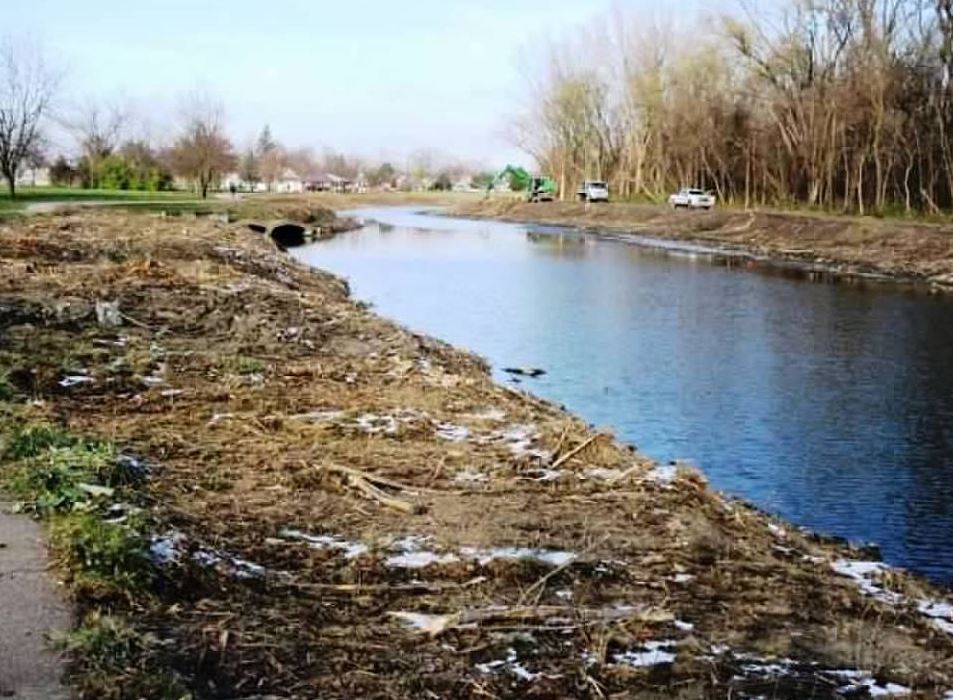


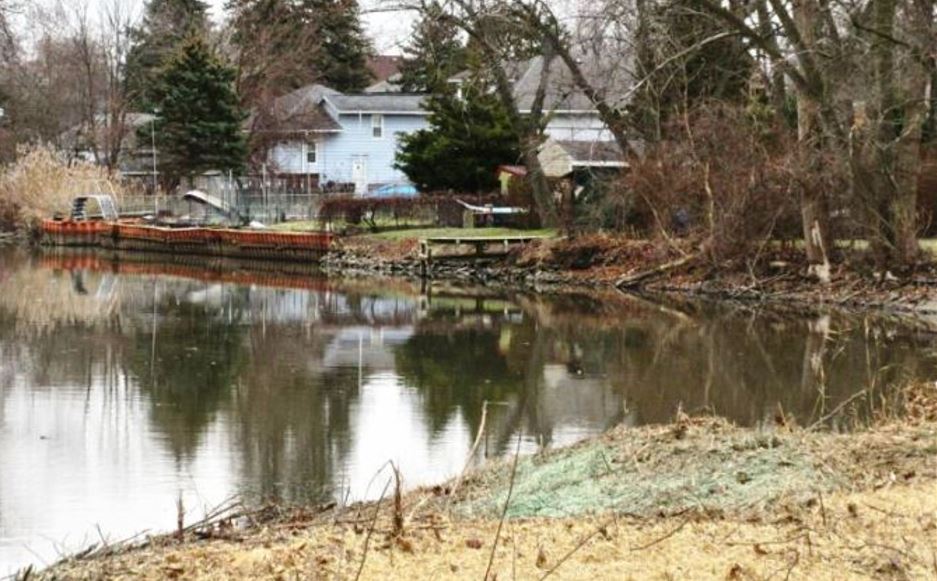
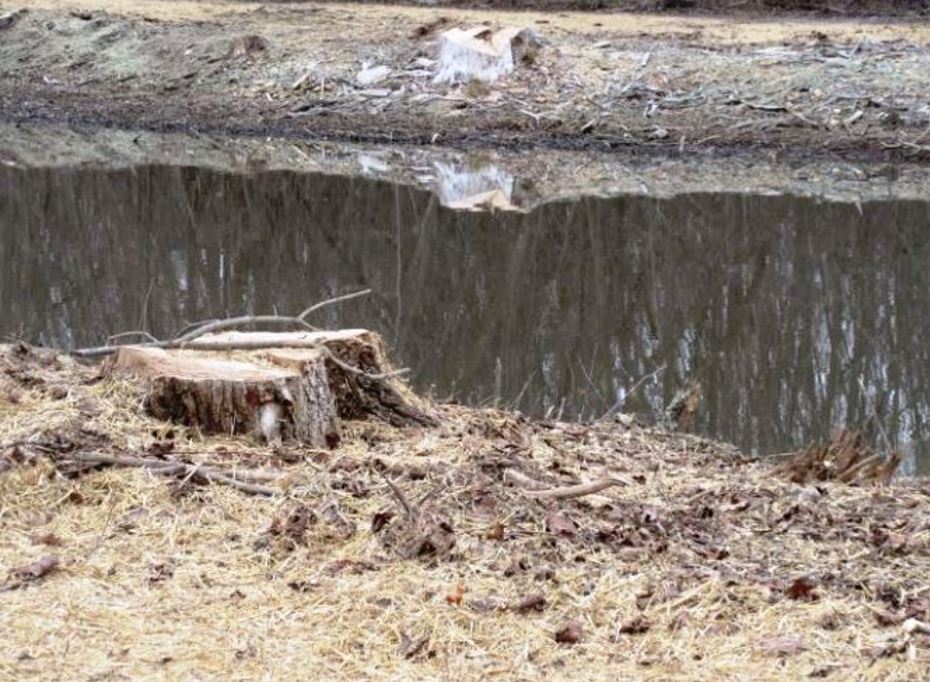

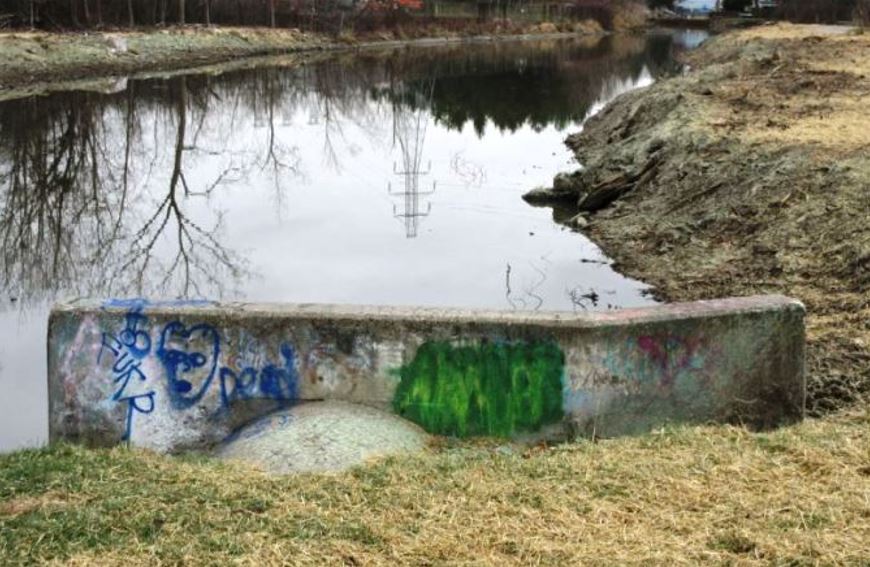
In early Fall the poor squirrels buried their peanuts for lean times, only to have them unearthed once again. No wonder some of them are still skittish and wary at times.
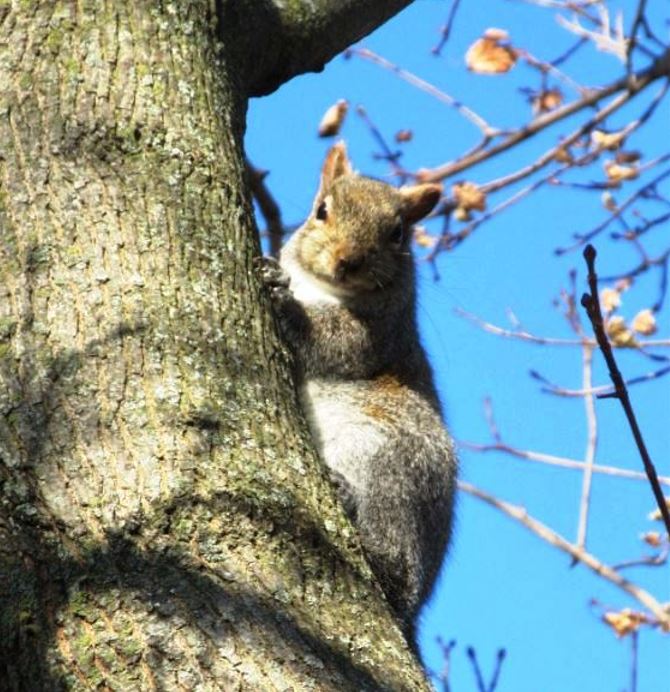

The water level is extremely low in the Creek now and it is rare to see a duck in the water these days. In recent months, we’ve had deer sightings on the other side of the Creek and there have been coyotes that have crossed over to the Park, wading through the water, not walking on ice … of course, this is not great news for the furry and/or feathered critters that make Council Point Park their home.
A ray of sunshine ….
But, amidst the negativity above, there was one small glimmer of hope I experienced on my Christmas Day visit.
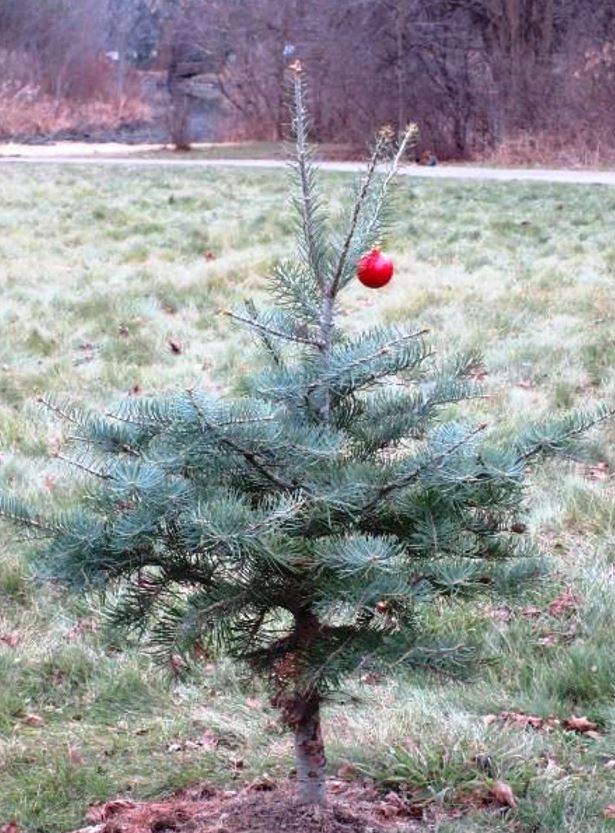
I have seen this tiny fir tree there for the past few years and I really never gave it much thought as the City planted many deciduous tree saplings around the same time. I took this photo intending to include it with my Christmas post.
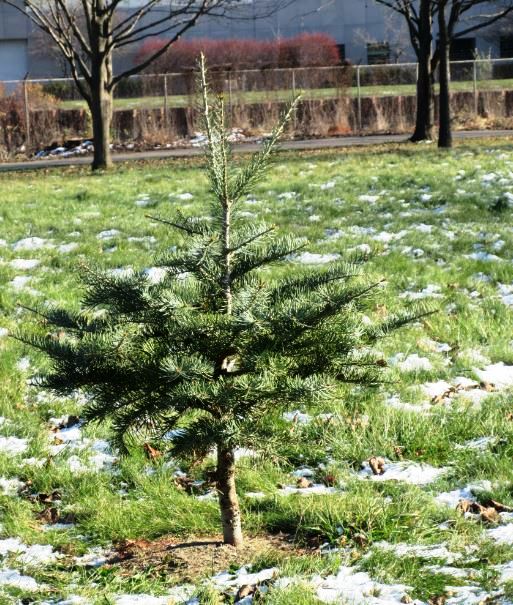
But about two weeks ago I showed up one morning, without my camera, to find this tiny tree sporting one red bulb, à la the infamous Charlie Brown Christmas tree. The next day I took my camera, half-expecting to see the bulb smashed on the ground, or gone.
Surprising, it was still there, so I took this photo to use along with the squirrels for my Christmas Day post instead of the original photo.
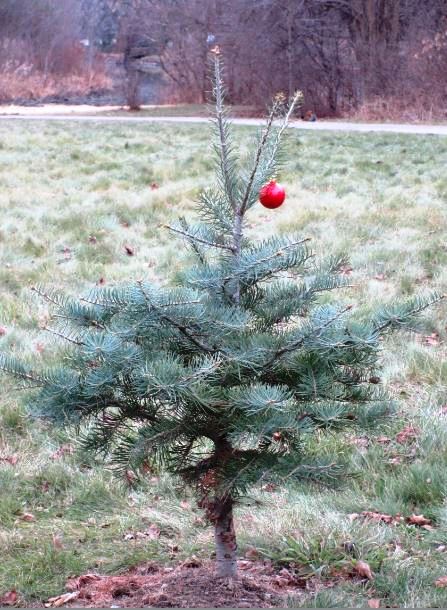
To my surprise, on my Christmas Day walk, a male walker, whom I only run into sporadically, pointed out how festive “his” tree looked. Of course Your Roving Reporter had to dig into that whole story and I learned that he had one of those small Christmas trees in a pot at home. It was getting big, so two years ago he and a buddy planted the tree along the perimeter path. (Luckily they didn’t plant it on the opposite side.) The tree “took” and is thriving, several feet tall now and he decided to bring one red bulb and place it on the tree. Well it brightened my spirits after seven months of looking at the remnants of what had once been a beautiful venue.
Now on to a few more positive notes about my year and yes, I realize this post will be very long, so I will be doing my favorite pics of 2024 post next week.
For the 13th straight year, I met my walking goal!
Aptly, I put a bow on my 2024 walking goal (1,257 miles/2,024 kilometers) on Christmas Day. I had five more miles left and with the threat of multiple days of rain and/or fog looming, I figured I’d better just get ‘er done. I waited until mid-day when I knew there would be no slick spots and ventured out. Yay! You know the drill – for 2025, it will be one more mile (1,258 miles/2,025 kilometers).
However, unlike the gingerbread girl pictured above, I was not hampered by snow in the waning days of 2024 as to my mileage goal. In fact, yesterday we enjoyed balmy weather: 58F/14C, some 24 degrees above normal. Not exactly Winter weather, but I’ll take it!
So, onward and upward for 2025!
Even my 15-year-old car got a workout as I put a whopping 1,545 miles on it in 2024. I know fellow bloggers Ruth and JP will be patting me on the back for sure with those stats! 🙂
Retirement is bliss; I rather like being a lady of leisure.
Nine months ago today I retired … Good Friday, 2024.
I was 67 years old … two weeks before I would turn 68 and what better incentive to just do it after reading this earlier in the year?

So, post-retirement … have I been productive, or was I a slacker? Well … ahem, if we are discussing walking miles, I did well and, if we are discussing blog post productivity, I churned out 106 posts. I can’t fathom how many photos I took – whew! Great Linda, those are fun things to do, but, if only everything else I planned (in my head) would have wrapped up so nicely by year-end, I’d have been thrilled.
WordPress decided Windows 7 was passé …
Well, thank you for doing that WP and, when I could no longer create a post without it freezing every few sentences, it was time to upgrade, something I had avoided doing for many years. Windows 7 was comfortable, like my walking shoes and it must be a sign of getting older, resisting change and all. So the upgrade was a pain and cut into my DAILY TO DO CHART but it got done … I had no choice.
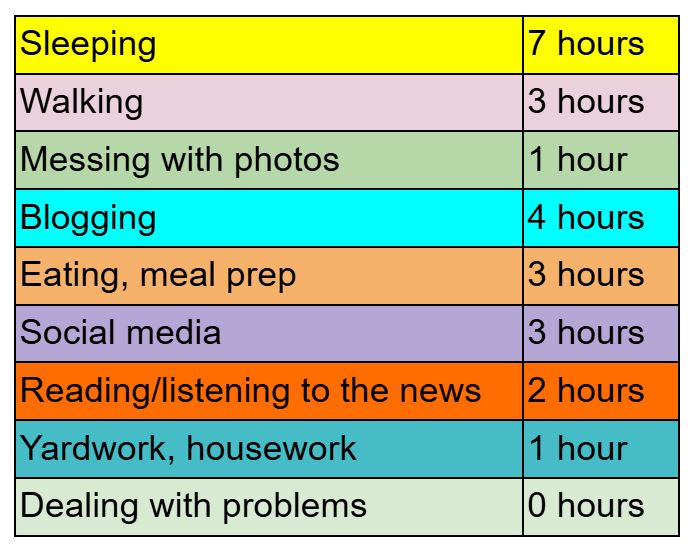
Accomplishments and/or new ventures.
By the end of September, I took stock of my accomplishments in the six months post-retirement and my brow furrowed a little. Sure I had walked my socks off and taken a slew of photos but I had not accomplished a heck of a lot otherwise, despite my good intentions.
As to walking, sometimes it didn’t really feel much like anything was different, except having the ability to go on longer excursions at bigger parks on weekdays. I continued rising at the crack of dawn, still heading out as soon as it was light to enjoy the coolest part of the day, so old habits never died in that respect.
Then, along came September and the advent of Fall. All of a sudden the sun was rising later and later and a little bell went off in my head when I realized I no longer had to scramble to get my miles walked and hurry home to get ready for work … I could leave later and still get a long walk in.
It was finally time to shake off that mindset and embrace retirement – right?
But Linda – what about all the lists of things you wanted to accomplish?
Since I announced my retirement in my Easter post, a few of you have told me “you have all the time in the world – relax” or they suggested that “the retirement agenda and things you wanted to accomplish will eventually fall into place – you just need to find your groove.”
I took all those recommendations to heart – really I did. But, um, six months later and all I had accomplished was finding five new venues to visit, walk and take photos of. And I had done a lot of walking down the beaten path (and along that *&^# beaten path I had a tick hitch a ride on my ear – grrr).
But, did I get my house decluttered of work clothes and accessories I won’t be wearing in this retirement phase of my life? Well I half-heartedly embarked on that project and, after initially digging my heels into that task I proudly carried ten or more bags of garbage to the curb. Then I had to curtail that venture since the City switched garbage collection companies on July 1st and it took them about six weeks to get themselves together, sometimes not showing up for several weeks at a time So, I tabled that project to the new year now. in the depths of Winter to tackle it in earnest. Fitting household projects around walking, photography, blogging, reading and other hobbies, it seems housework takes a back seat.
Hobbies you say? What hobbies?
As September drew to a close, I sat nursing my coffee after returning home from a five-mile jaunt and took stock of stuff … “stuff” being my life.
What happened to all the retirement resolutions about hobbies I made? They were in the cloud, the cloud being in my head as I didn’t write down any lists. I had hobbies I wanted to pursue … taking some art classes, learning a language, reading more – had I accomplished any of these things? No!!
Procrastinate much?? I admit I am critical of myself most days.
So, in October I began dipping my toe in the water …
One item on my Retirement Bucket List was to learn how to sketch and paint, the latter so I may eventually join a plein air painting group when they have “paint-outs” where they gather at various large parks that I frequent and paint the landscape. I’ve written about the group in the past and I am in their Facebook group so I see where they go and what they paint. After meeting them the first time I took a free watercolor painting class down along the Detroit River at Dingell Park, went home, ordered lots of art supplies from Amazon and everything is packed in a box awaiting me to be inspired and begin.
So I signed up for a watercolor class taught by a local artist who is also a high school art teacher and on October 9th, off I went to learn how to paint still life pumpkins and I produced this painting which will never hang in the National Gallery of Art or The Louvre, but it was fun.

In fact, I intended to book myself for a second class but could not as the venue lost internet/phone/power so when that fizzled and died, I took an online watercolor tutorial instead. It will be a while until I’ve got the chops to join the group … practice makes perfect, right?
I resolved to study French and began doing so online after a 46-year absence from speaking or writing it. French was mandatory in Canada, so I took it from age five to ten and resumed throughout my college years; in fact, the last two years of our advanced French class we were not permitted to speak English. I thought I’d have an advantage, but other than remembering numbers and simple words like dog, cat and cow, it’s been intense with lots of grammar and loads of vocabulary words (750 to date) and verb conjugations (ugh) – today is Day #66. Brain strain for sure!

In the last quarter of the year, I started and finished four books before year-end and hope to become the avid reader I once was.
After wavering back and forth about the backyard perimeter gardens destroyed by the downed wire fire in December 2022 and the last Polar Vortex, every time I went into the backyard, I wavered on simply laying down sod versus a new butterfly garden. I had the back garden debris and tree stumps removed, new retainer walls put in and mulch laid down. As of now, I’m hoping to start a perennial garden come Spring; my only concern is if we have another extraordinarily hot Summer … or, for that matter, erratic weather going forward. It is a lot of work – do I want to dedicate that much time to it? I have awhile to ponder over it at any rate.
I guess if I had to pick a word for 2025, it would be this one … soon I will begin the 2025 version of tallying up my steps and I hope they continue to be long and leisurely walks, the best kind.

Your New Year’s greeting from me will arrive in this week’s Wordless Wednesday.
I am joining Terri’s Sunday Stills Photo Challenge this week and next: “Your 2024 Year-in-Review!” (in photos)





























































 Linda Schaub




























 WALKIN', WRITIN', WIT & WHIMSY