Leaves were falling, temps were falling, but …

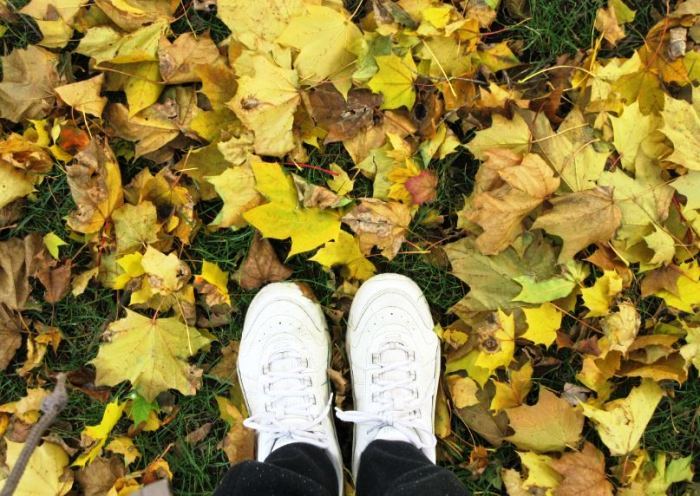
… no raindrops or snowflakes were falling, so happily I set out to glean some steps, amass a ton of photos and simply enjoy myself. It was a perfect Autumn day and I aimed to make the most of it. I knew the beautiful leaves were slightly past their peak and mild weather was on the wane. There was talk of the “s” word and snowflakes a’flyin’ in the coming week.

At the end of that day, worn out from walking at three parks, then working in the yard for four hours, the pedometer registered a little over seven miles, since heading out in the early morning hours of November 6, 2021.

My first stop of the day was the 44-acre Refuge Gateway of the Detroit River International Wildlife Refuge (“DRIWR”) located at the Trenton Channel of the Detroit River in Trenton, Michigan. I follow the DRIWR on social media and they had touted a hiking event from 9:00 a.m. to 10:30 a.m.; I wasn’t participating in that event, thus I wanted to be early to beat the crowd.

You probably noticed that DRIWR has the word “international” in its official lengthy moniker and this is for a reason: it is North America’s only international wildlife refuge, with the U.S. on one side of the Detroit River and Canada on the other.

This was my fifth trip to this venue since my initial visit in October 2020, shortly after it opened. Even before gas prices were sky high, I usually made a weekend morning out of visiting these three shoreline parks: Lake Erie Metropark, the DRIWR and Elizabeth Park as they are all located within a six-mile area.

Unbelievably this visit to the Refuge would be a totally critter-less trek. How could that be possible? I failed to see a single Ring-billed Seagull, usually a perpetual visitor at any shoreline park. I had hoped to return home packing photos of the abundance of roosting Double-crested Cormorants I spied in the trees across from the fishing pier during the “Walk for the Wild 5K Challenge” on October 9th. Evidently they had flown the coop with just the many nests dotting the trees.

The weatherman said it was 32F/0C with a heavy frost and high humidity. As I dressed I decided another layer or two was in order as I’d be down by the breezy shoreline and likely would be grateful I had bundled up.

As I walked down the hill from the parking lot and past the Prairie Habitat, I noticed the Milkweed pods were either closed up tight or spewing wisps of white fibers which glommed onto the frost-tipped grass and, even in the dim light, on the horizon I saw Humbug Island’s trees were either blah or bare.

In the distance, the sun was slowly filling in the sky casting its rays ever so slightly onto the 700-foot/213-meter-long Korneffel Fishing Pier.
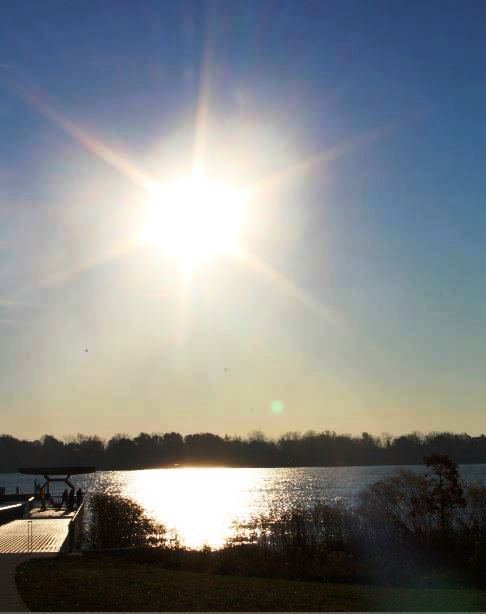
As I peered down that pier that juts out into the western Trenton Channel, just a few fishermen dangled their lines, hopeful for a bite from some of the 113 species of fish in these waters. The Korneffel Pier is able to accommodate 100 persons at a time, so I wondered if the rest of the anglers begged off due to frozen fingers or they had other fish to fry on this frosty morn?

As I stepped onto the Pier, I felt my lug-soled hiking boot sllllllide a little and I went to grab the railing. I had been momentarily blinded by the sun and failed to see this layer of frost on the Pier, which is comprised of metal and a Trex-like material. Suffice it to say, I backed up posthaste – no way was I going to walk that Pier until the tail end of the trek.
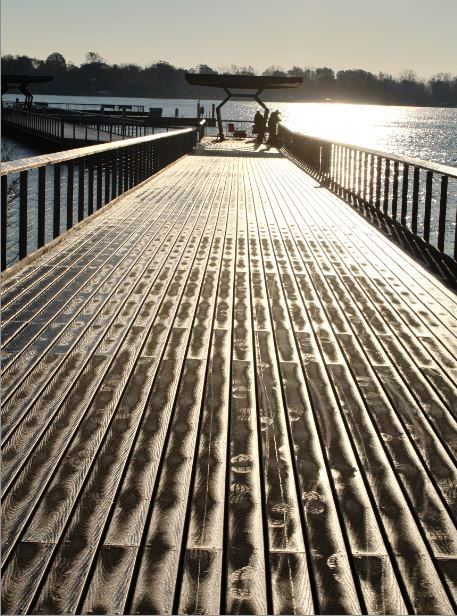
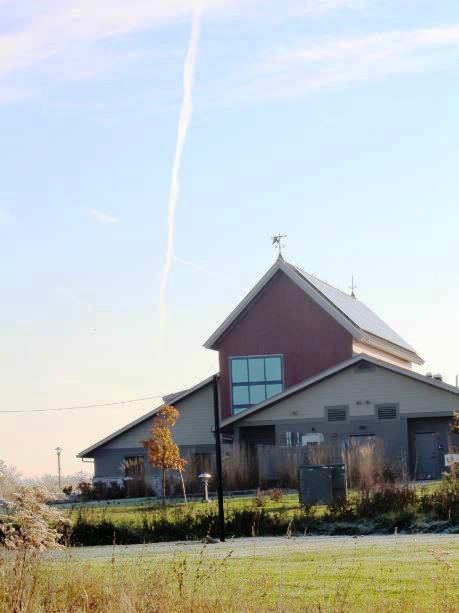
So, I hiked back up the hill as the sun was climbing high in the sky. I passed the Visitor Center where I saw the scrawls in the frost, likely the handiwork of the Visitor Center workers.
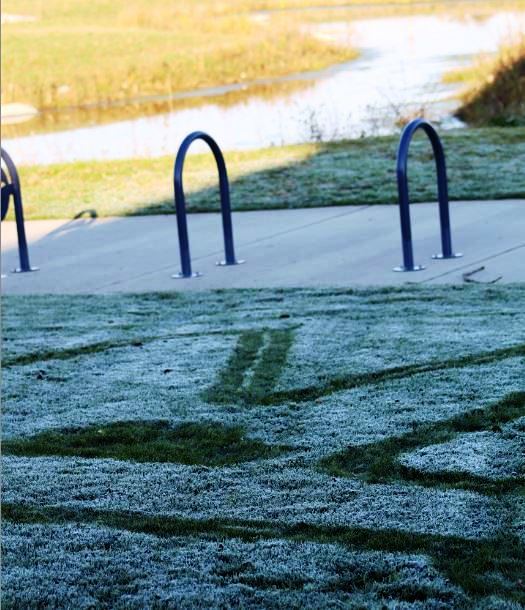
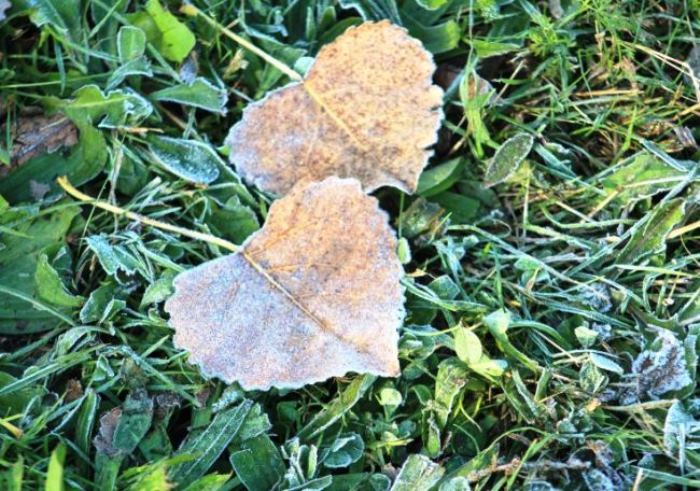
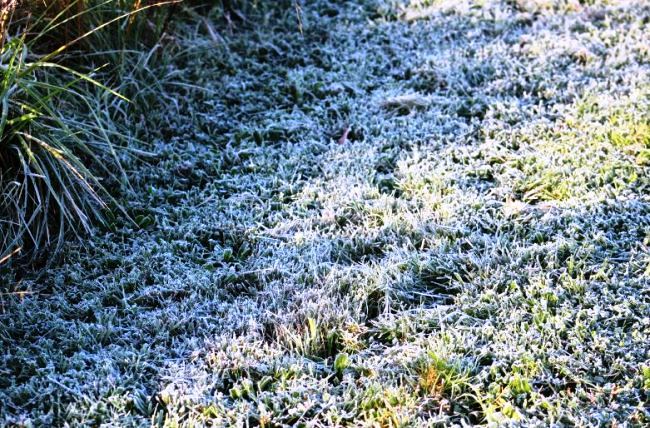
As I meandered along, I began noting that the heavy frost had left leaves looking like Frosted Flakes cereal and in spots, the grass looked like Mother Nature had sprinkled icing sugar onto it.
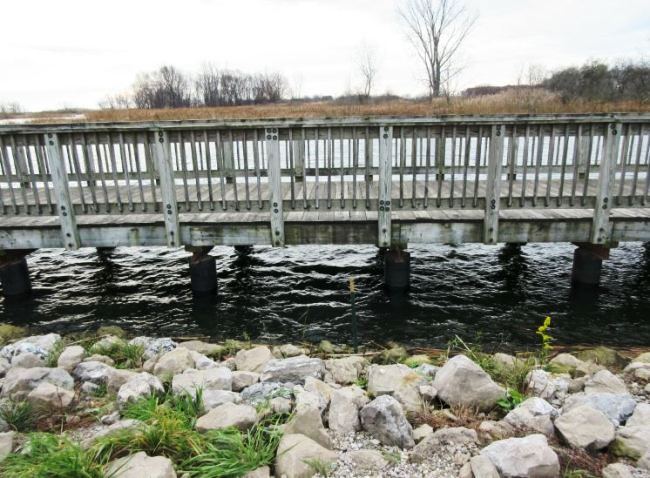
I approached the Monguagon  Boardwalk which crosses over the Delta. I was hoping to take photos of any Herons or Egrets fishing for breakfast, but I struck out and once again was thwarted by heavy frost that had slickened up that walkway.
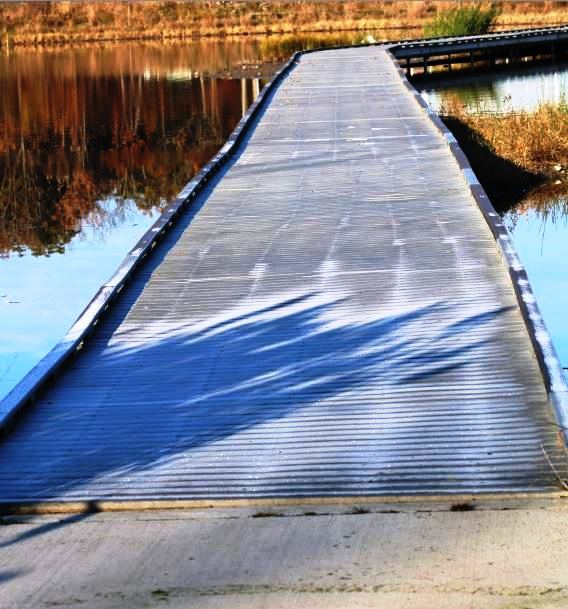
Call me a ‘fraidy cat, but I won’t cross the Boardwalk if there’s any wind, because, as you can see, there is no railing and it is a similar material to the Fishing Pier, so I had no intentions of crossing the Boardwalk with this frosty glaze and perhaps slipping and falling into the water.

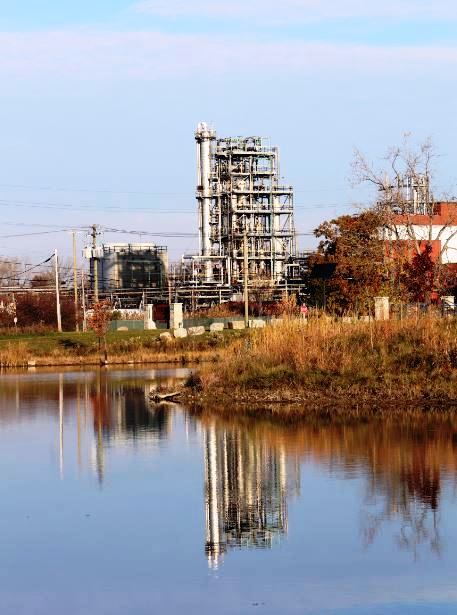
Finally the sun was up and bright so I got some photos showing the reflections on the water at the Delta. The entrance to the DRIWR and a sizable portion of the Refuge run along West Jefferson Avenue, in the heart of an industrial area, so I am usually careful not to include nearby industrial plants, nor the red and white “Trenton Stacks” which rise from the Trenton Channel Power Plant, in my photos.

I made an exception today due to awesome reflections and to illustrate how industry and nature co-exist here at the DRIWR.

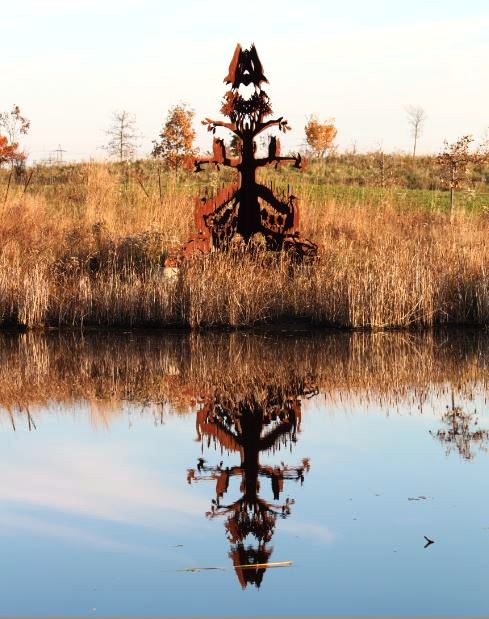
There is some artwork that appears on the fringe of the Monguagon Delta. I scoured the internet to see what this is and who created it to no avail.
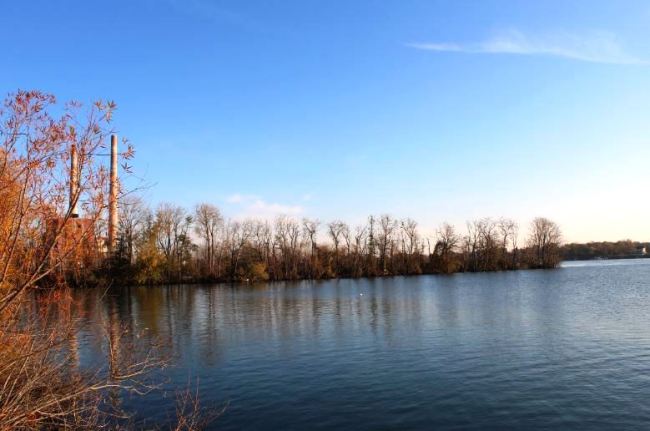
This area is the part of DRIWR that hints that industry once was king. The Trenton Refuge Gateway was originally the site of a Chrysler manufacturing facility that was deactivated in 1990 and unbelievably it took two decades to morph from that former industrial site into this natural Refuge. In this photo you see how the picturesque background is marred by the Trenton Stacks mingling with a row of tall trees
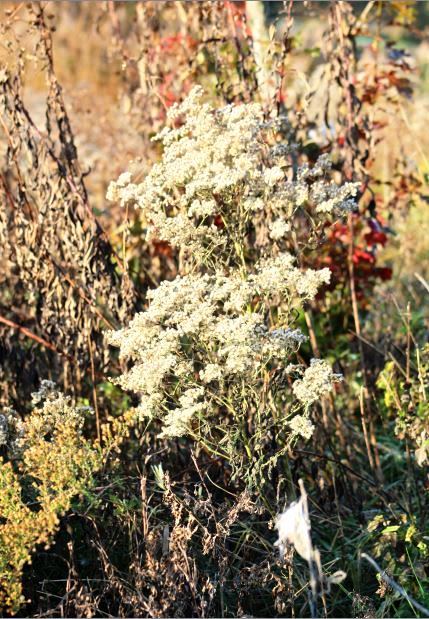
The landscape was blah as we had a hard freeze earlier in the week which zapped most of the vegetation, though the occasional wildflowers or colorful weeds had been spared.
Humbug Island was wearing its Autumn colors and some trees were already bare.
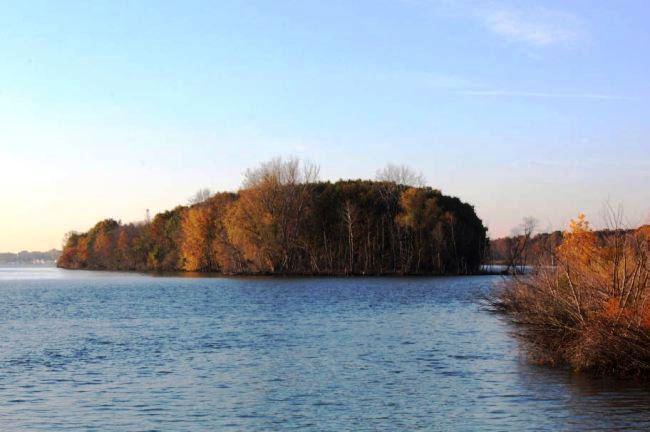
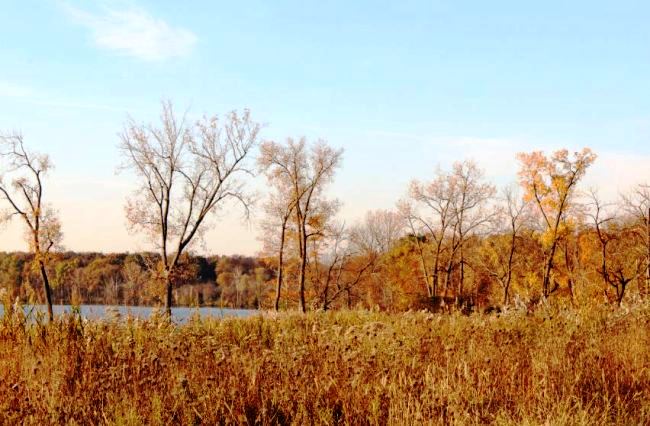
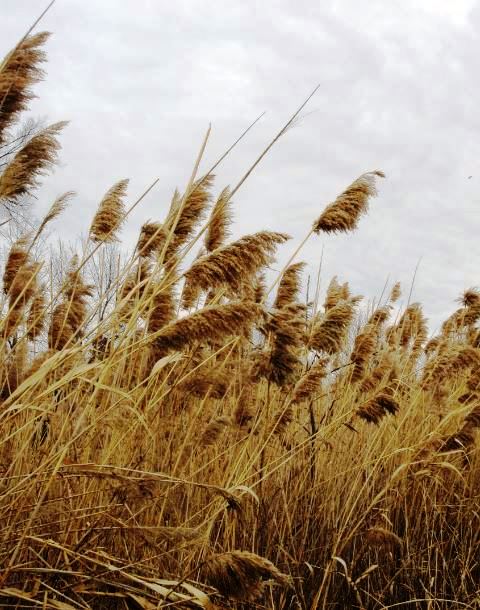
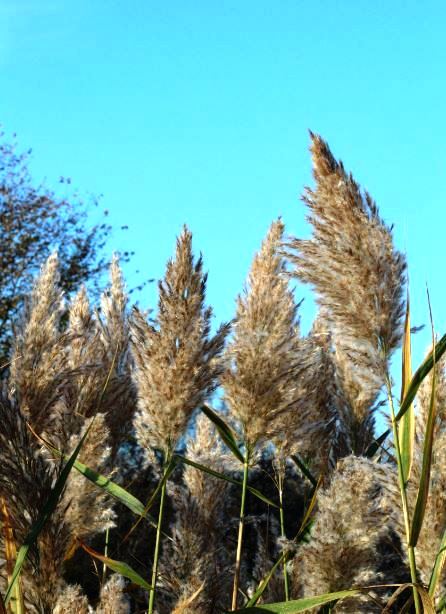
At a glance, the ever-present Phragmites resembled shafts of wheat.
Perhaps a jaunt at Humbug Marsh would not be slick and net some photos?

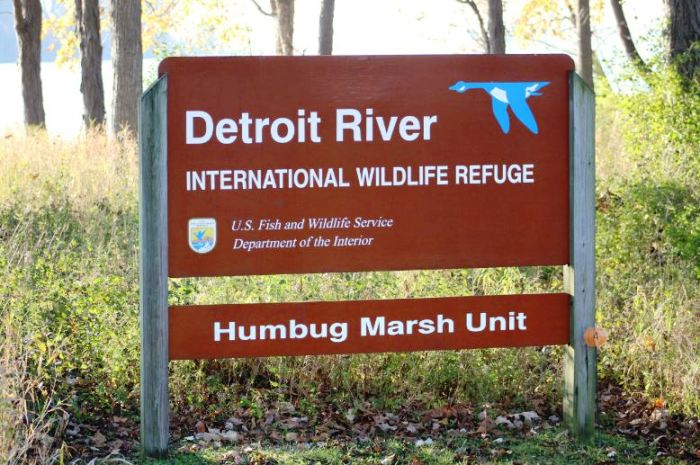
I figured I’d hike over to Humbug Marsh, a pristine 410-acre parcel of land that contains the last mile of natural shoreline along the U.S. mainland portion of the Detroit River. The other 97% of the Detroit River shoreline has been disturbed or otherwise destroyed.
There are several wooden outlooks, one with a pair of high-powered telescopes hidden within a bird blind that resembles a bird’s-nest. Other wildlife observation areas are outfitted with Adirondack chairs, including one near Eagle Point, where, if you’re lucky, you’ll see a pair of nesting Bald Eagles. The remaining outlooks all offer a superb view of Humbug Island, the waterfowl and a total of 300 species of birds that frequent the shoreline, migrate through and/or flit through the forest. Every visit I’ve looked around to find such hidden critters as deer, mink, otter or even an Eastern Fox Snake. I’ve not seen any of these four critters, nor the eagles and I can live without seeing the snake, though I’d like to see it from a few paces away . Within Humbug Marsh is the “Old Growth Forest” so named for its 300-year-old trees, including some very tall and spindly Shagbark Hickory trees. As I approached that area I thought to myself “surely, frost will not be an issue here – I’ll just walk on the Orange and Green Trails in the forest and stay off the elevated walkways which are made of the same material as the Pier and Boardwalk.”

So how did THAT work out Linda?

I passed this new contraption at the entrance to Humbug Marsh which subtly announced to me that the trails might be muddy, so here was something to scrape the mud off your footwear.
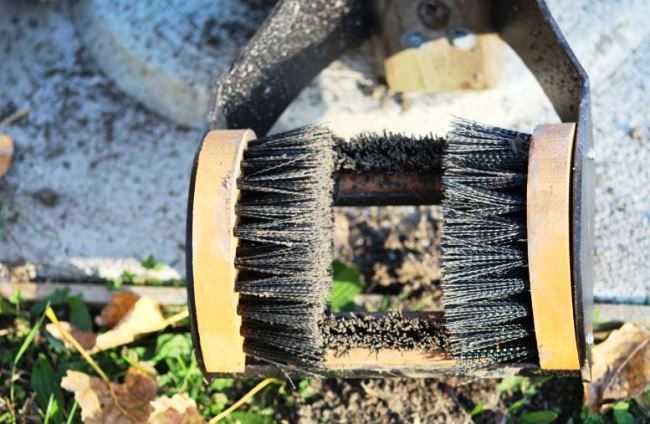
Still grimacing a little over the aspect of muddy shoes, I stopped to read this posted sign.
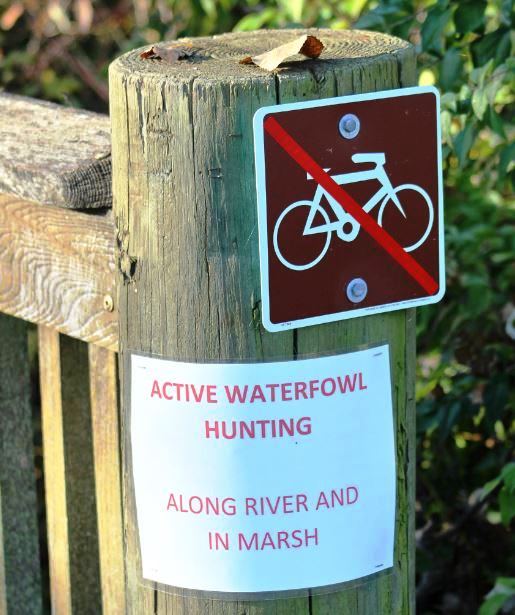
Well, I was disgusted and quickly turned on my heel to leave. While it is already disconcerting to me, a nature lover, to hear the barrage of gunshots from nearby Pointe Mouilee during duck-hunting season, I sure didn’t like reading that waterfowl hunters were right along the shoreline of the Refuge … that didn’t sit well with me at all.

I made another stop at the Pier to check on those Double-crested Cormorants. The early frost was gone, but the walkway was still slick. No worries as there were nests, but I didn’t see any birds.
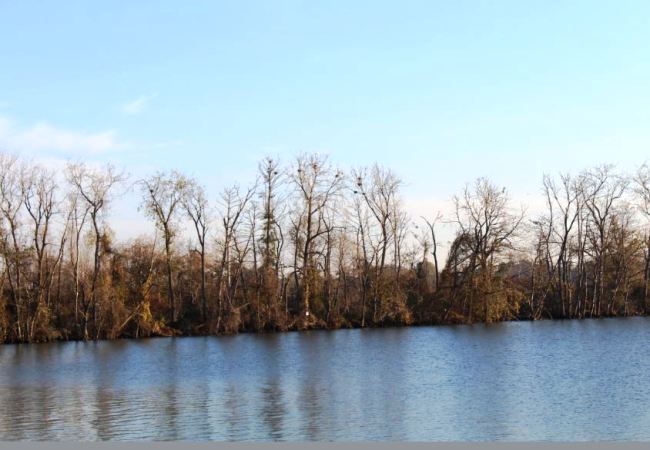
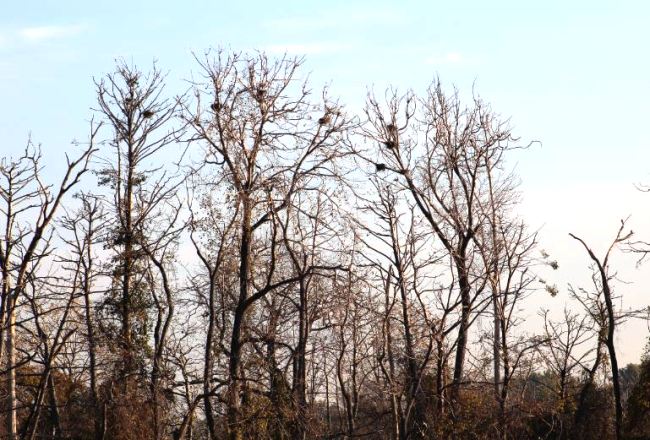
At least I saw a contrail over the Visitor Center as I headed to the car, after what was a very unremarkable trip here at the Refuge.
I was hopeful for a better i.e. more interesting walk at my next stop, beautiful Elizabeth Park, a venue that never disappoints. That trek will be next Monday’s post.

Posted in nature, walk, walking | Tagged , , , , | 61 Comments

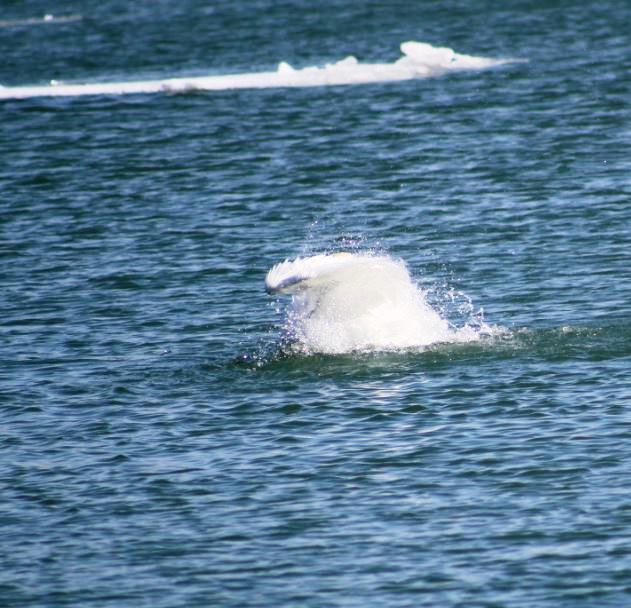
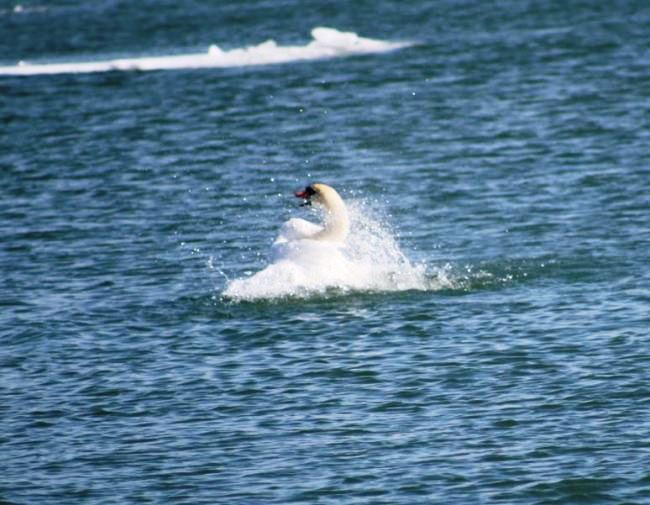
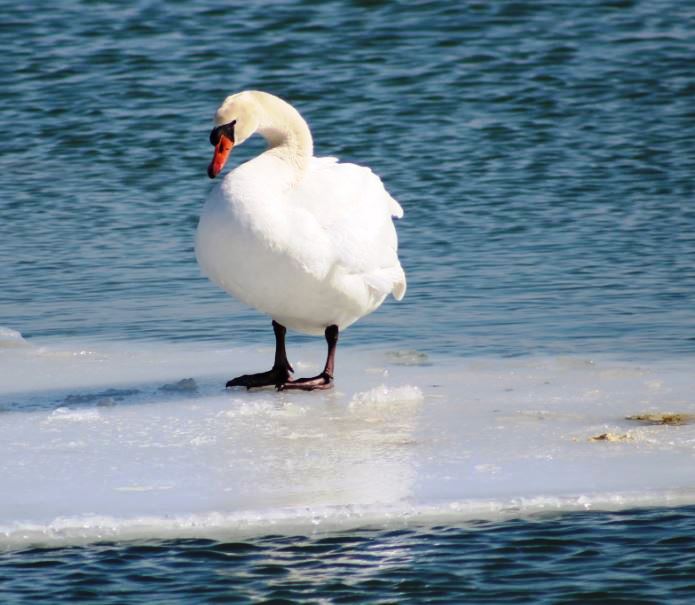
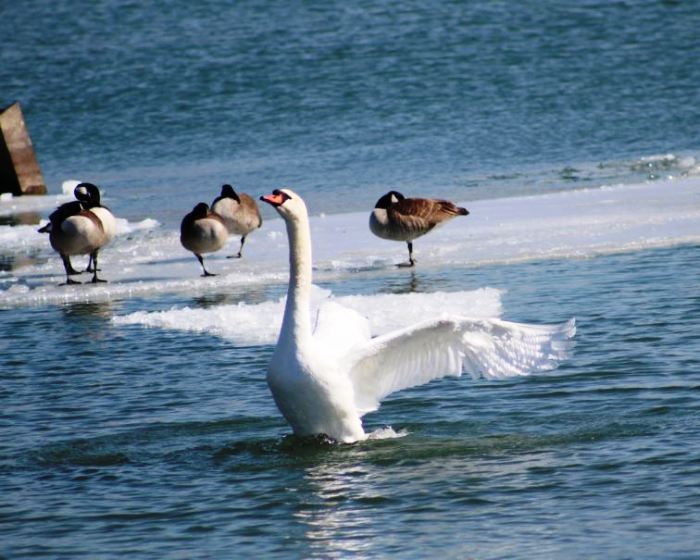
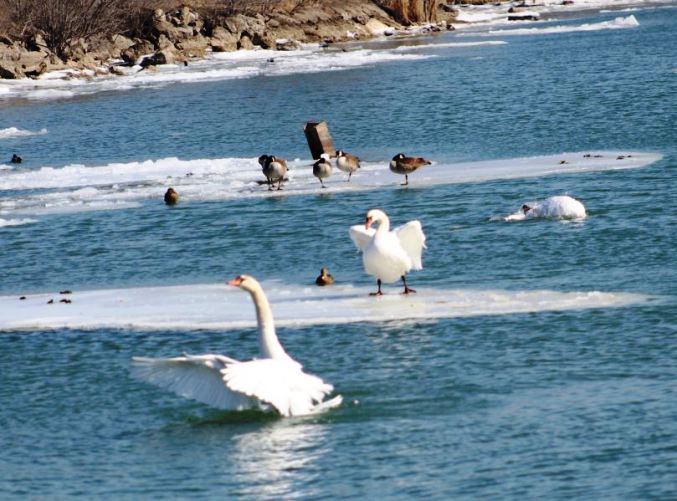
Swan sun salutation.  #Wordless Wednesday  #Wake up and greet the day!

Wordless Wednesday – allow your photo(s) to tell the story.

Posted in #WildlifeWednesday, #Wordless Wednesday, birds, nature | Tagged , , , , | 48 Comments

A tale of two seasons.

It’s Saturday afternoon and, while I write this post, still another wintry mix lingers, translating to a missed walk for me and capping off a rainy and unsettled week. I can hear some songbirds, likely Sparrows, tucked in a neat row on the back windowsills, seeking shelter from the elements and twittering softly. It’s almost one week into Spring, yet feeling like Winter as the two seasons clash with one another. Of course I continue to gripe about the weather and the toll it is taking on my walking regimen, (not to mention my final goal), but admittedly, after seeing images of the devastation from tornadoes that barreled through several states earlier this week, I’m content to sit here, cozy and warm, grateful to have a roof over my head.

At long last, I will be transitioning from almost-real-time posts to some treks taken last year. So, I’ll be skipping back two seasons for now, then reaching wayyyyyyyyy back with a collection of treks taken in three different seasons at the Henry and Clara Ford Estate. I’ll keep plugging along and, with the exception of an Easter post, I hope to be (and stay) current by Mother’s Day. Maybe the goslings at Council Point Park will make their debut by then for some cute Mom and baby shots.

This trek was taken on Saturday, November 20th. Glancing back at my notes I jotted down that day, we had some ugly weather on the horizon. The Thanksgiving week forecast was paired with suggestions ranging from “get your snow blower tuned up now” to “find your snow boots, shovel and ice scraper!” Yikes!

I had thought it might be fun to make that 30-mile roundtrip drive out there this weekend and compare a late November landscape to a late March landscape, a tale of two seasons at the same venue. Essentially the landscape would be the same … blah and boring, save for the brightly colored buoys piled up on the dock in the boat launch area, or the sighting of a Robin Redbreast trying valiantly to score a worm breakfast in the soggy, but still-cold ground. Its frustration would make me smile as I would watch it repeatedly jabbing its beak into the grass and coming up empty. But, I am a realist and know the trails would be flooded, so I’ll wait a little longer to venture there or to any shoreline parks.

So was this trek a final Fall fling???

After lingering at Council Point Park to feed my furry and feathered friends and walk a quick one-mile loop on the perimeter path, I headed to Lake Erie Metropark. I was taking my sweet time driving out to that rural area as it was rutting season and I didn’t want any unexpected car versus deer meet-ups in the early morn. It would be my first trip to this venue since that sweltering hot day over Fourth of July weekend when I was so enchanted with the fawn.

The sun was absent, the marsh area a little meh and the occasional 15-mph wind gusts made the leaves that carpeted the grounds dance around my feet. As had been the norm for most of the Spring, Summer and Fall months, the sunny and picture-perfect days seemed to be reserved for weekdays only. Well, I aimed to make the best of this day, rationalizing this may be a final Fall fling for a long nature walk.

It was downright chilly. I was wearing my flip-back mittens with gloves underneath, but that was not warm enough and my fingers were cold ten minutes after my arrival. The wily wind seemed to slink up my coat sleeves and swirl around my neck, even threatening to yank off my wool cap. But I was going to stick it out anyway.

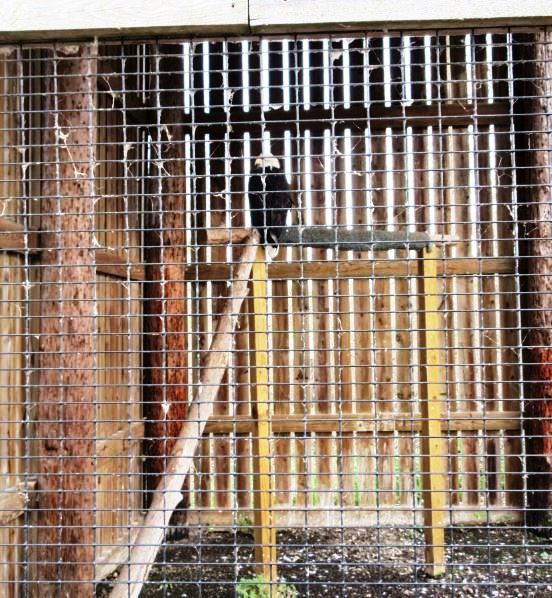
My first stop was at the Marshlands Museum area to visit Luc, the resident eagle. That is Luc’s enclosure to the left.

I called out a hearty hello as I neared Luc’s enclosure. “Good morning Luc” I said and I was rewarded with a loud chirp. “Good boy” I told him as he checked me out with a backwards glance, swirling his head around, but remaining facing the wall. Luc is this park’s resident eagle, rehabbed back in 2009 after being injured in the wild in the Saginaw Bay area. Luc is not releasable as he is blind in his left eye and has an impairment of his right wing rendering him unable to fly, thus his permanent habitat is here near the Museum area. I chatted with Luc a few minutes, took some photos, then moved on.

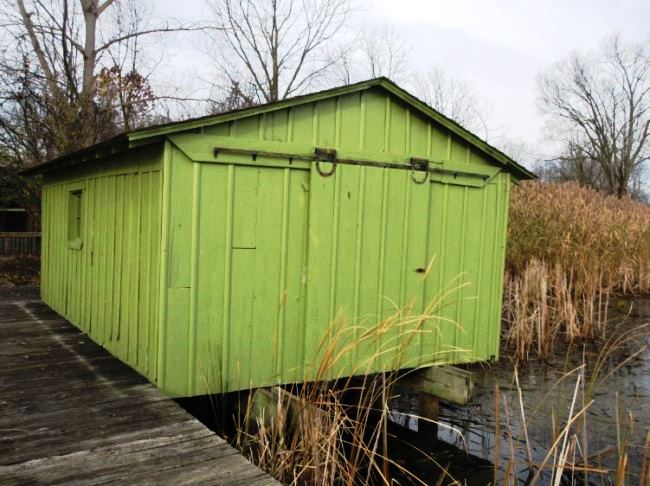
A footpath leads from Luc’s enclosure to a wooden overlook. The boathouse straddles the marsh at the overlook.

It was quiet and peaceful. The sun was trying hard to make an appearance as I gazed at the maze of dried-up reeds. Here you can stand and watch the waterfowl.

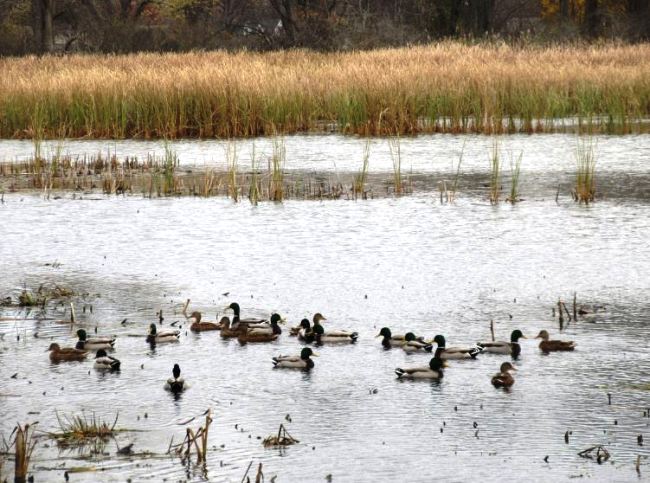
A paddling of Mallards was near the reeds. They scattered quickly when they saw me, quacking away – no, I didn’t take it personally. Some of the ducks zoomed over closer to two Mute Swans that were alternately preening and diving for breakfast. The swans seemed uninterested in protecting the ducks from me and went on about their own business and paid me no mind. On occasion I’ve seen a Great Blue Heron, or a Great Egret in this marsh area, but they were MIA that day. So, I struck out here on getting any nice close-ups and, with the exception of Luc’s chirpy reception, the rebuffing of the ducks pretty much set the tone for the balance of my walk.

Along the way

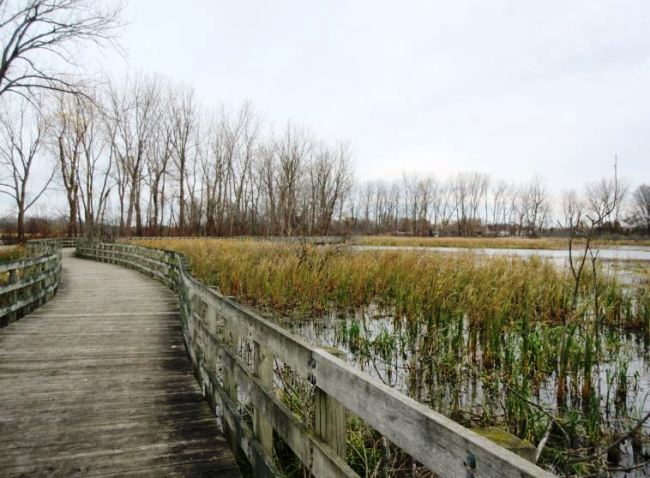
I retraced my steps and headed to the long and winding overlook that runs parallel to the road leading to the boat launch area and eventually the Cherry Island Trail.

Despite the cold temps, there was no ice, but the water was wavy as you see in this lagoon area. I stepped off the outlook to take a photo.

This was another pair of Mute Swans.

Here is a photo of the boathouse across the lagoon and the original swans hanging out with some ducks.

There was not much to see as I walked along. A few now-dormant Milkweed pods …

… and tall Phragmities were bobbing their feathery heads in the wind.

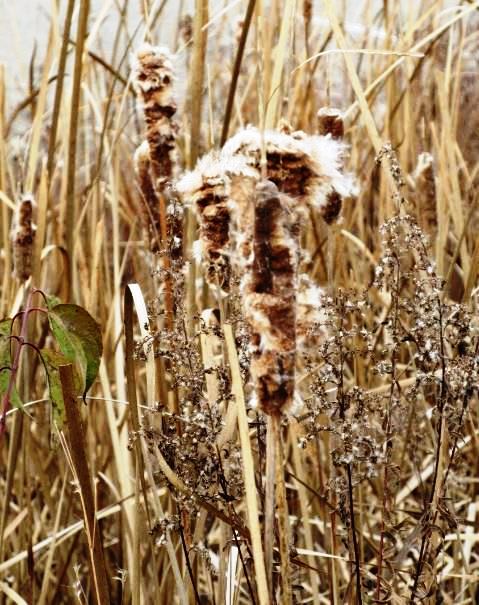
Cattails had burst at the seams with puffs of cottony fibers spilling out of them.

This marsh area sure was dull and desolate looking. The only sign of life I saw in the area was this bird.

At first glance, I thought it had something stuck on its head, trash of some sort? I took a photo, then saw the white “cap” was its plumage. Once it saw me, it took flight. I’ve seen pictures of black-and-white Magpies – was this one? I was intrigued and that night a Google search told me it was not a Magpie, but maybe a White-headed Woodpecker – maybe you know?

A skein of geese flew overhead.

Were the geese headed for warmer climes? The cynical part of me took this scene, coupled with the weather forecast, as an omen of the Winter ahead. (If those geese were Winter weather prognosticators, they weren’t wrong because Winter has been the gift that keeps on giving and giving ….)

I finally arrived at the boat launch area

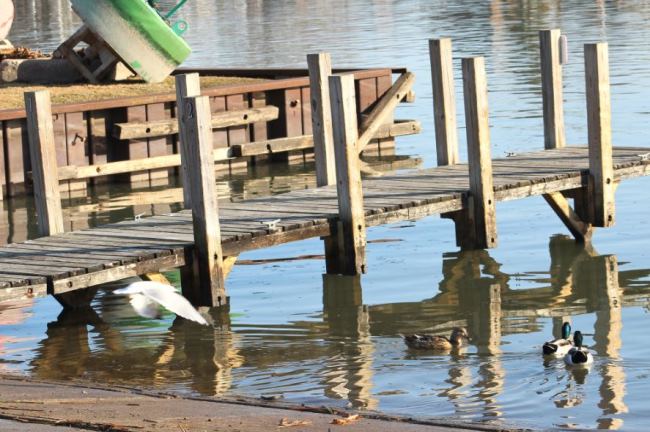
A hint of sun was welcome though it didn’t warm me up at all.  The buoys were “packed away” for the season, resting on the heavy wooden boat docks.

On this calm morning I could hear the “pop, pop, pop” of gunshots going off in the distance.  Yep, duck hunting season in Michigan.  If ducks were smart, they would stay at Lake Erie Metropark as duck hunting is not allowed here.

At the boat launch area it was fairly quiet for a weekend, likely since raptor migration season was waning.  People come from miles around from September through late November to watch and photograph the parade of raptors migrating past this very area.  Lake Erie Metropark’s boat launch area is one locale where these raptors pass through, then Pointe Mouillee State Game Area, five miles down the road, is another area.  Here at the boat launch area, official counters identify, then tally what birds of prey pass through daily during this three-month period.  Those identifications and numbers with handwritten totals are posted on a board in the window of the Marshlands Museum and also entered into databases at the official Detroit River Hawk Watch site and this national hawk count site. 

I hung around about twenty minutes but saw no one pointing excitedly at the sky, so alas, there would be no birds of prey for me to photograph on that cold November day. I saw a few ducks and seagulls at one of the boat docks, but that was it.

I wondered if I would be able to navigate along the Cherry Island Trail without sinking into the mud. I was in luck, as everything was dry, but, as I meandered along, I didn’t see anything that caught my eye.

There have been many Saturday or Sunday treks, where I abandoned that muddy and waterlogged trail and returned to my starting point. I have rubber boots, but they are not conducive for long walks – perhaps I should just tote them along for the sole purpose of traversing those soggy and muddy trails that are a blip in that’s day’s nature walk.

At last, the Marshlands Museum and my car were in sight …

… and I was eager to get into the car and crank up the heat to thaw out my frozen fingers before driving home.

Posted in nature, walk, walking | Tagged , , , | 93 Comments

Spring cleaning, er … preening #Wordless Wednesday #Dunk, drip, pick, flap, fluff –n- go!

Wordless Wednesday – allow your photo(s) to tell the story.

Posted in #WildlifeWednesday, #Wordless Wednesday, birds, nature | Tagged , , , , | 65 Comments

Patience is a virtue.

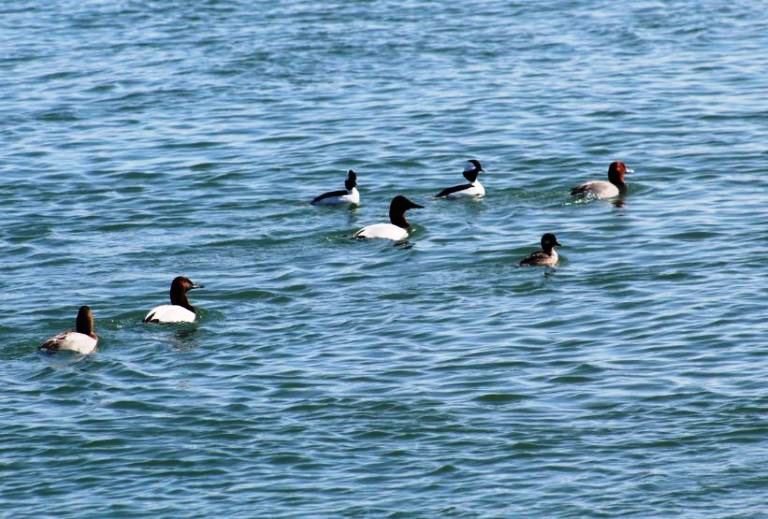
Since I began my nature treks in conjunction with this blog, the beautiful Canvasback Duck has remained on my annual “Birdie Bucket List” but a sighting of one has thus far eluded me. These beautiful ducks, usually just referred to as “Canvasbacks” generally nest and live in the Great Plains states, but migrate to Michigan to overwinter along the Detroit River, Lake Erie and Lake St. Clair shorelines. There are annual, organized field trips by the Detroit Audubon Society and the Metroparks to view the paddlings, (a/k/a “rafts”), of Canvasbacks. Through the years I’ve seen plenty of photos of these ducks on the Dingell Park Facebook page, yet there has never been a sighting by Yours Truly whenever I’ve been at that venue.

On the last leg of my Detroit River excursion on Sunday, February 27th, I finally got a chance to catch sight of some Canvasbacks. I owe that opportunity to a couple of birders I was chatting with at Dingell Park. They told me they belong to the Detroit Audubon Society and usually attend that organization’s excursions. When our discussion turned to ducks, I mentioned the Canvasbacks and how I would like to see them. The gentleman then peered through his binoculars and told me there was a large paddling of Canvasbacks about a half-mile away near the BP gas station and marina. From my perspective, with my naked eye, they looked like a lot of dots on the water, but I was game to go there, so I thanked him and said “I’m going to head there and hopefully it’s not private property or a closed marina and I have some luck.”

So, I set out on that half-mile trek to see the Canvasbacks. Well yes, from the main road, if I craned my neck, I could indeed see some, but I was greedy to see them up close. The marina gate was wide open with no “private property” or “no trespassing” signs to impede me, so I decided to approach the shoreline, though admittedly I kinda slunk behind some huge fir trees, then crept ever closer along the cement walkway parallel to the marina. The Canvasbacks were still not all that close.

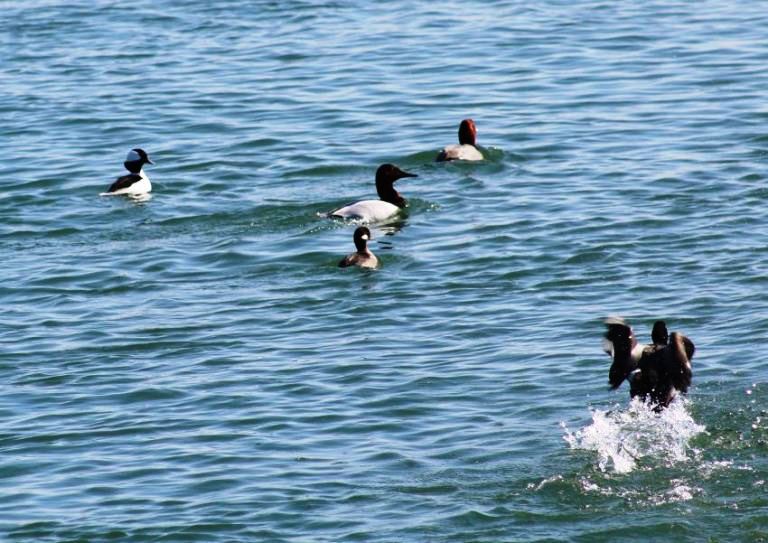
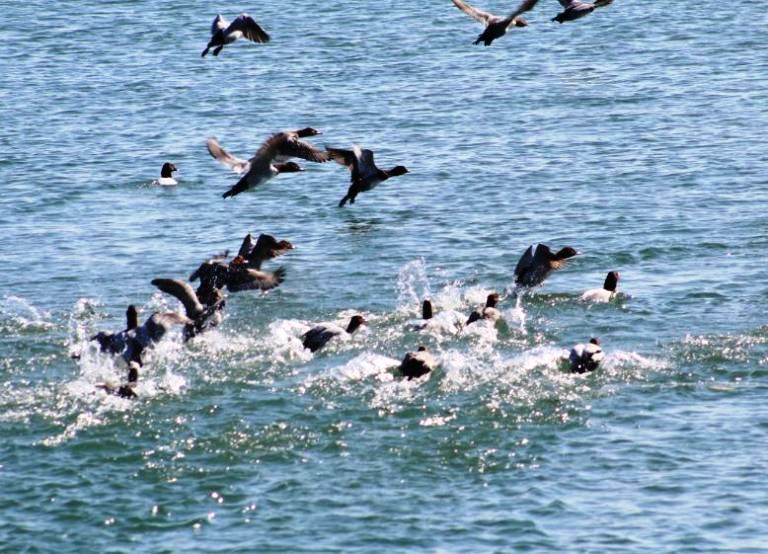
Though I remained very still, something spooked those ducks and they scattered, some taking flight …

… and some paddling as fast as those webbed feet could go, all in an effort to get away from this hulking human.

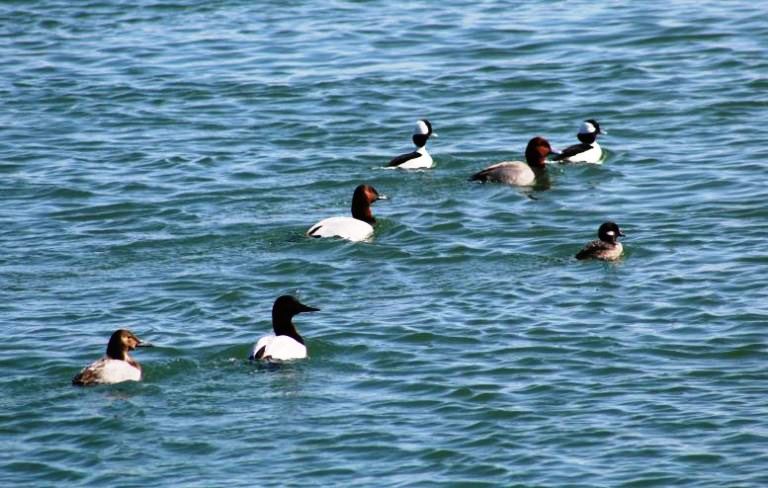
Then they regrouped and I got a few more pictures, albeit not stellar, but closer than before.

Later, when viewing the photos on the computer screen, if I squinted just right, I could see a couple of Bufflehead Ducks in the group (top right).

I half-wished I’d see someone and could just ask if I could go right to the shoreline, but in my heart I knew I needed to leave before someone told me to do so, but not before I took a few shots of the marina, with Mud Island in the background.

Well yay me – I was happy to cross Bald Eagles AND Canvasback Ducks off my Birdie Bucket List the same day!

But wait … the best was yet to come!

Having one’s ducks in a row … (most of the time anyway).

Mom preached many words of wisdom to me, from the time I was a child until I was an adult. Among her favorite “Momisms” was this English proverb: “Good things come to those who wait.”

Another favorite expression of hers, (usually voiced in a sigh of exasperation directed at me), was “Lord, love a duck!”

Following a delightful day at Dingell Park and my first glimpse of those Canvasback Ducks at the marina, I once again returned to my favorite nature nook, Council Point Park. As I walked along the perimeter path I wondered if the pair of Mute Swans would still be there. It was cold and gray and when I suited up for my walk, I purposely left the camera behind as I reasoned “what more could I ask for after yesterday’s bountiful waterfowl shots?”

While I was content to settle for the faraway photos of those coveted Canvasbacks down along the Detroit River shoreline, who knew the very next day a solitary male Canvasback with its rust-toned plumage and amazing red eyes would hold me captive in the very same spot as the Mute Swans had a mere 24 hours earlier? I quickly scanned the Creek for a similar-shaped duck with dull plumage, which might be its mate, but I saw none.

Well, there I was without the camera and I cursed myself for leaving it at home. That’s the third time I’ve had this happen, also on a work day. Before, when I saw a Mama Mallard with a slew of ducklings walking behind her and most recently with the wall-to-wall shad. You’d think I’d have learned – sigh. In those instances I had driven that day – but not this time. I had a one-mile trek if I were to go home and retrieve the car and the camera. I’d need to take the car out of the garage, drive back, take photos, drive home, put the car away and still be on time for work. To say I was annoyed with myself is an understatement and, as I gazed at this duck, I said “just capture the images in your mind Linda – there will be other Canvasbacks.” I watched this duck dipping and diving in the Creek, just ten feet from where I stood, then I left.

As I walked home I noticeably picked up the pace as I decided this up-close Canvasback Duck would complement the lame faraway shots taken at the marina and would become a separate post. I made it home, unlaced my hiking boots, padded in sock feet to get the camera and was in the car headed back to the Park in record time. There was a 50% chance that duck might have left.

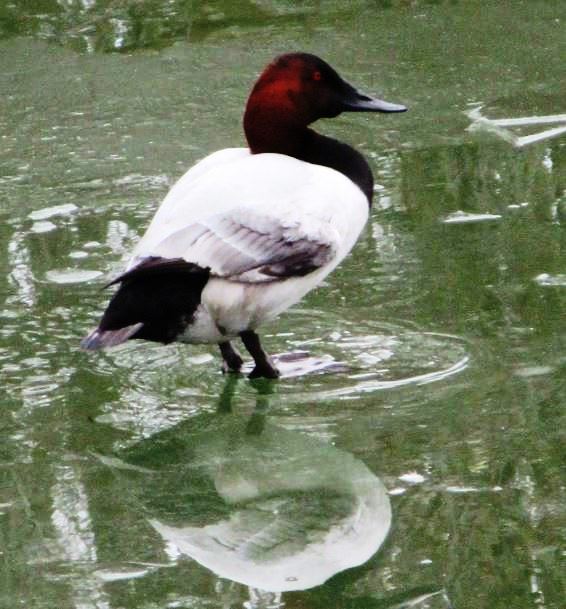
The Canvasback was there, but instead of being “almost touchable” it had moved away and was preening on top of some ice in the middle of the Creek. I took a lot of shots, in between when the duck came up for air after preening and picking its feathers, then I headed home. Whew – I hoped this flurry of activity at least resulted in one good shot. Well, given the gray day, it wasn’t too bad.

I vowed never to leave the house without the camera again.

The next morning was sunny and gorgeous, the month of March coming in like the proverbial lamb and, while I strolled the perimeter path, I wondered if that meant March would exit like a lion? I thrilled to the trills of the Red-winged Blackbird which always reminds me Spring is near. That Blackbird remembered me from last year as it stopped singing and eagerly flew down to the path to await a peanut.

I figured the Canvasback Duck had likely moved on, but you’d better believe my camera was tucked in my zippered pocket.

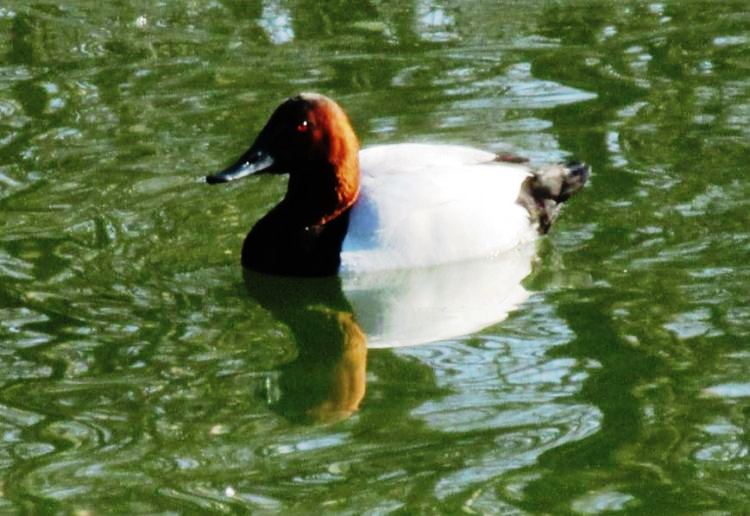
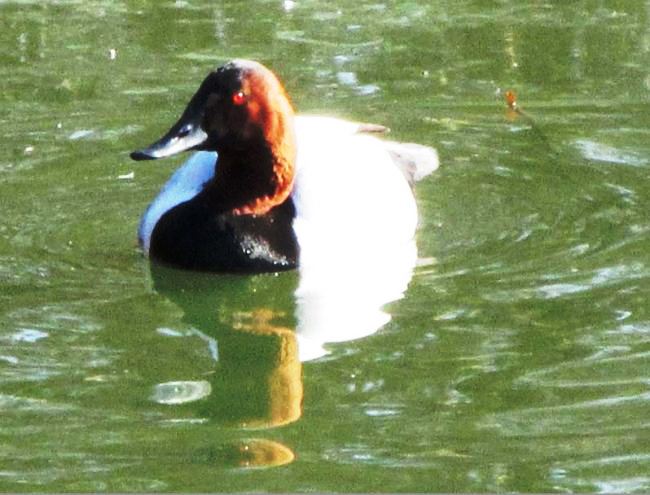
Well after Monday’s mad dash to get photos, the Canvasback Duck was still there, near the cement ledge, paddling around. Look at the bright-red eyes! I whipped out the camera. Must. Take. More. Pics.

Just hangin’ with my buds.

I’ve observed in my many nature walks that ducks are basically social creatures, even though I have witnessed male Mallards’ occasional aggressive behavior, which is likely a territorial issue around breeding time. At Elizabeth Park it is not unusual to see the Mallards, Pekins and Hybrid Mallards huddling en masse in the dead of Winter, or paddling together amiably in the canals and Detroit River shorelines in the other seasons.

This Canvasback Duck lingered for the rest of the week at the Creek at Council Point Park, co-mingling with the Mallards.

Maybe he was a loner, but he seemed to fit in.

All the ducks went missing from the Creek on March 5th after a gusty windstorm. When the Mallards returned from sheltering along the shoreline, my Canvasback pal was missing and has not returned. He has likely joined his brethren down at the River.

For you birders, click here to read a recent article about Canvasbacks here in Michigan.

Posted in birds, nature, walk, walking | Tagged , , , | 75 Comments

March Winds. #Wordless Wednesday #Back off Ms. Schaub, I’m NOT ready for my close-up!

Wordless Wednesday – allow your photo(s) to tell the story.

Posted in #WildlifeWednesday, #Wordless Wednesday, nature, walk | Tagged , , , , | 43 Comments

Birds of a Feather.

Hmm – do I dare churn out a few more posts on local waterfowl after two Mute Swan posts last week?

Well, that is the plan until I FINALLY return to the remaining 2021 treks that were usurped by holiday and Winter posts.

Today you’ll see a recap of my visit to Dingell Park at the Detroit River shoreline on February 27th. You may recall my intention was to bop by Council Point Park, then head straight to Dingell Park, but then I was waylaid by the pair of Mute Swans that caused my fascination with the green-banded Pen #M011.

After parking the car, first I strolled the boardwalk and got some steps in …

… but spent a lot of time at the pavilion area.

Then, after chattin’ it up with a couple of birders, I strayed to the border of Ecorse and Wyandotte for more photos. Because there was a twist to that trek, I’ll save that leg of the journey for next Monday’s post.

The Herons were MIA, but other waterfowl were well represented.

What a difference from my last trip here in early January when the icy Detroit River was so barren looking, with waves frozen in place and huge slabs of ice slapping up against the shoreline.

It was a beautiful morning – the water was sparkling and the sun glinting off the remaining ice floes. Because it was windy, the ice floes were drifting ever so slightly, occasionally bumping up against the icy shoreline, making clinking noises like ice in a glass. It was a waterfowl enthusiast’s paradise … I didn’t know where to look first.

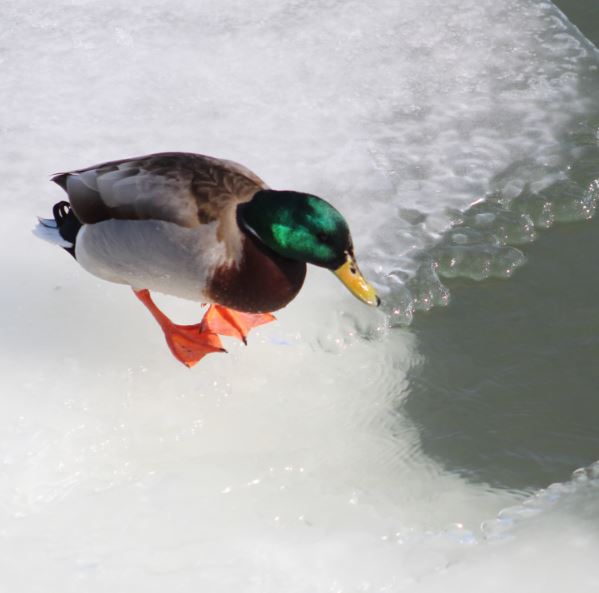
A few Mallards had staked out smaller, stationary chunks of ice as their spot (despite having icy-cold feet, but maybe it was a respite from the frigid water).

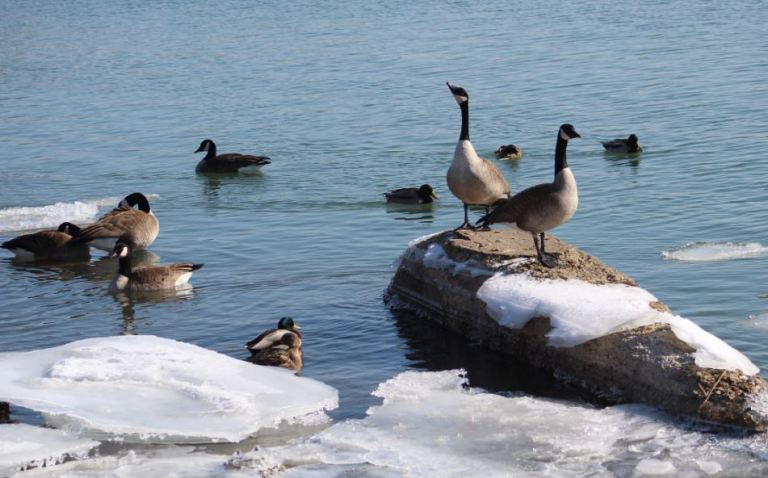
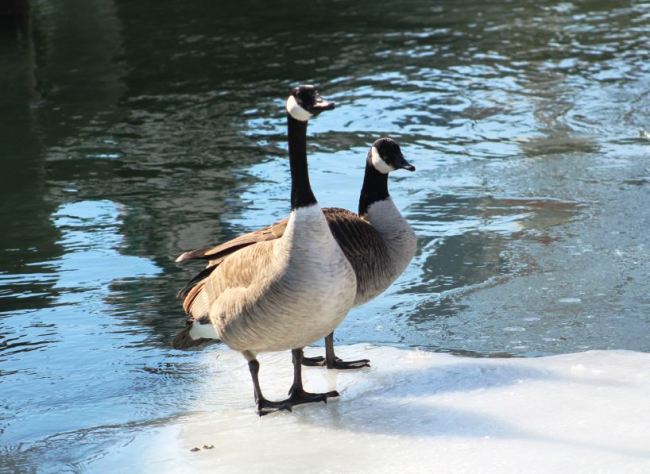
Canada Geese were either snoozing or honking noisily at the world, but mostly at one another, with all the usual histrionics that Canada Geese are so fond of doing, only to“make friends” a minute after hissing, wing flapping and a lowering of their slender black necks to water level.

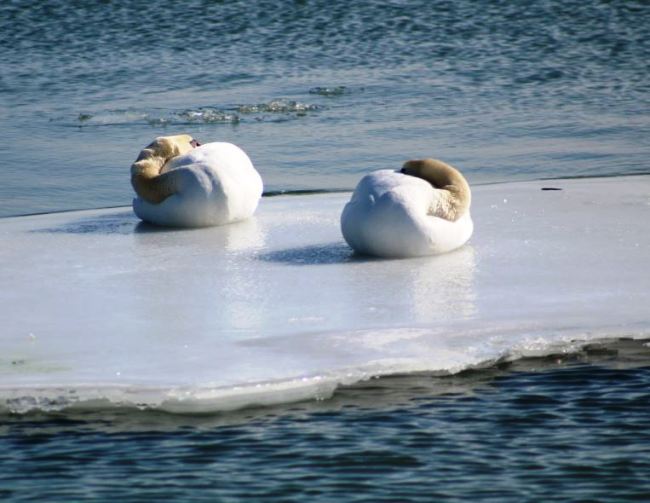
There were Mute Swans sleeping, swimming, or hanging out with some geese on ice floes. Note their dirty necks from diving for aquatic plants to feed on.

Time was a’ tickin’ for Bald Eagle sighting.

My decision to head to Dingell Park was based on the weather. We were slated to have warmer weather over the next few days, so likely the ice floes would melt, thus potentially this was my last chance to see the Bald Eagles that overwinter at Mud Island (a 21-acre property across from Dingell Park). The eagles stay in the bare trees at this uninhabited island, while scoping out their next meal. Then they swoop down to catch a fish with those long talons, but they also catch fish from the ice floes.

I follow Dingell Park on Facebook and the eagles had been plentiful in January and February. Photographers posted up-close images of mature eagles (dark-brown plumage with a completely white head) and also juvenile eagles (mottled brown plumage all over). There were a variety of ducks featured, as well as a pack of coyotes traveling across the frozen ice (I’d have loved to have seen that).

Well my visit didn’t disappoint as I saw several eagles that day. From the pavilion platform I had a good view and was by myself most of the time. Usually the viewing area is crowded: photographers with cameras with long lenses, or folks using binoculars, all wishing to see and/or photograph the eagles.

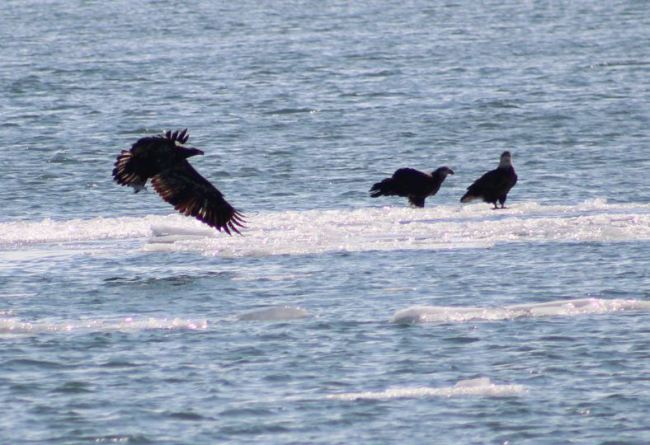
Later, a man and woman were standing at the pavilion near me, she with a smartphone and he with a camera on a tripod and binoculars suspended from his neck. We chatted about the beautiful morning, then shifted our focus to the trees at Mud Island. Soon a lone eagle took flight from the trees and glided overhead. I got a couple of shots, but the sun went out momentarily, so they are more like silhouettes.

Moments later that eagle joined a pair of eagles on an ice floe.

I watched intently, but no eagle in that trio of hopefuls caught a fish, so that same eagle left on its own. It was successful as you see in this picture, with a fish caught in its talons.

I enjoyed myself, snapping a ton of pictures and surprisingly, not one seagull was around – were they worried about the eagles making them their prey?

Posted in nature, walk, walking, Winter | Tagged , , , , | 79 Comments

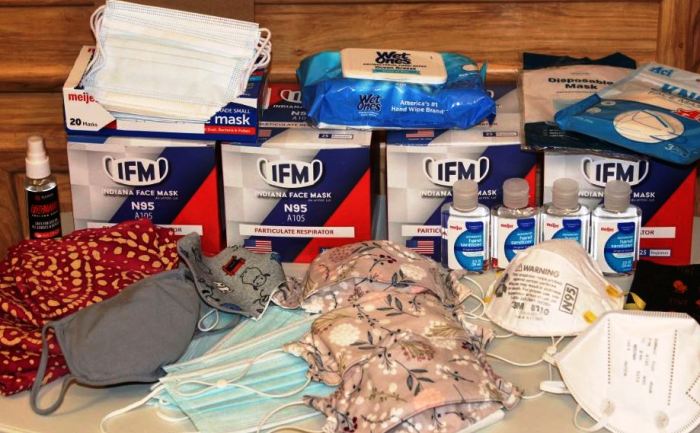
A Plethora of Pandemic Paraphernalia.  #Wordless Wednesday  #Two yrs. of COVID in MI (2M cases; 32K deaths)

Wordless Wednesday – allow your photo(s) to tell the story.

Posted in #Wordless Wednesday, COVID-19 | Tagged , | 44 Comments

Mute Swan (M011) Update.

Like many of you, I was interested in learning more about this banded Mute Swan M011, the subject of yesterday’s blog post. It was the first banded wild bird I’ve ever seen – talk about being at the right place at the right time, so this event makes up for my unsuccessful participation in “The Great Backyard Bird Count” last month.

Here’s some information I have gleaned. I was surprised to learn that Ms. Swan has been wearing that neck collar for nearly eight years:

The Mute Swan was captured and neck collared for identification as part of Ph.D. research with Michigan State University. The goal of this research is to understand the movement and survival of Mute Swans in Michigan and is being conducted in partnership with the Michigan Department of Natural Resources and USDA-APHIS Wildlife Services. The outcomes of this research will inform management strategies for Mute Swans in Michigan and across the United States.

As part of the research, neck collars were placed on select Mute Swans in several areas of the state during the summer of 2014. They will be continuing to mark and monitor Mute Swans across the state for the next few years.

Mute Swan M011 was captured and banded in August of 2014 about sixty miles from here at St. Clair Flats State Wildlife Area (Harsens Island, Michigan).

There was also a website to submit information on many species of banded birds. It is the Federal Bird Banding Laboratory (a/k/a Patuxent Research Refuge Bird Banding Laboratory), so I filled out the form and their requested criteria about M011 and submitted three photos. For my submission, I will receive a Certificate of Appreciation.

Posted in nature | Tagged , | 66 Comments

Mingling with Mute Swans at Council Point Park.

Last Sunday I had big plans … not fun plans, but I had dawdled long enough in compiling the tax paperwork, so it was time to hunker down and get ‘er done.  So, I would walk to the Park, do some laps, feed my furry and feathered friends, then head home.  I wasn’t too enthused with the prospect to be honest. 

Then I looked outside. 

It was a bright and beautiful day – who wants to be inside sifting through paperwork?  In a heartbeat, I tabled that tax task to the next weekend and decided to drive, make a quick pit stop at Council Point Park, then head one mile east to Dingell Park on the Detroit River. 

Though I had sworn off taking any more pictures until I had exhausted the 2021 photos, apparently I had a momentary lapse of judgment as I sped out the door with the camera in hand.  Hours later I would return with enough waterfowl shots for several posts.

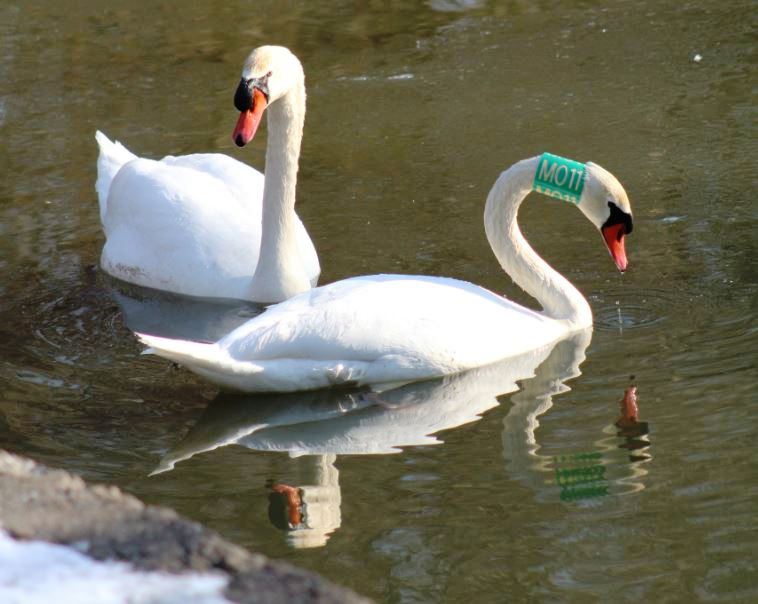
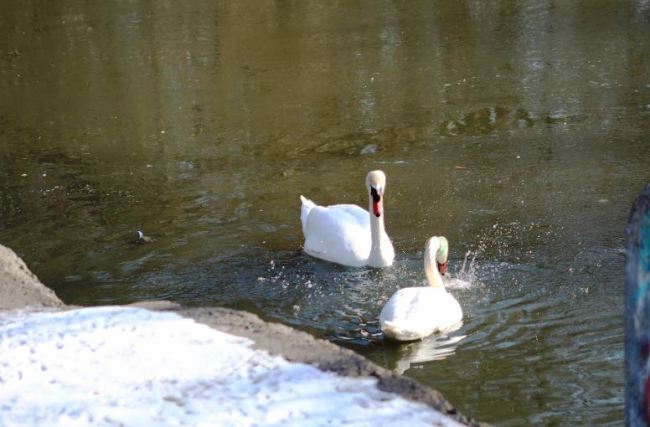
Mr. and Mrs. Mute Swan graced the Park with their presence.

At Council Point Park, I really didn’t plan on taking any photos, but, as I walked around the perimeter path, suddenly there was a flash of white between the bare bushes and trees.  That sighting could mean only one thing:  a Mute Swan visit.  In nearly nine years of walking at the Park, I’ve only seen Mute Swans about a half-dozen times.  So, I hurried over, hooking my bag onto my arm, shucking my mittens, exchanging them for my fingerless gloves.

My hunch was correct.  There was a pair of Mute Swans gliding around the alcove area, the same spot which was so popular with the Mallards due to the dead shad.  I had not seen any shad, dead or alive, the last time I was here, but I suspected some bodies might have lingered as a fishy smell permeated the air.

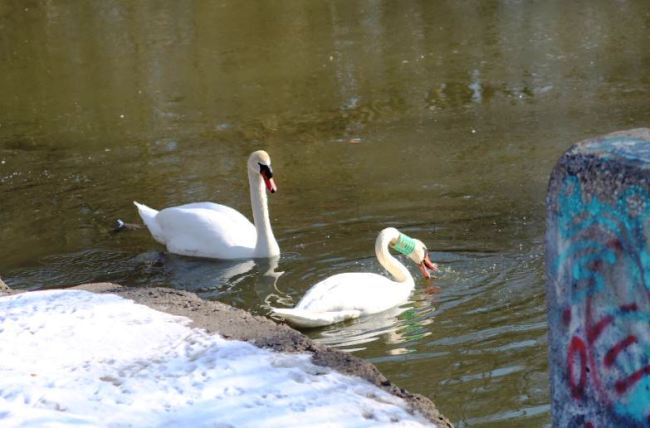
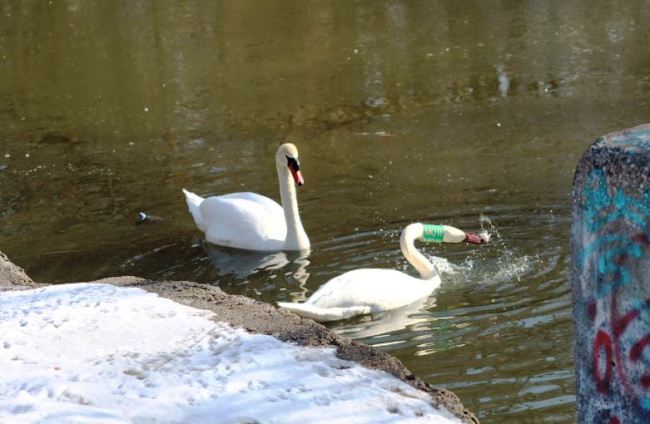
I stood back admiring the swans from afar before taking photos.  It was a male (“Cob”) and female (“Pen”) and they alternated between preening, diving for aquatic plants and admiring one another.  I often see photos of swans beak to beak, their graceful necks forming a heart – these two were close together, but I captured no such dramatic shots.

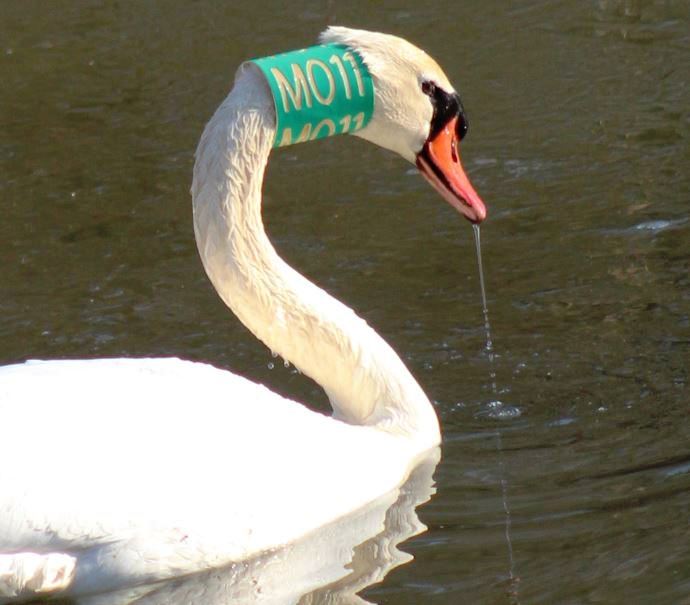
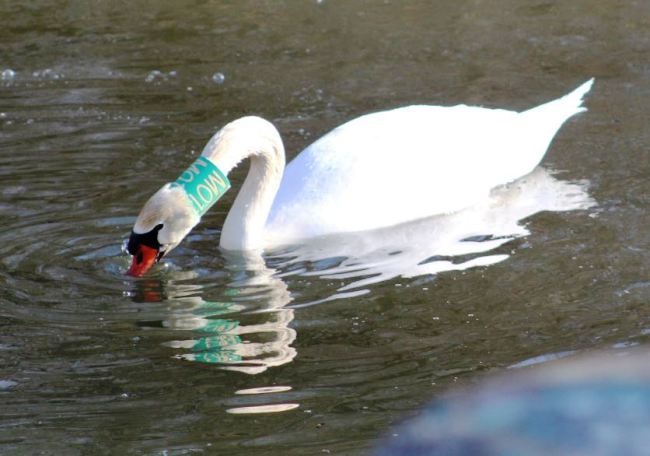
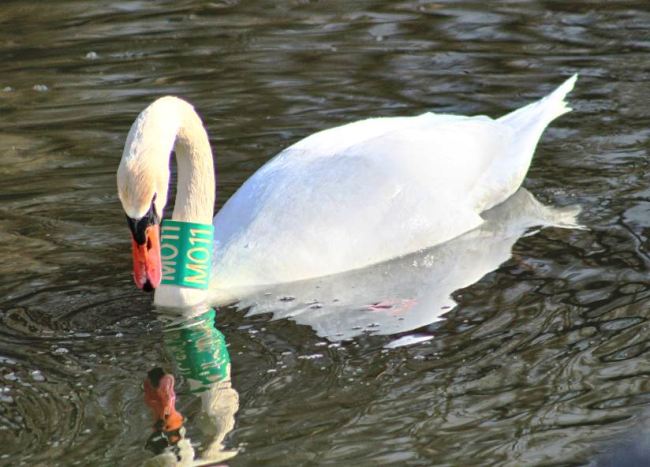
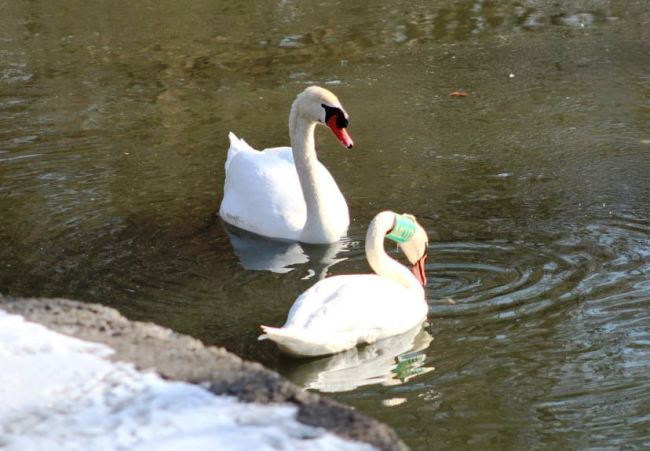
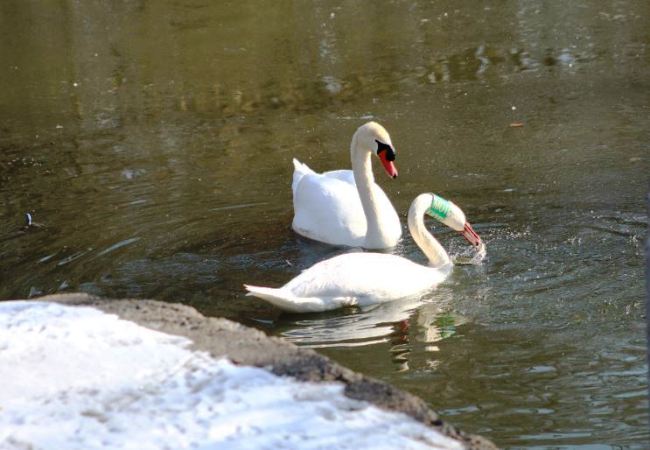
It was then I noticed one of the swans had something on its neck.  I first thought it was some muck it had dredged up from the Creek bed, but it was moving.  I turned the camera on and quickly zoomed in.  It was a band of some sort with numbers on it.  Hmm – strange they would band a bird around its neck and not its feet?  I pondered about the swan’s “necklace” and watched it slipping up and down this beautiful creature’s neck effortlessly and seemingly not constricting it.

Yes, I was mesmerized by these Mute Swans.

Filled with bravado, yet determined to thwart any unwelcome advances by a prickly Cob, I inched a little closer to the ledge and began taking photos of the pair.  But, after only a few shots, evidently the clicking of the shutter alerted the Cob, who paddled closer to the cement ledge, so I backed up posthaste.  I managed to get a few shots in as you see below.

The male (“Cob”) quickly paddled over to see if I was a threat to him or the Missus.
Looks like I passed muster and he returned to the female/mate (“Pen”).
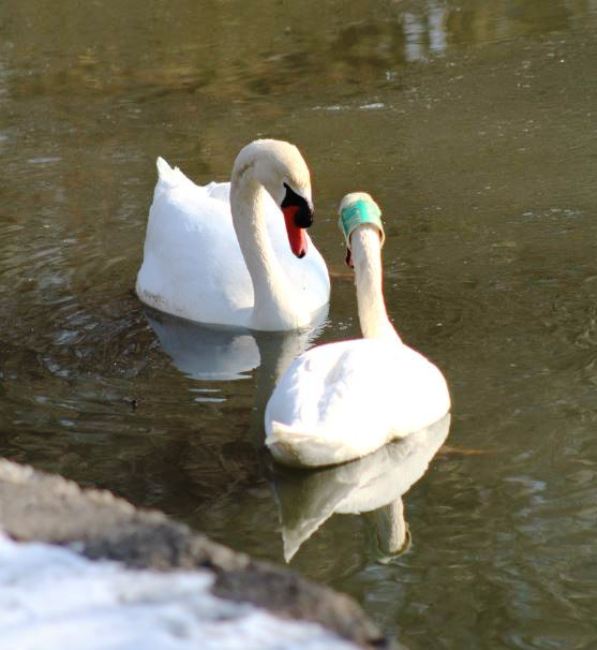
You likely noticed the collar/tag on this Pen in the header image. It easily slid up/down its graceful neck.
Though to me the poor Pen looks mighty uncomfortable and a bit constricted in this shot.
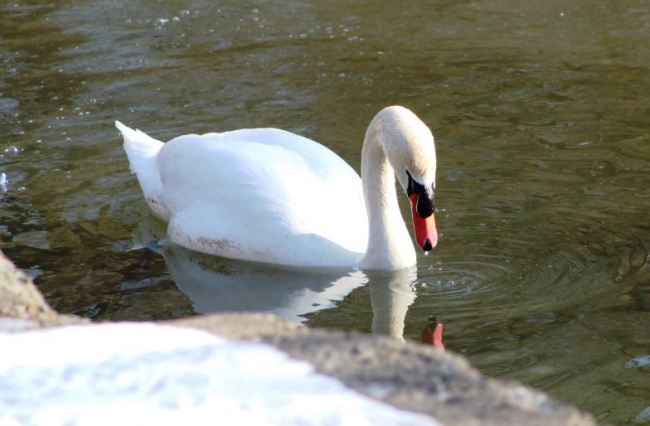
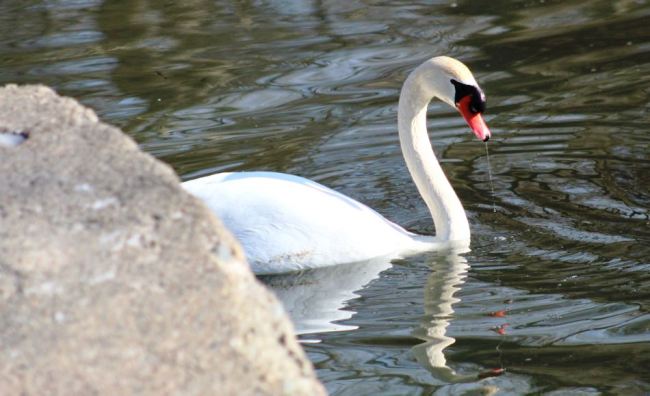
Swans are so graceful and beautiful, even when simply sipping water or gliding in the Creek.
I wonder if this Pen likes what she sees as she gazes at her reflection?

Together or apart, the Mute Swans made an impression on me as I watched them on that cold February morning. Although I’ve seen no more shad floating about, there are other fish that populate the Creek waters and clearly that was the magnet for the Mute Swans’ appearance. Interestingly, the Cob was content to watch the Pen go diving several times for a fish and then wrangle it as you will see in the photos below. I couldn’t tell if she shared her fish with her mate.

Mute Swans breed anytime from March through June. Every year I am hopeful to find cygnets tucked away on their mom’s feathers on her back going for a free “boat ride” – maybe this year?

I wondered if I could find out the history of this collared Mute Swan, so after going through my photos on Saturday, I researched a little on my own.  I found an article online by David R. Luukkonen, Ph.D., a Wildlife Research Biologist with the Michigan Department of Natural Resources.  The DNR had collared and tagged many Mute Swans and he requested any sightings of swans with their I.D. info and location be forwarded to him as they wished to track the swans’ whereabouts throughout Michigan.  I submitted the criteria requested and three photos.  I hope I can learn the origin of where this swan was tagged and released; if so, I’ll update this post.
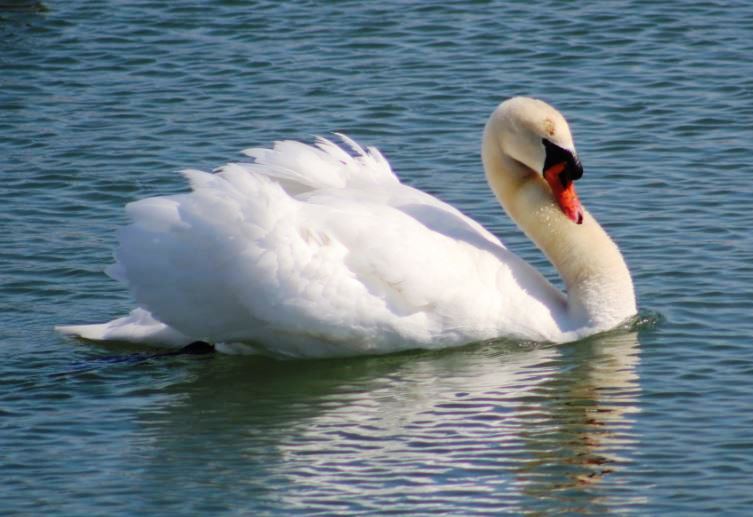
P.S. – Wondering about my wariness to approach the swans?

Because you only have to be chased by a Mute Swan once to remember how scary it was, as you read above, I stood a respectable distance away while admiring and taking pictures of the pair.  Here’s the backstory, for those of you who were not around in 2018 when I had two encounters with Mute Swans within a few weeks’ time. 

The first encounter happened after taking photos of a pair of Mute Swans on a picturesque day at Council Point Park.  Portions of the pathway were icy and the landscape snowy.  As I happily clicked away, I heard one of the swans making a snorting noise and figured its nostrils were stuffed up from diving into the frigid water.  Well, that was an incorrect assumption.  While Googling later that day, I learned the swan was irritated with me and made these noises.  But why?  I was not doing anything to anger it.  Just admiring the pair’s grace and beauty and taking photos.
In fact I was still standing there when suddenly the huge Mute Swan huffed and puffed its way up the Creek bank and proceeded to charge at me.  Yikes!  On a Winter’s day when you had to be mindful of where you stepped, (and I’m talking about icy patches, not goose poop), my heart was pounding as I began walking backward, thinking I could go to the nearby park bench and climb up onto it to foil any attempt for this big brute to attack me.  Mute Swans are known for their unprovoked attacks on humans.  The swan plodded toward me, those powerful legs and webbed feet quickly shortening the distance between us.  I was glad I had my wits about me and some quick thinking on my part as I tossed some peanuts I had in a Ziploc bag toward it, thinking it might eat them, allowing me a hasty getaway.  It worked!  I hightailed it to the other end of the Park and to the car, lest it should decide to come after me.   It’s good to respect wildlife, though I certainly wasn’t hurting either of the swans.  If you want to see the post about our interaction, here is the link and just scroll down near the end.
The other incident, just a few weeks later, at the same venue, did not involve a menacing Mute Swan, but instead a Mute Swan that was intently pushing its way through the thick ice on the Ecorse Creek.  I stopped in my tracks on the perimeter path, marveling at how incredulous it was that this swan had forged a path through the ice and, having reached the Creek banks, it climbed up the sides and began preening all the icy chunks from its feathers.  Its neck was soaking wet and it looked exhausted for that had been quite a trip.  As it stood there, I knew it was tired, likely not even mindful of my presence.  I remained frozen in place, worried that once the swan stopped preening, it might come after me, but I was surprised that it turned around and walked to the Creek bank and into the water to continues its ice-cutting journey once again.  I was happy I had the camera handy for this sequence of events.  That post may be found here. 

Posted in nature, walk, walking | Tagged , , , | 73 Comments